
Every month, scores of B2B founders and marketing directors across India schedule calls with digital marketing agencies, asking the exact same question:
If we sign the contract today, when will we see high-quality inbound leads?
Most agencies will smile, showcase a generic pitch deck, and tell you exactly what you want to hear: Give us 7 to 14 days. We’ll launch a targeted campaign, and your sales team’s calendars will be flooded.
It sounds perfect. It helps the agency close the deal. But within 60 days, reality sets in. The leads that do arrive are completely unqualified, often retail consumers or small-scale operators who cannot afford your solution. Your sales team wastes dozens of hours chasing ghost profiles, pipeline revenue remains flat, and you feel burned. Again.
Let’s look at this honestly. B2B lead generation in India is a complex, relationship-driven process. Your buyers are not making impulsive, single-click purchasing decisions. They are navigating internal approvals, assessing complex integrations, and evaluating multi-lakh or multi-crore investments.
If an agency tells you they can crack that code in a single week, they are selling you an illusion.
This guide breaks down the brutal, unvarnished truth about B2B marketing timelines in the Indian context. We will unpack exactly how long it takes to generate genuine business leads by channel, explore why short-term promises are massive red flags, and outline what a transparent, high-performing pipeline strategy looks like from day one.
Why Most Agencies Promise Leads in 7 Days
If you have been offered a lightning-fast lead generation timeline, you haven’t discovered a secret growth hack—you have likely encountered a standard industry trap.
To understand why quick turnarounds are dangerous, you need to understand how transactional agencies manipulate short-term campaigns to hit superficial metrics:
The Lead Form Optimization Trick
It is remarkably easy to generate hundreds of “leads” in 7 days if you completely lower the barrier to entry. An agency can spin up a basic Meta or LinkedIn Lead Gen Form with pre-filled fields (Name, Email, Phone Number).
They target an incredibly broad audience, offer a generic, surface-level PDF download as an incentive, and let the algorithm run.
Because the form pre-fills automatically using the user’s personal social media data, people click Submit without even realising they have engaged with a business platform.
The results are immediately disastrous for your business:
- The phone numbers belong to personal accounts that go unanswered during business hours.
- The contacts have zero intent, zero decision-making power, and often do not even remember clicking the ad.
- Your cost-per-lead (CPL) looks incredibly cheap on an agency dashboard, but your actual acquisition cost is zero because none of them converts.
The True Cost of Agency Fraud
When an agency optimises purely for short-term lead volume to survive their initial 90-day retention window, they destroy your sales team’s productivity. Your inside sales reps spend weeks filtering out junk data instead of nurturing real, mid-market or enterprise opportunities.
True B2B lead generation isn’t about collecting random contact cards.
It is about building a predictable mechanism that captures the attention of real decision-makers (CEOs, CFOs, COOs, and Heads of Procurement) when they are actively seeking a solution. That process takes strategic alignment, precise data architecture, and time.
Channel-by-Channel Realistic Timeline: LinkedIn, Meta Ads, Google Ads, SEO
Different digital marketing channels operate at entirely different speeds. A balanced B2B strategy combines short-term capture channels with long-term compounding assets.
Here is a realistic timeline breakdown for the Indian B2B market:
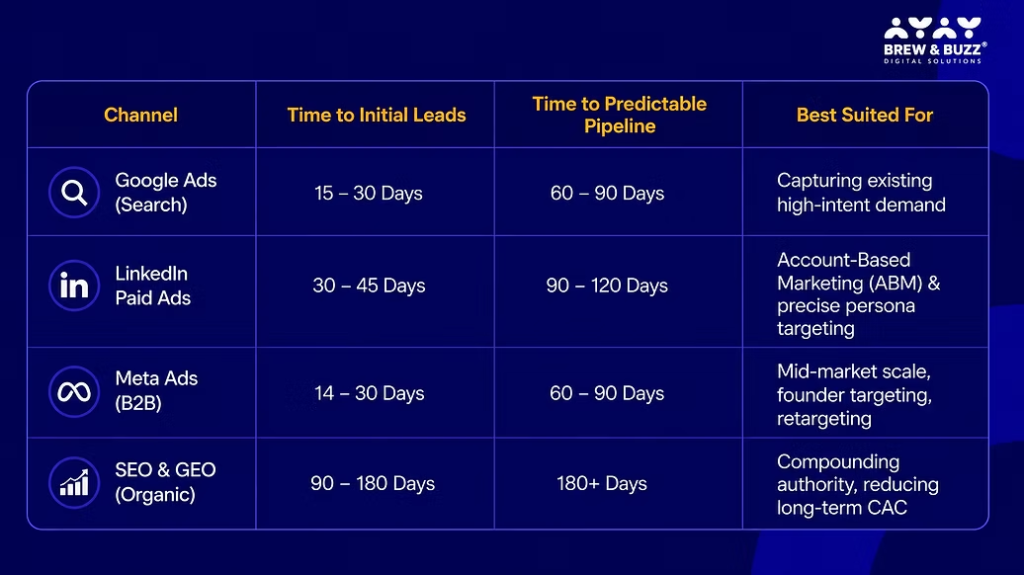
1. Google Ads: 15 to 30 Days
Google Search Ads target users who are actively typing high-intent queries (e.g., “industrial warehouse automation services Pune”). Because the buyer’s intent is already present, you can capture leads quickly.
- Why it takes 15–30 days: The initial two weeks are spent building dedicated, high-converting landing pages, setting up precise server-side conversion tracking, and allowing Google’s Smart Bidding algorithms to move past their initial learning phase.
2. LinkedIn Lead Generation: 30 to 45 Days
LinkedIn is unmatched for targeting precise enterprise personas by company size, job title, and industry vertical. However, LinkedIn users are not actively looking to buy software when they open the app—they are consuming professional content.
- Why it takes 30–45 days: You must first warm up the audience. You cannot immediately ask a Manufacturing VP to jump on a demo call. The initial weeks require a structured content funnel: moving them from industry insights to a targeted case study, and finally to an inbound inquiry form.
3. Meta Ads: 14 to 30 Days
In India, B2B founders, promoters, and MSME owners spend a significant amount of personal time on Instagram and Facebook. Meta’s optimisation algorithms are highly sophisticated, allowing you to reach these decision-makers cost-effectively.
- Why it takes 14–30 days: Meta requires rapid creative testing. You must launch multiple ad formats (short-form video, image carousels, founder-led content) to see what resonates with the Indian manufacturing or tech ecosystem, refining the messaging over the first few weeks.
4. SEO & GEO (Compounding Authority): 90 to 180 Days
Search Engine Optimisation and Generative Engine Optimisation (getting your brand cited by ChatGPT, Perplexity, and Google AI Overviews) are long-term plays.
- Why it takes 90–180 days: Modern AI search models and search engine crawlers don’t trust new content instantly. They look for consistent, authoritative signals across the web. It takes months of publishing expert, fact-dense content and securing authoritative industry footprints to become a trusted, cited entity. However, once established, this channel drives your lowest cost-per-acquisition (CPA) for years.
What Affects Lead Generation Speed: Industry, Ticket Size, and Sales Cycles
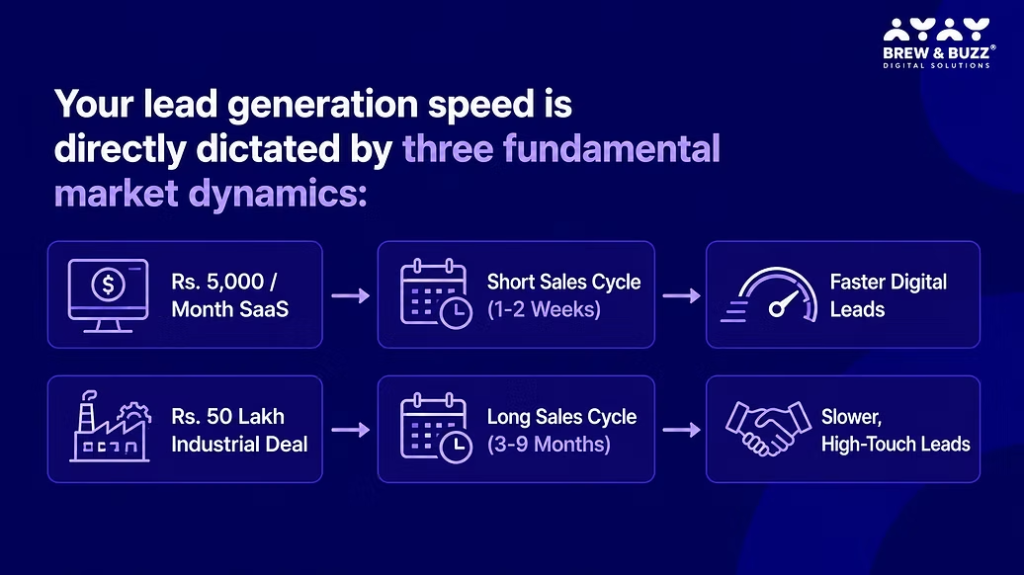
No two B2B companies are identical. A timeline that works perfectly for a SaaS startup selling a Rs. 5,000/month tool will completely fail for an industrial manufacturing firm closing Rs. 50 Lakh corporate contracts.
1. The Ticket Size & Contract Value
As your contract value scales, your lead generation timeline stretches. If your solution costs lakhs or crores per year, no one is going to fill out an online form after seeing an ad once. The digital campaign’s role shifts from a direct sale to an entry point for a long-term relationship.
It takes time to design the deep content pieces—like comprehensive technical breakdowns and whitepapers—needed to justify large budgets.
2. The Internal Decision-Making Unit (DMU)
If you sell to an MSME owner in Gujarat or Maharashtra, the decision-maker is often a single individual. The cycle can move quickly. But if you sell to an enterprise or a multi-national corporation, your lead generation funnel must influence an entire committee: Procurement, IT Security, Finance, and the ultimate Business Unit Head.
Your marketing assets must be tailored to speak to each stakeholder, slowing the initial conversion speed but securing far larger deals.
3. The Existing Brand Footprint
If your company has completely neglected its digital presence, your initial timeline will naturally stretch. If a buyer clicks your ad, checks your LinkedIn page, and finds zero recent updates, or searches your brand name on Google and finds nothing, they will drop out of your funnel.
Building foundational brand authority is a necessary prerequisite to driving fast conversions.
How to Measure Early Success Before Leads Start Coming In
If real B2B lead generation takes time, how do you know your investment is actually working during the first 30 to 60 days?
You must look past vanity metrics like “impressions” or “clicks,” and focus instead on high-conviction leading indicators. If these four metrics are moving in the right direction, your pipeline is healthy, and leads will follow:
1. Engagement Quality & Content Dwell Time
Look at your website analytics platform (such as Microsoft Clarity or Google Analytics). If your average session duration on landing pages jumps from 15 seconds to over 2 minutes, it proves that targeted decision-makers are genuinely engaging with your technical insights, pricing structures, and case studies.
2. Marketing Qualified Account (MQA) Interactions
Track who is interacting with your paid campaigns or visiting your profile pages. If your LinkedIn campaign analytics show that senior leadership from your exact target account list is viewing your content, downloading your resources, and tracking your brand, your targeting is working perfectly.
3. High-Intent Actions (Micro-Conversions)
Before a buyer fills out a multi-field inquiry form, they take smaller actions. Track these micro-conversions closely:
- Did they spend time reviewing your detailed pricing page?
- Did they download a deep, technical integration blueprint?
- Did they interact with an on-site calculator tool?
4. Direct Feedback from Your Sales Team
The ultimate validator is your sales team. When they say, The inbound calls we are getting this week actually understand our product and match our target company profile, you know your positioning is spot on—even if the overall lead volume is still ramping up.
Build a Predictable B2B Engine, Not a Short-Term Band-Aid
In the Indian business ecosystem, trust is the ultimate currency. You cannot build a sustainable, multi-crore B2B pipeline using cheap marketing shortcuts, deceptive lead forms, or empty agency promises of overnight success.
True marketing success belongs to the founders who have the patience and clarity to build an authentic, data-backed acquisition engine. By aligning realistic expectations with data tracking, precise positioning, and consistent content, you protect your business capital and build an asset that generates value for years.
Frequently Asked Questions (FAQ)
Why does B2B lead generation take longer than B2C?
B2C marketing typically targets single buyers making low-friction, high-emotion purchasing decisions. B2B lead generation involves high contract values, long-term operational impacts, and multiple internal corporate stakeholders. This structural complexity naturally extends the research and decision-making process.
What is a realistic cost-per-lead (CPL) for B2B marketing in India?
There is no universal B2B cost-per-lead. A qualified lead for a mid-market ERP software or a specialised manufacturing service can range anywhere from Rs. 2,000 to Rs. 8,000+, depending on target persona scarcity. Beware of any agency promising leads for Rs. 100 to Rs. 200—these are almost always low-intent, unvalidated form fills.
Should we run LinkedIn Ads or Google Ads first?
If your target audience is already actively searching for your service on Google, start with Google Search Ads to capture that immediate demand. If you are introducing a brand-new concept or need to target a highly specific list of enterprise accounts that aren’t searching for you yet, LinkedIn Ads or targeted Meta campaigns are the better starting point.
How much ad budget should a B2B startup allocate initially?
For a meaningful B2B campaign rollout in India across platforms like LinkedIn or Google Ads, we recommend a minimum testing budget of Rs. 60,000 to Rs. 1,00,000 per month. This provides the platform algorithms with enough data density to optimise targeting and identify high-converting buyer segments.
How does BrewAndBuzz filter out unqualified leads?
We eliminate low-intent lead data by avoiding pre-filled social media forms for core conversions. We route prospects through high-intent landing pages featuring detailed, multi-field contact forms that require corporate email addresses, company details, and explicit business criteria before submission.