
From Meta Leads to Sales Opportunities: How Brew & Buzz Built a Complete Lead Generation & Follow-Up System for HOSPEX Healthcare Expo
A full-funnel B2B trade show lead generation case study — Meta Ads, manual pre-sales calling, WhatsApp follow-up, and centralized lead tracking, run as one connected system.
Quick summary
Brew & Buzz ran a full-funnel lead generation system for HOSPEX Healthcare Expo, a B2B trade show in the healthcare and medical technology space. Three Meta ad creatives generated 104 form leads at ₹230.66–₹340.15 per lead. Every lead was routed through manual pre-sales calls and a structured follow-up cadence, tracked in a shared CRM sheet with live status tagging — turning a paid-media campaign into a managed sales pipeline rather than a one-off ad push.
Campaign at a glance
- 104 total leads across 3 Meta ad creatives
- ₹230.66–₹340.15 cost per lead (~47% spread)
- ≈ ₹28,707 total ad spend (calculated)
- 100% of leads routed into a tracked follow-up process
- Category: exhibition / B2B trade show lead generation (MICE)
Methodology & data sources
Every figure in this case study is pulled directly from two primary sources used during the live campaign, not a marketing summary written after the fact: the Meta Ads Manager delivery report (ad-level delivery status, leads, and cost-per-result per creative), and the internal lead-tracking sheet used by the pre-sales team (contact records with live status and follow-up tags for every lead). Nothing here is modeled, projected, or benchmarked against industry averages — figures are exact platform numbers, and the one calculated figure (total spend) is explicitly marked as derived.
The challenge
HOSPEX Healthcare Expo needed more than website traffic or brand impressions. As a B2B trade show for healthcare and medical technology companies, its real currency is qualified exhibitor and visitor leads that convert into booked conversations. Event marketing in this category tends to break in two specific places:
The strategy: a full-funnel system, not just an ad campaign
The engagement was built around three connected pillars, run in parallel and reporting into one shared record.
Meta Ads — Creative-led lead generation
Three distinct creative directions were tested simultaneously, so performance differences would show up in the data instead of being argued about in a meeting.
| Ad Creative | Leads Generated | Cost per Lead |
|---|---|---|
| Light graphic — "Hosmeansbiz" | 32 | ₹230.66 |
| Mix images | 35 | ₹249.72 |
| Dark background, centered text | 37 | ₹340.15 |
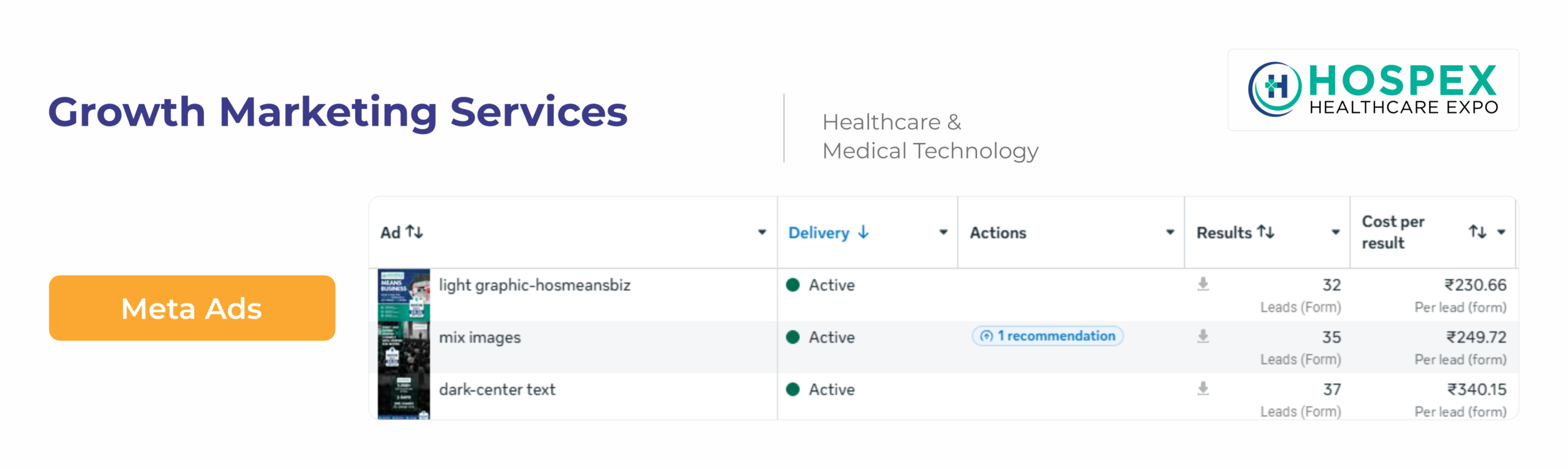
Meta Ads Manager delivery report showing all three creatives active, with leads (form) and cost-per-result per variant.
Expert read: The spread between ₹230.66 and ₹340.15 per lead is a 47% gap between the cheapest and most expensive creative. Cost-per-lead alone doesn't show which creative attracted the most qualified lead — that judgment only becomes possible once pre-sales call outcomes and lead-tracker statuses are layered in. Meta's in-platform recommendation on the mix-images creative was actively monitored, and delivery status was checked across all three variants throughout the flight to catch underperformance early.
Pre-sales calls (manual)
Every form lead was routed into a manual outreach process rather than left in a spreadsheet. This human layer does what ads alone cannot: qualifying real interest, answering objections about the expo, and separating a genuine prospect from a curious click. In B2B healthcare specifically, a form fill from a hospital procurement contact and a form fill from a student researching the industry look identical in an ads dashboard — only a call tells them apart.
Follow-up marketing
Leads that weren't ready to convert on the first call were fed into a structured follow-up cadence — WhatsApp details, callback scheduling, re-engagement — rather than discarded. In outbound B2B follow-up, the common leak is not a bad lead; it's a good lead that never gets a second or third touch. This pillar exists to close that leak.
Execution in detail: the lead tracking backbone
These three pillars fed into a single centralized lead tracker, giving the HOSPEX team one place to see exactly where every lead stood, from first contact to final status. For every lead, the tracker captured full name, phone number, company name, email, and website; a live status field (e.g. Call back tomorrow, WhatsApp details shared, DNR, Visitor, Interested — sharing sponsorship details); and a follow-up flag (e.g. DNR 2nd, Call again, Yet to fire, WhatsApp getback).
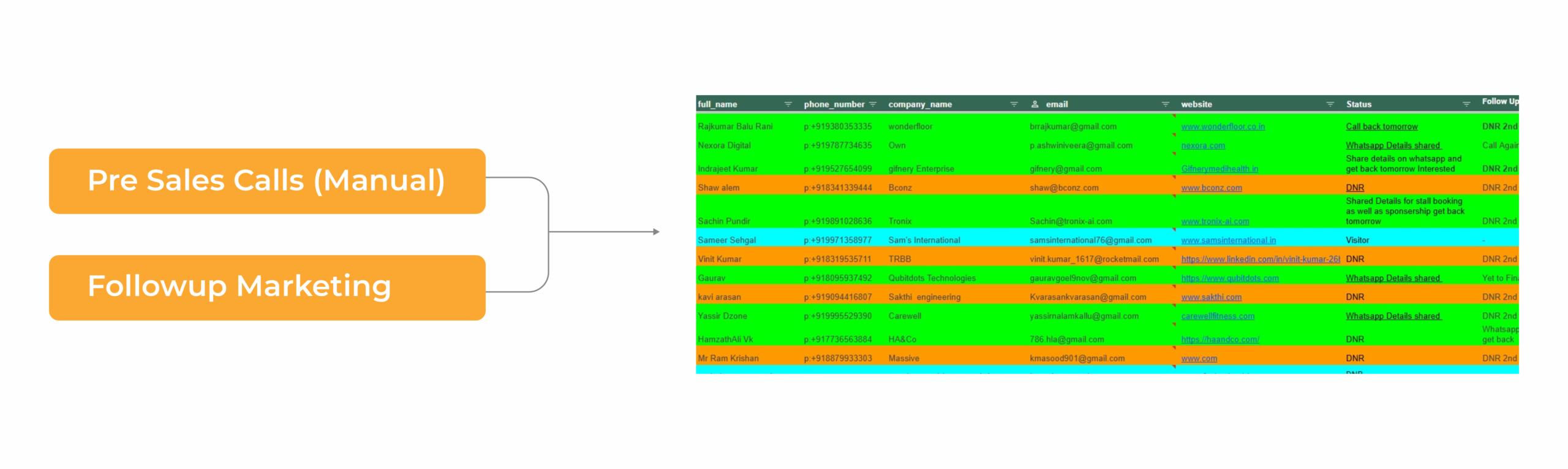
Centralized lead tracker with live status and follow-up tags for every lead generated.
Sample lead status snapshot
The tracker screenshot used for this case study shows a partial view of ~12 leads (out of 104 total). This is a sample, not the full breakdown — shown here to illustrate how granular the tracking was, not as a final result.
| Status | Count in visible sample (~12 rows) |
|---|---|
| DNR (Did Not Respond) | ~5 |
| WhatsApp details shared | ~3 |
| Call back tomorrow | 1 |
| Visitor (confirmed) | 1 |
| Other (stall/sponsorship follow-up notes) | ~2 |
Results achieved
| Metric | Outcome |
|---|---|
| Total leads generated | 104 leads across 3 creatives |
| Cost per lead (CPL) range | ₹230.66 – ₹340.15 |
| Total ad spend (calculated) | ≈ ₹28,707 |
| Most cost-efficient creative | Light graphic — ₹230.66/lead |
| Highest-volume creative | Dark background — 37 leads |
| Leads routed into tracked follow-up | 100% |
| Funnel visibility | Ad delivery → form fill → call outcome → follow-up status |
Cost-per-lead figures reflect Meta's reported delivery data at the time the screenshot was captured — a snapshot of a live, in-flight campaign rather than a final, audited total. This case study covers leads generated and lead-status tracking, not final revenue, exhibitor bookings closed, or ROI.
Key takeaways
Test creative variety early
Running three distinct ad styles in parallel exposed a 47% cost-per-lead gap between the best and weakest performer — before the budget was spent, not after.
A form fill is the start, not the end
The manual pre-sales call layer is what turns curiosity into qualified conversations, especially where the person who filled the form isn't always the decision-maker.
Follow-up needs structure, not memory
A shared, status-tagged tracker meant no lead depended on one person remembering to call back.
Media and sales process, designed together
Results came from treating Meta Ads, manual calling, and follow-up marketing as one connected system under the 4B Framework — not three separate workstreams.
What this case study doesn't claim
- The source materials show leads generated and lead-status tracking, not final revenue, exhibitor bookings closed, or ROI.
- Cost-per-lead figures reflect Meta's reported delivery data at the time the screenshot was captured — treat these as a snapshot of a live, in-flight campaign.
- The lead status snapshot is drawn from a ~12-row visible sample, not the full 104-lead tracker, and is labeled as such.
- "Qualified" lead volume isn't broken out separately from total form leads in the source data — status tags are the closest available proxy.
This case study is built only from what's verifiable in the underlying Meta Ads and CRM data — no benchmark comparisons, no invented conversion or ROI figures. The 4B Framework referenced throughout is Brew & Buzz's own growth marketing methodology, applied here across paid acquisition (Meta Ads), human qualification (pre-sales calls), and retention of interest (follow-up marketing) under one tracked system.
FAQ
How many leads did the Meta Ads campaign generate for HOSPEX Healthcare Expo?
What was the cost per lead?
How were leads followed up after the ad campaign?
What made this different from a standard paid lead-gen campaign?
What does this case study not include?
Looking for lead generation for your event or trade show?
If you're running an exhibition, expo, or B2B trade show, Brew & Buzz helps you build a complete funnel — not just an ad campaign: