
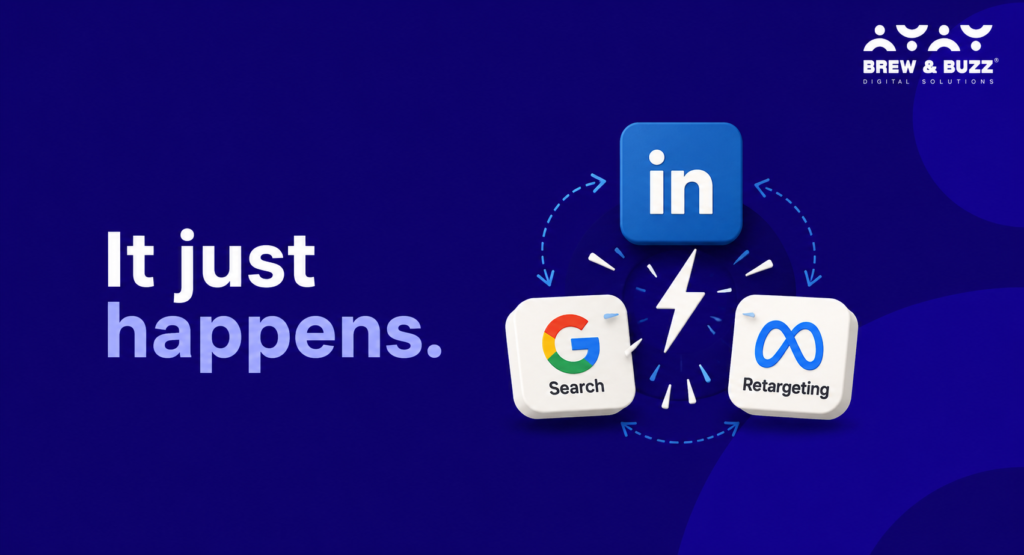
If you’ve ever tried running a LinkedIn campaign, a Google Search campaign, and a Meta retargeting sequence at the same time for the same business, you already know the problem. Nobody set out to make them compete with each other. It just happens. The LinkedIn ads say one thing, the search ads say another, the retargeting creative was built two months ago, and nobody’s touched it since, and by the time you sit down to look at results, you’re comparing three completely different sets of numbers that don’t tell you anything useful together.
We see this constantly. Most B2B teams aren’t running one campaign anymore; they’re running four or five in parallel, each managed a little differently, each reporting on its own metric. And honestly, that’s not a tooling problem. It’s a structural problem.
This is what we’ve learned running multi-campaign accounts at BrewAndBuzz, and it’s roughly the same playbook any decent B2B performance marketing agency should be using in 2026, built around content clusters, search intent mapping, AI-assisted research, and a genuinely audience-first approach to what gets written and where it gets shown.
Why Multi-Campaign Accounts Fall Apart
Before getting into what works, it’s worth being honest about why this usually breaks:
- Campaigns get built by different people, in different tools, on different days. A performance marketer sets up the Meta campaign, someone else handles the SEO calendar, and a third person runs LinkedIn outreach — often without ever comparing notes.
- The same research gets done three times, three different ways. Three people end up building three slightly different pictures of the same buyer.
- Everyone optimizes for their own metric. CTR here, MQLs there, engagement rate somewhere else — none of it rolls up into one number leadership actually trusts.
- The buyer notices before you do. A prospect who clicks a search ad, reads a blog post, and later sees a retargeting ad often gets three unrelated messages instead of one story that builds.
None of this gets fixed by hiring more people or buying another tool. It gets fixed by giving every campaign a shared backbone to pull from, which is really the whole job of a performance marketing agency managing this at scale.
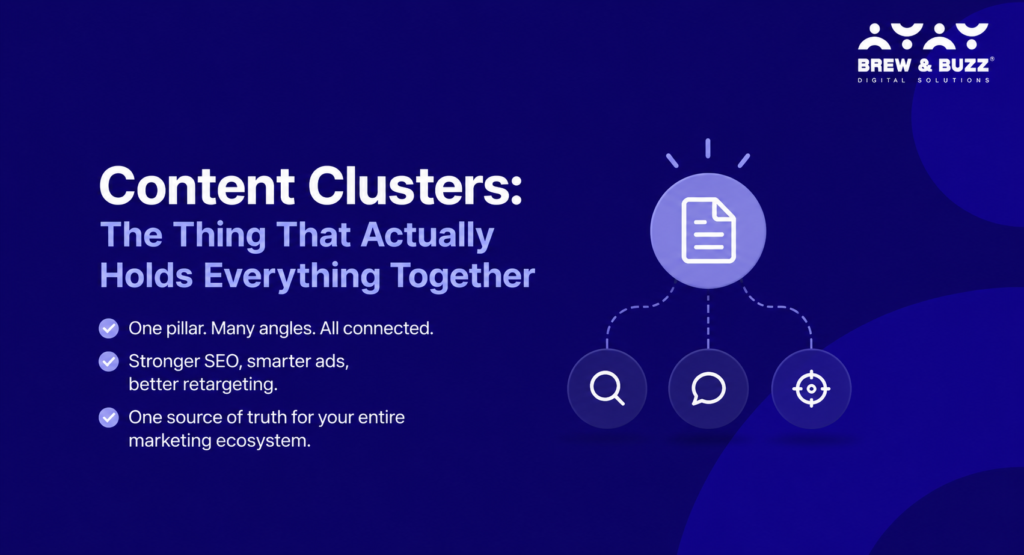
Content Clusters: The Thing That Actually Holds Everything Together
A content cluster is simple in theory: one pillar page on a broad topic, a handful of linked pages underneath it going deeper on specific angles. What’s less obvious is how much weight that structure ends up carrying once you’ve got multiple campaigns running.
Once a cluster exists, it’s not just an SEO asset anymore. It becomes the shared reference point for ad copy, landing pages, and retargeting — the one place everyone on the account goes to check what’s actually being said and why.
A few reasons this matters more than people expect:
- You stop researching the same thing twice. Build one cluster, say, B2B Lead Generation for Manufacturers as the pillar, with sub-pages on cold outreach, LinkedIn growth, and performance marketing — and every campaign team pulls from the same well of talking points and proof instead of reinventing it.
- Landing pages stop floating on their own. A lot of paid campaigns point to a standalone page with zero organic support behind it. Sit that page inside a cluster instead, and it inherits internal links and topical authority, which means it can start ranking organically too — so you’re not permanently dependent on ad spend to keep it visible.
- Retargeting gets a lot less generic. Someone who reads your “MQL vs SQL” page can be shown an ad that actually references that page, instead of the same brand message everyone else sees.
How we set this up in practice:
- Build clusters around the buyer’s actual problem, not your service name. Why B2B leads go cold beats Our Lead Gen Services every time, because it’s how people actually search and think.
- One owner per cluster, who signs off on any campaign messaging tied to it. This single step prevents most of the fragmentation.
- Revisit clusters every quarter. Buyer language moves fast enough now that something written in January can sound dated by Q3.
Search Intent Mapping: Getting Paid, Organic, and Social to Agree
Intent mapping is really just categorizing every keyword, every ad target, every page by where the buyer actually is — not by what they typed into the search bar.
The four standard intent categories haven’t changed. What matters is how deliberately you route budget across them:
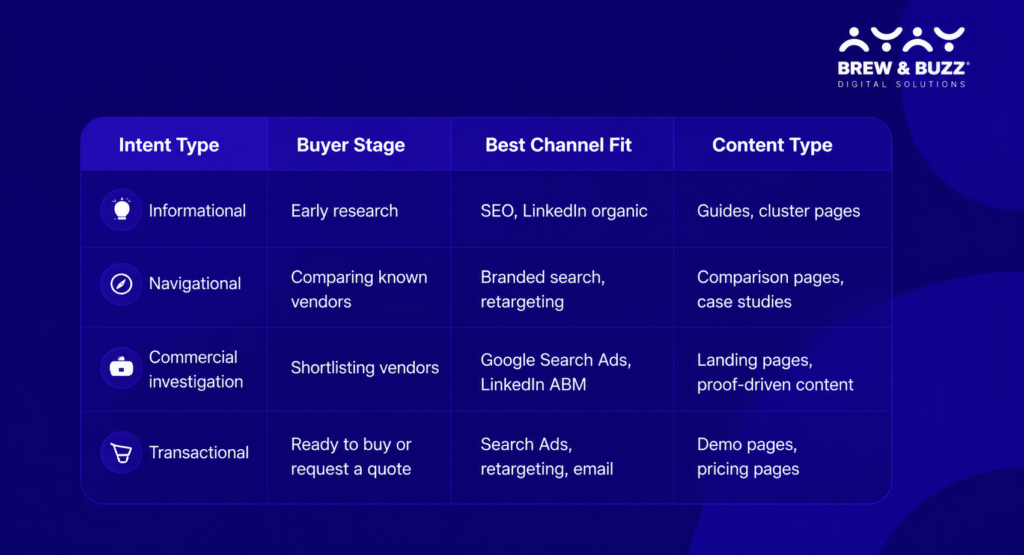
Here’s where most of the budget actually leaks: a Google Search campaign bidding on an informational keyword like what is B2B lead generation, sending that click straight to a demo request page. The visitor wasn’t ready for that ask. Conversion rate drops, Quality Score drops with it, and cost-per-click quietly climbs across every other campaign sharing that account.
This is also, frankly, where conversion rate optimization starts long before anyone touches a landing page headline. Getting the right traffic to the right page at the right stage does more for your conversion numbers than almost any on-page tweak will.
Mapping intent before you allocate a single rupee of budget means:
- Top-of-funnel keywords go to SEO and organic LinkedIn, not paid — saving spend for the stages that actually convert.
- Each intent stage gets its own landing page instead of one page trying to do everything.
- Retargeting moves people from informational content toward a commercial offer over two or three touches, instead of one hard pitch too early.
AI-Assisted Research: Faster, Not Lazier
Managing several campaigns at once means research needs to happen at a pace no single person can keep up with by hand — keyword shifts, competitor ad changes, buyer language, all moving weekly now, not quarterly. AI-assisted research is genuinely useful here, but only when it speeds up a strategist’s thinking rather than replacing it.
Where it earns its place in 2026:
- Sorting keywords and queries into intent clusters. What used to take a day of manual tagging now takes an hour of refining what the AI already grouped.
- Watching competitors so you don’t have to check manually. Tools tracking ad libraries and publishing cadence catch a competitor’s messaging shift within days, not a quarter later.
- Rough first drafts of audience research. AI can pull together a first pass on buyer objections and language from reviews, forums, and public comments — a starting point a human then checks against real sales calls.
- Faster A/B variants. Generate a batch of headline or ad copy options quickly, then let a human pick and refine.
Where it still needs a real person checking it, every single time:
- Buyer language: AI personas tend to sound generic unless they’re grounded in actual sales call notes or CRM data from that specific business.
- Regional nuance in B2B buyer behavior in India, the GCC, and Southeast Asia doesn’t match what most AI tools were trained on, which skews heavily US-centric. That gap needs a local correction every time.
- Anything presented as a fact. If AI surfaces a stat about a market or competitor, verify the source before it goes anywhere near an ad or landing page.
The agencies and in-house teams are getting real value from this: treat AI as a way to get to a first draft faster, not as the one making the final call.
Audience-First Content Strategy: The Filter Everything Else Runs Through
Content clusters and intent maps only work if they’re built around a real audience, not a guessed one. Being audience-first means testing every piece of campaign content, paid or organic, against one question: does this match what this specific buyer needs right now, said the way they’d actually say it?
What that looks like day to day:
- Segment before you cluster. A cluster for manufacturers and one for exporters shouldn’t share a landing page even if the underlying service is identical; the objections and decision-makers are different enough to matter.
- Write from what sales actually hears, not what marketing assumes. Pull real phrases from discovery calls into headlines and page copy. It outperforms internally invented marketing language almost every time.
- Let the audience decide the channel, not the CPC. If your buyers live on LinkedIn and barely touch Meta, don’t run Meta just because it’s cheaper per click. Cheap reach to the wrong person is still wasted money.
- Close the loop between sales and content. Update messaging based on what content sales reps actually reference when they close a deal, not just what got the most clicks.
Putting It All Together: How a Performance Marketing Agency Runs This in Practice
Here’s roughly the sequence that keeps a multi-campaign account coherent instead of chaotic:
- Map the audience segments first, before touching a single channel or budget line.
- Build one content cluster per core buyer problem, with one owner approving all related campaign messaging.
- Tag every keyword, ad set, and page by intent stage, and route budget so each channel handles the stage it’s actually good at.
- Use AI to speed up research and drafting, but verify every claim, persona detail, and regional nuance before it goes live.
- Report on one shared view of a qualified lead, not five channel-specific vanity metrics.
- Treat conversion rate optimization as ongoing, not a one-time landing page fix; revisit it every time traffic sources or intent mix shifts.
- Rebuild clusters every quarter, because buyer language moves faster than most campaign calendars assume.
Final Thought
Managing multiple ad campaigns well isn’t really about having more performance marketing experts on the account or a bigger toolset. It’s about giving every campaign the same backbone to work from. Content clusters give every channel the same research and message. Intent mapping keeps the budget from getting spent on the wrong stage of the journey. AI-assisted research keeps pace with a market that changes weekly. Conversion rate optimization stops being a landing page trick and becomes something baked into how traffic gets routed in the first place. And an audience-first filter keeps all of it honest.
Run the campaigns like they’re one system because to the person on the other end, clicking through all three, they already are.
Frequently Ask Questions
Scaling successful ads isn’t about simply increasing your daily budget. It requires understanding which campaigns consistently generate profitable results and then expanding them strategically. We analyze conversion data, audience performance, creative engagement, and campaign objectives before increasing spend. By testing new audiences, optimizing bidding strategies, and continuously monitoring performance, we help businesses scale their advertising while maintaining a healthy return on ad spend (ROAS). This approach minimizes wasted budget and ensures sustainable business growth.
The right advertising platform depends on your business goals, target audience, and buying journey.
Google Ads is ideal for capturing high-intent users actively searching for your products or services.
Meta Ads (Facebook & Instagram) work well for brand awareness, lead generation, and ecommerce growth.
LinkedIn Ads are best suited for B2B businesses targeting decision-makers and professionals.
YouTube Ads help businesses build awareness and educate potential customers through video content.
Many businesses achieve the best results by combining multiple platforms into a unified performance marketing strategy instead of relying on just one channel.
Poor-performing ads usually result from incorrect audience targeting, weak landing pages, ineffective creatives, or improper campaign optimization. Instead of increasing your budget, we first identify where conversions are dropping in your sales funnel. We continuously optimize keywords, audiences, ad creatives, bidding strategies, and landing pages while tracking every conversion. This data-driven approach helps eliminate unnecessary ad spend and improves overall campaign profitability.
Modern performance marketing uses automation to improve efficiency without sacrificing control. We leverage automated bidding strategies, AI-powered audience optimization, conversion tracking, automated reporting, rule-based budget management, and performance alerts. These automations reduce manual work while allowing marketers to focus on strategy, creative testing, and business growth. The result is faster optimization, improved campaign performance, and significant time savings.
Performance marketing is a digital marketing approach where businesses pay based on measurable results such as leads, sales, app installs, website conversions, or qualified enquiries. Unlike traditional advertising, every campaign is tracked using real-time analytics and conversion data. Platforms like Google Ads, Meta Ads, LinkedIn Ads, and YouTube Ads allow advertisers to optimize campaigns continuously based on actual performance. This ensures your marketing budget is invested where it delivers the highest return on investment (ROI).
Yes. Performance marketing can be highly effective even with a modest budget when campaigns are planned strategically. Instead of targeting broad audiences, we focus on high-intent keywords, precise audience segmentation, optimized landing pages, and continuous testing to maximize every advertising dollar. As campaigns generate profitable results, budgets can be gradually increased to scale growth without taking unnecessary financial risks. Starting small also provides valuable performance data that helps build stronger campaigns over time.