
Why your personal profile outperforms your company page and how to rebuild it for buyer intent.
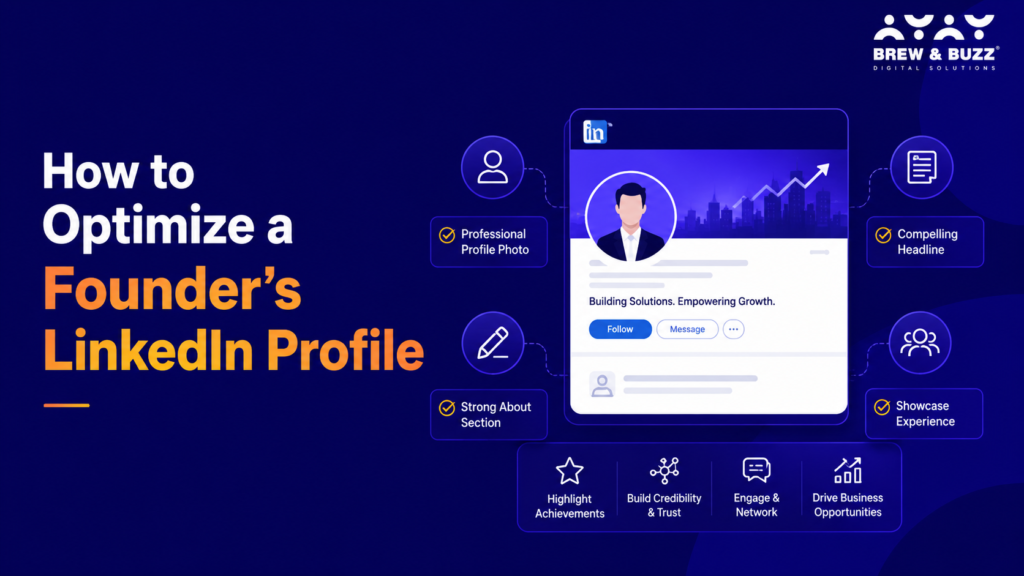
Most founder LinkedIn profiles read like resumes. A neat list of past roles, a few certifications, a headline that says CEO at XYZ Company, and not much else. It looks professional. It also generates almost nothing in the way of leads.
If you’re a founder or managing director running a B2B company out of India in manufacturing, exports, industrial services, or professional services, your LinkedIn profile is quietly doing one of two things right now. Either it’s working as your most cost-effective lead generation channel, or it’s sitting there as a digital visiting card nobody reads twice.
The numbers back this up. In 2026, personal LinkedIn profiles carry an average engagement rate of roughly 2.6%, against about 1.7% for company pages, and individual founders now post slightly more often than brand accounts do, not less. That gap isn’t a quirk of the algorithm. It’s a structural preference for people over logos, and it’s the entire premise this guide is built on.
This guide breaks down the exact structure we use with founders at BrewAndBuzz, built on our own 4B Framework, to turn a personal profile into a system that consistently attracts buyer intent — and stays visible as AI search tools like ChatGPT, Perplexity, and Google’s AI Overviews start deciding who gets recommended in your category.
Why Your Personal Profile Beats Your Company Page
This isn’t an opinion; it’s how the platform is built. LinkedIn is a network of people, not logos. A company page post reaching a few hundred people is normal. The same message posted from a founder’s personal profile, with a real face and a real name attached, routinely reaches several times further, because the algorithm rewards person-to-person signals over brand-to-audience broadcasts.
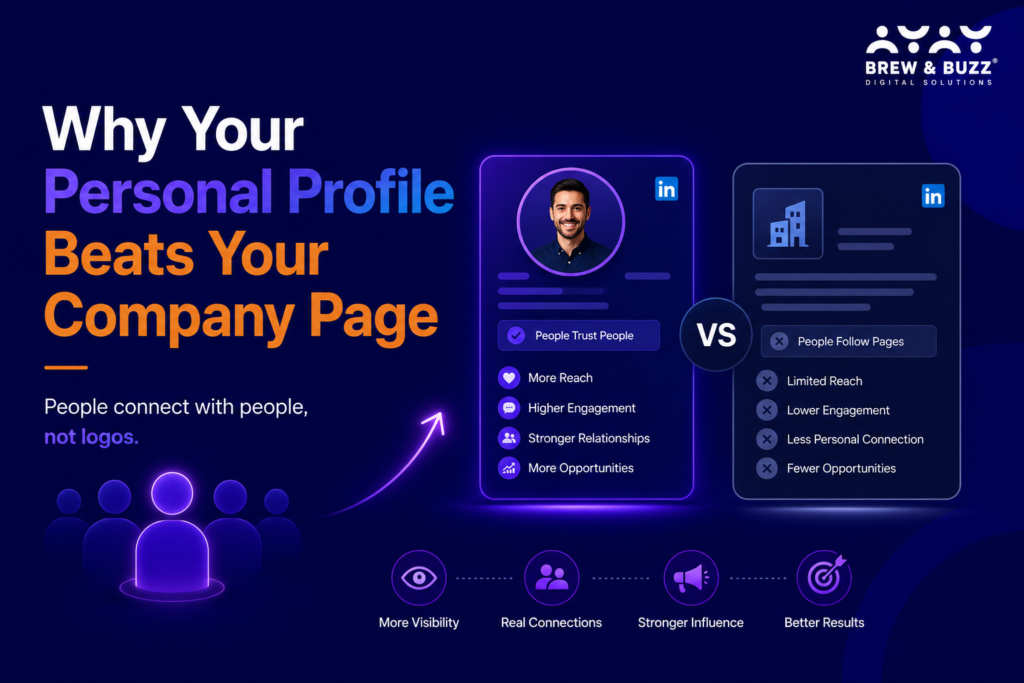
What the data shows: Multiple independent studies from 2026 converge on the same directional finding, even if the exact multiplier varies by source: personal profiles consistently outperform company pages, generally landing somewhere between 3x and 8x more engagement on comparable content. One consistent underlying mechanism explains why: posts that pick up three or more comments within the first 60 minutes see roughly 5x amplified reach, and people simply comment on people far more readily than they comment on brand pages.
There’s a trust dimension too, and it matters more in B2B than almost anywhere else. When a plant manager in Riyadh or a procurement head in Bengaluru is evaluating your company, they’re not building a relationship with a logo. They’re deciding whether to trust you, the person whose name is on the export documents, who shows up on the sales call, who they’ll actually be dealing with for the next three years. A well-built founder profile lets that trust start forming before the first call ever happens.
The Anatomy of a Lead-Generating Founder Profile
Every high-performing founder profile we’ve rebuilt follows the same underlying architecture: headline, banner, About section, Featured section, and activity, each one doing a specific job in moving a stranger toward a conversation.
1. The Headline: Say Who You Help and What Changes
A stronger pattern: [Who you help] + [What you help them do] + [Proof or mechanism]. For example, a founder in industrial exports might write something closer to “Helping Indian manufacturers win GCC contracts | 40+ export accounts scaled | Founder, XYZ Company” instead of a plain title. It’s specific, it’s provable, and it immediately filters in the right audience.
Before & After: A Real Headline and About Section Rewrite
Here’s what this looks like applied to an actual profile — a managing director at a mid-sized industrial exports company, before and after a rebuild:
| BEFORE | AFTER |
| Headline Managing Director at Sharma Industrial Exports Pvt. Ltd. | Headline Helping Indian auto-component manufacturers win long-term GCC supply contracts | 12+ years exporting to UAE & Saudi | MD, Sharma Industrial Exports |
| About (opening line) I have over 15 years of experience in the industrial manufacturing and export sector. I started my career as a production engineer before founding. | About (opening line) Most Indian auto-component exporters lose GCC contracts not on price, but on compliance delays and inconsistent lead times. I built Sharma Industrial Exports specifically to fix that. |
The after version names an exact audience, an exact market (GCC), and opens with a problem the buyer already recognizes — instead of a career summary nobody asked for. That’s the entire shift this guide is trying to get you to make, applied to two lines.
2. The Banner: Reinforce, Don’t Repeat
The banner image is free real estate most founders waste on a stock skyline. Use it to restate your positioning visually: a one-line value proposition, a client logo strip, or a credibility marker like “Trusted by 50+ B2B exporters across India & GCC.” It should support the headline, not duplicate it.
3. The About Section: Write It for a Buyer, Not a Recruiter
This is the section founders get most wrong. It’s usually written in third person, past tense, career-summary style, which is exactly how you’d write it for a job application, and exactly wrong for a prospect. A buyer doesn’t care about your career arc on the first read. They care about whether you understand their problem.
Structure that consistently works:
- Open with the problem your ideal client is facing, in their language, not yours.
- Position yourself as the person who solves it, with one or two lines on your mechanism or framework.
- Add proof — a number, a client category, a result, an industry you’ve worked in.
- Close with a direct, low-friction next step — not let’s connect, but something specific, like an invitation to message about a particular challenge.
Length: aim for 1,300–1,900 characters (roughly 200–300 words) — long enough to cover problem, proof, and mechanism, short enough that a busy buyer reads the whole thing on a phone screen without tapping “see more” and abandoning halfway. LinkedIn allows up to 2,600 characters, but the profiles that convert rarely need all of it.
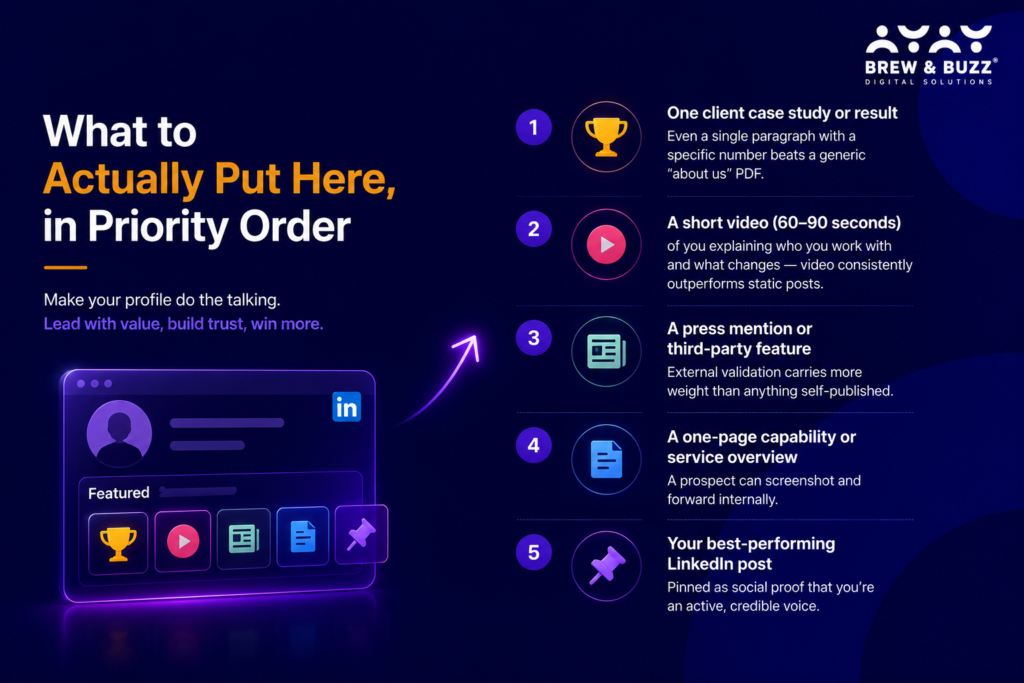
4. The Featured Section: Your Evidence Locker
This is where credibility compounds. Case studies, client testimonials, press mentions, a short explainer video, a downloadable one-pager anything that lets a skeptical buyer verify you without needing a call. Founders who leave this section empty are asking prospects to trust them on faith, in a market where faith isn’t the currency; proof is.
5. Experience & Activity: Consistency Signals Real Authority
Rewrite your experience section in outcome language, not job-description language. And post regularly enough that both human visitors and LinkedIn’s own algorithm treat your profile as active, not dormant. A profile that hasn’t posted in four months looks abandoned to a prospect and to the platform.
Authority Platforms: Building Trust Beyond LinkedIn
A founder profile doesn’t operate in isolation anymore. Buyers — and increasingly AI systems — cross-reference what you say on LinkedIn against what exists about you elsewhere. This is where “parasite SEO” thinking becomes useful: publishing on platforms that already carry domain authority, so your name and expertise show up wherever your buyer is searching, not just on your own site.
- Industry directories and B2B marketplaces relevant to manufacturing, exports, or your specific vertical, where a founder bio with consistent positioning reinforces your niche.
- Guest contributions and bylines on trade publications or business media, which build both backlinks and third-party validation.
- PR mentions and interviews, even small trade-press features, which act as trust signals that are far harder to fake than a self-written bio.
- Google Business Profile and company knowledge panels, kept consistent with your LinkedIn positioning, so search engines associate the same entity across platforms.
The goal isn’t to chase every platform. It’s to make sure that wherever a buyer or an AI model looks for a second opinion on you, the story matches.
Content Distribution: Getting the Right Eyes on What You Post
Writing good posts is half the job. Distribution is the other half, and it’s the half most founders skip.
Posting Frequency and Format: What Actually Works for Founder Profiles
For a founder or MD running a B2B company — not a full-time content creator — two to three posts a week is the sustainable target. 2026 engagement data shows individual profiles posting roughly 3 times a week on average, and that cadence is enough to keep the algorithm treating your profile as active without turning content into a second job.
A realistic weekly mix for a founder profile looks like this:
| Day / Slot | Format | Purpose |
| Monday, morning IST | Text post (150–300 words) | A perspective or lesson from the past week sets the tone before GCC/SEA audiences come online. |
| Wednesday, midday IST | Carousel or document post (4–8 slides) | A framework, checklist, or before/after breakdown carousels consistently hold attention longer and get saved, which the algorithm reads as strong intent. |
| Friday, midday IST | Short video or client story (60–120 sec) | A client win, a behind-the-scenes moment, or a direct-to-camera take video is still under-used by B2B founders, which makes it disproportionately effective right now. |
The first 60 minutes after posting matter more than the rest of the week combined. Reply to every comment within that window, and where possible, message a handful of relevant connections directly to flag the post. Early comments are what trigger the algorithm’s wider distribution, roughly 5x amplified reach once a post crosses that 3-comment threshold early.
Repurpose, Don’t Just Publish
A single client win can become a LinkedIn post, a short case study for your Featured section, a talking point in a sales call, and a line in your next outreach email. Founders with limited time get the most mileage by treating every piece of content as raw material for four or five different formats, not a one-time post.
Post Where Your Buyers Actually Are
For most Indian B2B founders targeting GCC and Southeast Asian buyers, that means timing posts around when those markets are online, engaging directly in relevant industry group discussions, and commenting thoughtfully on posts from prospects and partners, not just publishing into the void and hoping the algorithm does the rest.
Build a Rhythm, Not a Burst
Three thoughtful posts a week, sustained for six months, will outperform a daily-posting sprint that burns out in three weeks. Consistency is what both human audiences and LinkedIn’s ranking system reward.
Entity Trust: Becoming a Recognized Entity, Not Just a Profile
Search engines and AI systems increasingly think in terms of entities real, verifiable people and organizations with consistent data rather than isolated web pages. Building entity trust means every mention of you and your company online tells the same, verifiable story.
| Entity Signal | Why It Matters |
| Consistent name, title, and company across LinkedIn, your website, and directories | Confirms you’re a single, verifiable entity rather than conflicting fragments |
| Structured data (schema markup) on your company site | Gives search engines and AI crawlers machine-readable facts about you and your business |
| Backlinks from credible industry sources | Acts as third-party validation, which carries more weight than self-published claims |
| Active, dated content (posts, articles, press mentions) | Signals you’re a current, relevant source — not an outdated one |
This is exactly the layer BrewAndBuzz builds into client sites through structured data and consistent positioning; it’s what turns a founder from “a person with a LinkedIn account” into a recognized entity that search and AI systems are confident recommending.
AI Visibility: Showing Up When Buyers Ask AI Instead of Google
A growing share of B2B buyers are no longer typing keywords into Google; they’re asking ChatGPT or Perplexity questions like who are the best LinkedIn growth partners for B2B founders in India or how should a founder set up LinkedIn for leads. Answer Engine Optimization (AEO) is about making sure your content is structured to be picked up as the answer to those questions.
Practical steps that move the needle:
Write content in a direct question-and-answer format, mirroring how people actually phrase queries to AI tools.
Use FAQ schema markup so structured answers are machine-readable, not buried in paragraph text.
Keep facts about your company (founding year, client base, service categories) consistent everywhere they appear, since AI models cross-check for consistency before trusting a source.
Publish original data or perspective — AI systems increasingly favor sources that add something new over ones that repeat existing content.
Ethical Ranking Strategies for 2026
It’s worth saying plainly: engagement pods, bot-driven comments, and fake follower growth are not a shortcut; they’re a liability. LinkedIn has gotten significantly better at detecting inorganic engagement patterns, and AI systems evaluating credibility are specifically trained to discount artificially inflated signals. A profile with 500 genuine, relevant connections and steady engagement from real prospects will outperform one with 10,000 disengaged followers, every time.
The sustainable approach for 2026 rests on a few honest principles:
Long-term consistency over short-term spikes — algorithms across every platform are converging on rewarding sustained, authentic activity rather than bursts of manufactured attention.
E-E-A-T in practice — Experience, Expertise, Authoritativeness, Trustworthiness aren’t just a Google acronym anymore; they’re what both human buyers and AI models are quietly scoring you on.
Real engagement over vanity metrics — a comment from a genuine prospect is worth more than fifty likes from an engagement pod.
Transparency in claims — every number or case study you cite should be one you can back up if a prospect asks.
Frequently Asked Questions
Structure the profile around buyer intent, not a resume: a headline built on the problem you solve, an About section written for a prospect, a Featured section stacked with proof, and a consistent posting rhythm that demonstrates thought leadership in your category.
Follow the buyer’s journey top to bottom: a headline naming the audience and outcome, a banner reinforcing positioning, an About section leading with the client’s problem, a Featured section with case studies or media proof, and an Experience section rewritten in outcome language.
Specificity, proof, and consistency. Name an exact audience and outcome instead of generic language, back every claim with visible evidence, and post often enough that both LinkedIn’s algorithm and AI search engines treat you as an active, trustworthy entity.
LinkedIn’s own engagement patterns consistently favor personal profiles, since the platform is built around people rather than logos. Buyers also trust a named individual with a visible track record more than an anonymous corporate account, especially in relationship-driven sectors like manufacturing and export
Roughly 1,300–1,900 characters, or about 200–300 words. LinkedIn allows up to 2,600 characters, but the highest-converting About sections are the ones a busy buyer can finish reading on a phone screen without needing to tap “see more.”
In priority order: one client case study with a specific result, a short 60–90 second video introducing what you do and for whom, a press mention or third-party feature if available, a one-page capability overview a prospect can forward internally, and your best-performing post pinned as social proof.
The company page functions as an operational reference point — logo, official updates, static company facts. The personal profile is where trust and relationships actually form, since LinkedIn’s algorithm and its users both favor person-to-person interaction over brand broadcasts. In B2B, buyers research the founder they’ll be dealing with far more closely than they research the company page.
Two to three times a week is the sustainable, effective cadence for a founder who isn’t a full-time content creator. What matters more than raw frequency is consistency over months and replying to comments within the first 60 minutes of posting, since that early window is what triggers wider algorithmic distribution.