
You took over the business. You know the machines, the clients, the numbers that matter. What you may not have thought about is that before a buyer, a bank, or a supplier ever sits across the table from you, they’ve already formed an opinion and they formed it on your LinkedIn profile.
Not the company page. Yours.
Here’s the tension you’re probably feeling, even if you haven’t named it: take over too quietly, and people wonder if anything has actually changed under you. Push too hard to reinvent, and it looks like you’re distancing yourself from the very track record that got the company this far. Nowhere does that tension show up more clearly than on your profile, where a stranger doing due diligence is trying to answer one quiet question is this person actually ready to run this?
Most successors get this wrong in one of two directions. Either the profile reads like the founder’s bio with a new name typed in, or it scrubs the family history out entirely, as if thirty years of on-time delivery counts for nothing. Neither version builds trust. What actually works is a profile that does both jobs at once it carries the weight of what came before, and it makes unmistakably clear what you, specifically, are building now.
And the stakes here are bigger than they look. Businesses that visibly involve the next generation in external-facing roles including how they show up online are consistently read by buyers and partners as lower-risk continuity bets than businesses where succession happens invisibly, behind closed doors. On LinkedIn specifically, personal profiles are seeing engagement rates around 2.6% in 2026, against roughly 1.7% for company pages. Translation: your profile, not the company page, is where your credibility actually gets built or lost in front of a skeptical buyer.
This is a practical walkthrough of the same one we use when we sit down with next-gen leaders of what your profile should actually say, and why.
Why Your Profile Carries More Weight Than the Company Page
The company page can tell someone how long the business has existed and what it manufactures. It cannot tell them whether the person now steering the ship can hold a twenty-year relationship together. That judgment — the one that decides whether someone signs a long-term contract with you — gets made by looking at a person, not a logo.
This matters most right now, during your transition, when people are quietly asking themselves whether service, responsiveness, and delivery reliability will hold steady under new leadership. When you show up clearly and confidently on LinkedIn with a defined point of view, visible proof of what you’ve already done, and consistent activity, you’re answering that question before anyone has to ask it out loud.
One more thing worth knowing: AI search tools now read LinkedIn activity as part of how they judge whether a business is a current, credible recommendation. If your profile goes quiet during a transition, the business itself can start reading as less active than it actually is, even while operations on the ground are running exactly as they should.
What Your Profile Actually Needs to Say
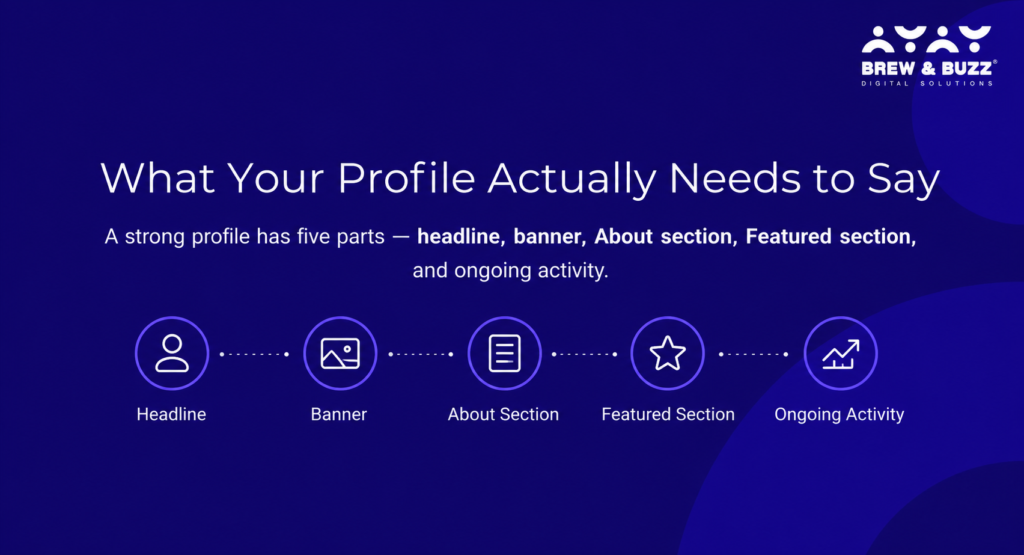
A strong profile has five parts: headline, banner, About section, Featured section, and ongoing activity. For you, each one has to do double duty: signal continuity and signal change, at the same time.
1. Your Headline: Name the Legacy, Lead With What’s Yours
Director at XYZ Company tells nobody whether you’re driving the business forward or simply holding a title you inherited. A stronger headline names both — the continuity and your specific contribution. Something closer to:
Third-generation leader, [Company] | Scaling precision components exports to GCC | 8+ years modernizing family-run operations
That single line tells a buyer you respect the foundation and you’re actively building on it.
Here’s what this looks like in practice, for a second-gen leader who recently took over a precision components business:
| BEFORE | AFTER |
| Headline Director at Mehta Precision Components Pvt. Ltd. About (opening line) — I joined my family business in 2016 and currently oversee operations. Mehta Precision Components was founded in 1998 by my father. | Headline Second-gen leader, Mehta Precision Components | Expanding into GCC export markets while holding our 25-year quality record | Director About (opening line) — Our clients have never had to worry about a missed delivery in 25 years — that’s the standard my father built. My job now is proving we can hold that same standard while taking on markets he never had access to. |
Notice what the “after” version does that the “before” can’t: it turns the family history into a proof point a buyer actually cares about — reliability, not sentiment — and it immediately tells the reader what you are personally accountable for going forward. That shift is really the whole point of this exercise.
2. Your Banner: Let the Visual Say “Continuity Plus Growth”
Use the space above your headline to reinforce the same message visually — a facility photo that spans generations, a line like 25 Years of Precision Manufacturing, Now Expanding to GCC, or a quiet nod to your founding year next to what the business can do today. It should support your headline’s story, not compete with it for attention.
3. Your About Section: Specificity Earns Trust, Sentiment Doesn’t
It’s tempting to write a tribute to your father or grandfather here. Understandable — but buyers skim past that. What holds someone’s attention is specificity: what exactly have you changed, added, or improved since taking responsibility?
A structure that works:
- Open with a credibility fact a buyer actually cares about — years in operation, defect rate, on-time delivery percentage.
- State plainly what you personally own now — a certification you pursued, a market you entered, a process you modernized.
- Add proof — a client category, a specific result, a capability the business didn’t have five years ago.
- Close with a direct next step and an invitation to talk about a specific kind of partnership or project.
Aim for 1,300–1,900 characters — roughly 200–300 words. Long enough to hold both the legacy and your own contribution. Short enough that someone reads the whole thing on their phone without tapping “see more.”
4. Your Featured Section: Prove the Handover Is Real
This is where you show the transition isn’t just a new title on an old org chart. Prioritize:
- One initiative you personally led — a new client win, a facility upgrade, a certification earned under your leadership.
- A short video, 60–90 seconds, of you talking about where you’re taking the business. Nothing establishes “the next generation is genuinely in charge” faster than hearing it in your own voice.
- Any press coverage of the transition itself — succession stories often draw local or trade press interest worth capturing.
- A short capability overview — what the business can now do that it couldn’t under the previous generation.
- Your best-performing post so far, pinned as evidence there’s an active, credible voice behind the name.
5. Staying Visible Through the Transition
A quiet profile does the most damage at exactly this moment — the period when people are watching closest reads as uncertainty, even when nothing is actually wrong. Rewrite your experience entries around what you’ve delivered, not just your title and dates, and keep showing up consistently through the handover, not just around the announcement.
Your Credibility Doesn’t Stop at LinkedIn
What exists about you elsewhere online either reinforces your profile or quietly undermines it. People — and AI tools — cross-check what your LinkedIn says against everything else they can find:
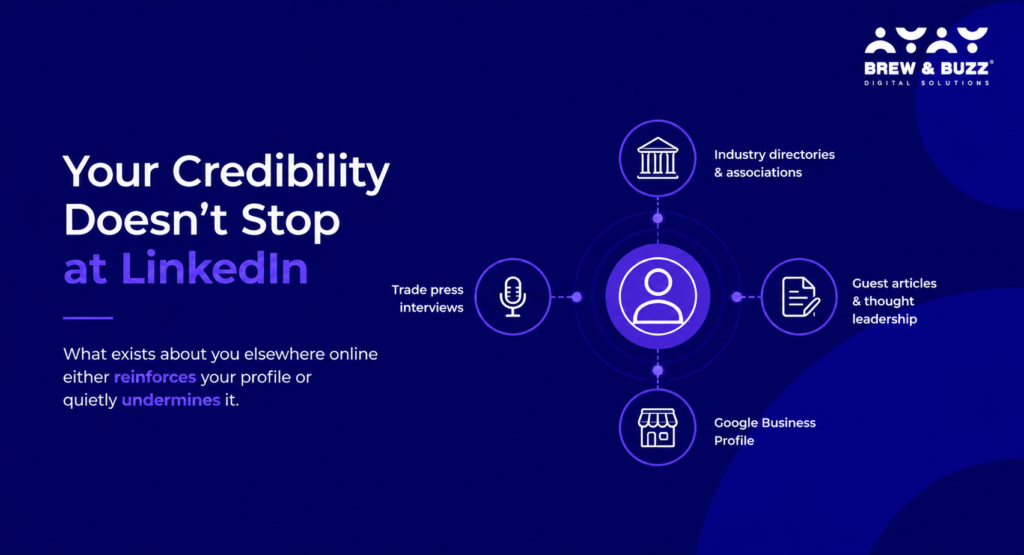
- Industry directories and manufacturing associations, where updated leadership details signal an active transition rather than a stalled one.
- Trade press interviews about the succession itself — “Gen-g leader modernizing a family manufacturing business” is a genuinely compelling story most trade publications want to run.
- Guest articles on manufacturing modernization, export strategy, or the specific challenges in your sector — good for backlinks, better for credibility.
- Your Google Business Profile, updated to reflect current leadership and kept consistent with what LinkedIn says.
A Realistic Posting Rhythm
You’re running a business, not managing a content calendar. Two to three posts a week is enough to read as genuinely active without becoming a second job during an already demanding transition.
| Day / Slot | Format | Purpose |
| Monday morning | Text post (150–300 words) | A specific lesson from operations or the transition — sets a grounded tone for the week |
| Wednesday midday | Carousel or document, 4–8 slides | A before/after on a process improvement or export-readiness checklist — the kind of format people save |
| Friday midday | Short video, 60–120 seconds | A walkthrough of a recent initiative, or a direct-to-camera note on where things are headed |
Reply to comments within the first hour of posting — early engagement is what pushes a post to wider reach, and posts that cross three comments early tend to see reach jump roughly 5x. For you specifically, that first hour is also when other successors and industry peers tend to engage first, which compounds your credibility inside that exact community over time.
Repurpose everything. A new certification, a client win, a facility upgrade — each one is a post, a Featured section update, a talking point, and potential press material. You don’t have bandwidth to invent new content every week. You don’t need to. Treat every real milestone as content.
Show up where other successors are. Gen-g leadership groups and family business forums on LinkedIn are full of people navigating exactly what you’re navigating. Genuine participation there builds visibility with an audience that refers business to each other constantly.
Becoming Someone and Something People Can Verify
| What’s Consistent | Why It Matters |
| Your name, title, and company across LinkedIn, your website, and directories | Confirms the transition is real and current, not a pending announcement |
| Structured data on your website reflecting current leadership | Lets search engines and AI tools surface accurate facts about who actually runs the business |
| Backlinks from trade press or association features on the succession | Third-party validation a self-written bio can’t replicate |
| Active, dated content from you | Signals the business is being actively led, not coasting on what your father or grandfather built |
Showing Up When People Ask AI Instead of Google
People evaluating your business for a long-term contract are increasingly asking AI tools questions like how should a Gen-g leader position themselves on LinkedIn or what makes a credible successor in a family manufacturing business. Being the answer to that question matters as much now as ranking on Google used to.
A few things that help:
- Write in a direct question-and-answer format, close to how people actually phrase these questions.
- Keep the facts about your leadership who runs the business, since when, what’s changed consistent everywhere they appear.
- Publish your own perspective on the transition itself. Generic manufacturing content gets ignored; a genuine point of view gets picked up.
What Actually Holds Up Over Time
Buying followers or running engagement pods to fake an established presence backfires fast — detection has gotten much better, and any serious buyer doing due diligence during a leadership transition will look closely for exactly this kind of inconsistency. What holds up instead:
- Claims that survive a direct follow-up question from a cautious buyer.
- Real engagement from real industry contacts — worth more than a large, disengaged following.
- Honest framing of the transition, including what you’re still learning. It builds more trust than an overconfident, all-figured-out posture ever will.
- Staying visible through the whole transition, not just in a burst around the announcement that fades a month later.
The Questions You’re Probably Actually Asking
One that acknowledges the business’s track record while establishing your own point of view — naming what you specifically own, like a plant expansion or a new certification, instead of just restating your father’s or grandfather’s story in the first person.
Continuity plus change. Reference the legacy briefly for context, then lead with what you’re actively building — new markets, modernized processes, expanded capability — so people see both stability and forward motion in the same profile.
Roughly 1,300–1,900 characters, or 200–300 words. Enough to cover the business’s foundation, your specific contribution, and proof — short enough to read in full on a phone.
A recent initiative you led, a short video of you talking about your vision, any press coverage of the transition, and a one-page capability overview. Proof the handover is real, not just a new job title.
The company page carries institutional history and operational facts. Your profile is where someone decides whether you’re genuinely capable of running the relationship going forward. It’s a trust check on you, not on the company.
Two to three times a week is realistic and effective, especially while you’re mid-transition. Consistency beats volume, and replying to comments in the first hour is what drives most of your reach.
If reading through this made you realize your own profile still sounds like it’s introducing you as the founder’s son or the founder’s daughter rather than as the person actually running things now, that’s normal, and it’s fixable. This is exactly the kind of profile we rebuild for Gen-g leaders, so let’s talk about what yours should say.