
Building buyer trust for API and formulation manufacturers before a single regulatory document changes hands
The call that almost didn’t happen
A regulatory affairs manager at a mid-sized European generics company is screening API suppliers for a molecule going into a new ANDA filing. Before she requests a single Drug Master File, she does what her whole team now does by default: she searches the company name on LinkedIn.
The company page confirms the plant location and a WHO-GMP listing, but it’s thin – no recent updates, generic stock photography. She clicks through to the Quality Head’s personal profile instead, because that’s usually where the real picture is. His profile has a post from three weeks ago about a recent EU-GMP audit closure, with a photo from the actual audit closing meeting. His About section names the specific dosage forms the plant handles and the regulated markets it already supplies. She messages him directly, and the DMF request goes out that afternoon.
Nothing in that sequence involved a sales pitch. It was due diligence, done quietly, on a platform most pharma manufacturers still treat as optional. In a regulated industry where trust has to be earned before a single document is exchanged, that’s no longer a safe assumption to make.
Why this matters more in pharma than almost any other sector
Pharma manufacturing carries a credibility burden other industries don’t – a buyer isn’t just evaluating price and capacity; they’re evaluating whether a plant’s regulatory standing will survive their own audit trail. A few data points explain why LinkedIn has become part of that evaluation, not separate from it:
- 67% of B2B buyers say they prefer to research a vendor independently before ever speaking with a sales representative, and 75% specifically use social platforms – LinkedIn foremost – to do that research.
- Buyers now spend roughly 45% of their vendor research time reading content from a company’s own employees rather than official company marketing material – which means a Quality Head’s or Regulatory Affairs Manager’s personal posts are doing more evaluative work than the company brochure ever will.
- 91% of B2B buyers say they would respond to outreach from someone whose LinkedIn content they already follow and engage with – meaning a regulatory manager who has been quietly posting about audits and certifications for months has already done half the trust-building before a buyer ever reaches out.
- The global API manufacturing market is projected to grow from roughly $266.72 billion in 2026 to $347.49 billion by 2030 – more manufacturers chasing the same regulated-market buyers, which makes a differentiated, credible online presence a genuine competitive factor, not a nice-to-have.
- Sales professionals with a strong LinkedIn presence report roughly 45% more opportunities than those without one, and social platforms are cited by a large share of B2B sellers as directly cutting the pre-call research time on both sides of a deal.
None of this replaces a plant audit, a DMF review, or a regulatory filing. It changes what happens before those steps even get scheduled – and in pharma sourcing, getting onto that first shortlist is often the hardest part.
Where most pharma manufacturing profiles fall short
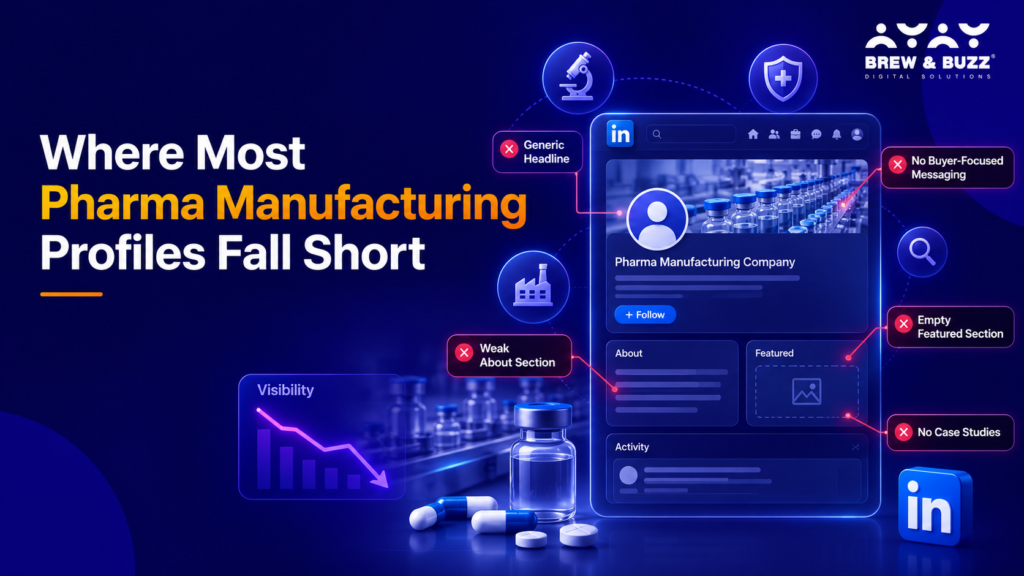
- The headline is a job title only – Quality Head at XYZ Pharma – with no mention of the plant’s actual certifications or the dosage forms and molecules it handles.
- The About section reads like a compliance boilerplate paragraph, heavy on words like quality, excellence, and commitment, light on which specific approvals the plant currently holds.
- Featured is empty or holds a single outdated certificate that a buyer has no way to verify is still current.
- There’s no visible, dated proof that the plant is active and audits are current – no recent posts, nothing timestamped in the last several months.
- The company page and the leadership’s personal profiles say different things, or the personal profiles simply don’t exist, leaving the entire credibility burden on a static company page.
In a regulated industry, vague language doesn’t just underperform on search – it reads as evasive to a buyer’s regulatory team, who are trained to notice exactly what isn’t being said.
The framework: entity SEO and topical authority for a pharma manufacturing profile
Entity SEO means naming the specific, verifiable things a buyer’s regulatory or procurement team is actually searching for: the certification by name (WHO-GMP, USFDA, EU-GMP, PIC/S), the product category specifically (API vs. formulation, and the therapeutic segment or dosage form), the filing status where relevant (DMF, CEP), and the regulated markets already supplied (not we export globally but the specific geographies). Each of these is a distinct entity that a search engine – and increasingly, an AI Overview answering a compliance-adjacent query – can match directly against a buyer’s question.
Topical authority means the profile’s posting history consistently orbits a narrow set of topics: audit outcomes, certification renewals, specific molecules or therapeutic categories, plant capacity or upgrades. A Quality Head who posts regularly and specifically about GMP audits and compliance milestones, rather than general company news, begins to read – to both buyers and algorithms – as a credible source on that exact topic. That consistency is what increasingly gets pulled into an AI-generated answer when someone searches “WHO-GMP certified API manufacturer for [therapeutic category].
Before and after: one profile, rewritten
BEFORE – typical Quality Head profile
| Before | After |
| Headline: Quality Head at Meridian Life Sciences | Headline: Quality Head, WHO-GMP & EU-GMP Certified API Manufacturing | Oncology & Cardiovascular APIs | Meridian Life Sciences |
| About: Meridian Life Sciences is committed to delivering the highest quality pharmaceutical products. We follow strict quality standards and are dedicated to excellence in everything we do. We believe quality is not negotiable. | About: I lead quality assurance at Meridian Life Sciences, a WHO-GMP and EU-GMP certified API manufacturer specializing in oncology and cardiovascular molecules, supplying regulated markets across the EU, GCC, and Southeast Asia. Our facility holds active DMF filings for six molecules, with two additional filings in progress for 2026. Our last EU-GMP inspection was closed with zero critical observations. If your regulatory or procurement team is evaluating API suppliers for a new filing, I’m the first point of contact for plant documentation and audit history – message me directly. |
| Featured: (empty) | Featured: Current WHO-GMP and EU-GMP certificates, a 90-second plant walkthrough video, DMF filing status sheet, a case study from a repeat EU client, product portfolio link |
| Last activity: None visible in over a year A regulatory affairs manager reading this cannot confirm a single fact – not which certifications are current, not which molecules the plant actually handles, not whether the facility is even still operating. There’s nothing here to verify and nothing an AI system could cite in answer to a specific query. | Recent activity: A post from ten days ago on the plant’s most recent EU-GMP audit closure, with photos from the closing meeting |
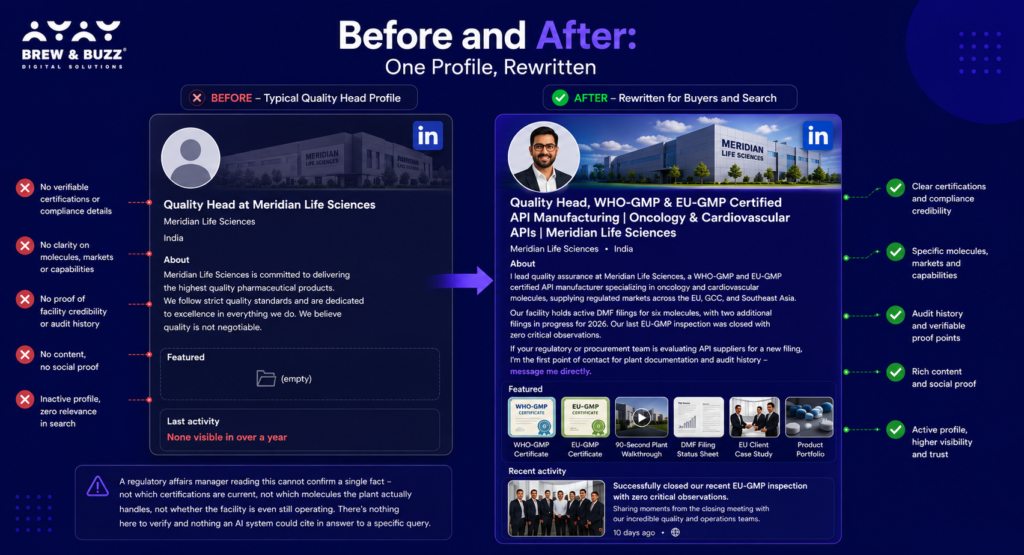
The underlying facility and its actual certifications haven’t changed – only how specifically and verifiably they’re named. That’s the difference between a profile a buyer’s regulatory team can act on and one they simply move past.
The profile framework, section by section
1. Headline (220 characters). Lead with certification status + product category/therapeutic segment + one credibility marker (a molecule count, a regulated-market client base, or years of export experience). A job title alone tells a buyer’s regulatory team nothing they can act on.
2. About (1,600-2,000 characters). Three blocks: what the plant manufactures and under which approvals (one to two sentences), proof – specific certifications, filing status, audit outcomes (two to three sentences), and a direct next step naming exactly what a buyer should message about. Front-load the first two lines, since LinkedIn truncates on mobile.
3. Featured. Three to five pinned, current items: the actual GMP certificate as a document, a short plant walkthrough video, a DMF/CEP filing status sheet where relevant, one regulated-market case study, and a product portfolio link. Refresh this every time a certification renews or a filing status changes – an outdated certificate in Featured can do more damage than an empty one.
4. Experience. Write the current role’s description with the same specificity as About – named certifications, named product categories, named regulated markets – rather than a generic job description. This field is indexed and searchable; treat it as a second proof point, not a formality.
5. Skills & endorsements. Use precise entities – WHO-GMP Compliance, API Manufacturing, DMF Filing, Regulatory Affairs, the specific therapeutic category – instead of generic terms like Pharmaceutical Industry or Quality Management. Specific skills are what LinkedIn’s own search matches against.
6. Recommendations. Two to three from actual regulated-market clients or auditors carry far more weight with a buyer’s compliance team than a longer list from internal colleagues. Ask a repeat client specifically what to mention: audit responsiveness, documentation turnaround, consistency across batches.
7. Activity (posts). In pharma more than almost any other sector, this is what makes the rest of the profile believable – timestamped, specific proof that the plant is active, audits are current, and certifications haven’t lapsed. A strong About section with no recent activity reads, to a cautious regulatory buyer, as a risk flag.
Posting format and frequency, by role
Founder / MD – posting frequency: 2-3x per week. Format mix: 35% company direction and industry commentary (a view on a regulatory change, a capacity investment, a lesson from an audit cycle), 30% capacity and infrastructure milestones with photos (a new line, an expansion, an approval received), 20% team and culture content tied to specific people rather than generic slogans, 15% direct capability or market-expansion posts. This profile is read by buyers assessing the company’s overall direction and stability, so credibility content should outweigh sales content.
Quality Head – posting frequency: 2x per week. Format mix: 45% audit and certification content (renewal announcements, audit closures, process improvements – with specifics, not vague reassurance), 25% technical process content (a quality control checkpoint, a new testing capability), 20% engagement with regulatory-affairs and quality content from peers and buyers in the same space, 10% team recognition. This is often the single most-checked profile on a pharma manufacturer’s LinkedIn presence – it should never go quiet for more than a couple of weeks.
Regulatory Affairs Manager – posting frequency: 1-2x per week. Format mix: mostly filing and market-access content – a new DMF filing, a market approval received, a regulatory pathway explainer relevant to the company’s product categories. This profile builds the specific, filing-level credibility that a buyer’s own regulatory team checks before a sourcing conversation moves to documentation exchange.
Across all three roles, specific and dated content – a named audit, a named certification, a named molecule – consistently earns more trust and more engagement than general compliance language, precisely because specificity is what a skeptical regulatory reader is trained to look for.
Personal profile vs. company page – different jobs, not competing ones
| Function | Personal Profile (Founder/Quality Head/Regulatory Affairs) | Company Page |
| Reach | Several times the organic distribution of a company page post | Lower organic reach; best paired with plant/facility-level updates |
| Trust | A buyer’s regulatory team checks the person accountable for quality and filings, not just the entity | Functions as the static, verifiable record – plant address, certifications on file, filing history |
| Best use | Audit updates, certification news, day-to-day proof the plant is active and compliant | Official facts a buyer’s team cross-checks against what leadership is posting |
| Direct outreach | Can send and receive connection requests and DMs | Cannot message buyers directly |
The company page still needs to be accurate and current – buyers will cross-check it against what leadership says – but in a regulated industry, a mismatch between the two is worse than either being incomplete alone. Keep both, and keep them consistent.
Thought leadership: writing for how buyers actually search for a person
Before a regulatory affairs manager sends a DMF request, a large share of them will search the Quality Head’s or the plant’s name directly – on LinkedIn, and increasingly through an AI assistant that summarizes what comes back before the call even happens. What that search surfaces matters as much as the compliance documents that follow.
The posts that build this kind of credibility fastest are not sales posts – they’re specific, occasionally technical, and willing to name a real audit finding and how it was resolved, rather than only ever posting good news. A Quality Head who posts we had a minor observation in our last inspection, and here’s exactly what we changed reads as more trustworthy to a regulatory buyer than one who only ever posts flawless announcements – because the first sounds like an actual quality system at work, and the second sounds like marketing.
Actionable checklist
- Rewrite the headline with certification status, product/therapeutic category, and one credibility marker.
- Rewrite the About section in three blocks – what, proof, next step – under 2,000 characters, naming specific certifications and filings.
- Load Featured with a current GMP certificate, a plant video, a filing status sheet, and one regulated-market case study.
- Rewrite Experience with the same specificity as About.
- Replace generic skills with named certifications, product categories, and regulatory functions.
- Request two to three recommendations from actual regulated-market clients.
- Set a posting calendar by role – Founder, Quality Head, Regulatory Affairs – per the frequencies above, and hold it for at least 8-10 weeks.
- Audit the company page against what leadership is posting to make sure the two never contradict each other.
Frequently Ask Quetions
Between 1,600 and 2,000 characters, in three blocks: what you manufacture and under which approvals, proof (certifications, filings, audit history), and a direct next step. The opening two lines matter most, since LinkedIn truncates the section on mobile
Three to five current items: the actual WHO-GMP or equivalent certificate, a short plant walkthrough video, a DMF or CEP filing status sheet where relevant, a regulated-market case study, and a product portfolio link. Keep every item current – an outdated certificate here is worse than none.
Personal profiles reach further and are the only place a buyer can message directly. The company page is the static, verifiable record; the personal profiles of the Founder, Quality Head, and Regulatory Affairs Manager are where a buyer’s team actually builds confidence in who’s running the plant.
Two to three times a week on the company page, and two to three times a week combined across the Founder’s and Quality Head’s personal profiles, staggered so the presence doesn’t go quiet. Regulatory Affairs can post less frequently but should stay active around filings and approvals.
All three, with different jobs – the founder covers direction and credibility, the Quality Head covers audit and certification proof, and Regulatory Affairs covers filing-level detail that a buyer’s own regulatory team often checks first.
Yes – profiles and posts are indexed, and specific, verifiable content (named certifications, named molecules, named filing status) is far more likely to be surfaced or cited than generic compliance language.
A buyer’s regulatory or quality team typically searches by molecule, dosage form, and certification, checks the company page for the static facts, then opens the Quality Head’s or Regulatory Affairs Manager’s profile to confirm certifications are current and the plant is visibly active – often before a single document is requested.
The certification status (WHO-GMP, USFDA, EU-GMP), the specific product category or therapeutic segment, and the regulated markets served – specific, verifiable entities outperform a generic job title in both LinkedIn’s search and Google’s.