
Why textile exporters and mill owners need a buyer-facing profile, not a factory brochure
The RFQ that never came
A sourcing agent in Dubai is putting together a shortlist for a UK retail brand that wants a new denim supplier out of India. She has four hours before her call with the buyer. She is not visiting factory websites – most of them take 20 seconds to load, half the product photos are broken, and the Contact Us form goes nowhere. She is on LinkedIn.
She searches jeans manufacturer India OEKO-TEX. Six profiles come up. Two are personal profiles of founders, three are company pages, and one is a plant head who posted about a new dyeing line last month with photos and numbers. She opens that one first, because it looks current. She reads the About section, checks Featured for the compliance certificate, glances at three recent posts to see if the factory is actually running, and messages him directly.
He replies in nine minutes. The other five never hear from her. This is not a hypothetical – this is the ordinary, unremarkable way B2B sourcing now works, and it is exactly why a LinkedIn profile has quietly become as important to a textile manufacturer’s export pipeline as the compliance certificate itself.
Why this is no longer optional – the numbers
A few data points explain why manufacturers who treat LinkedIn as an afterthought are losing deals they never even knew existed:
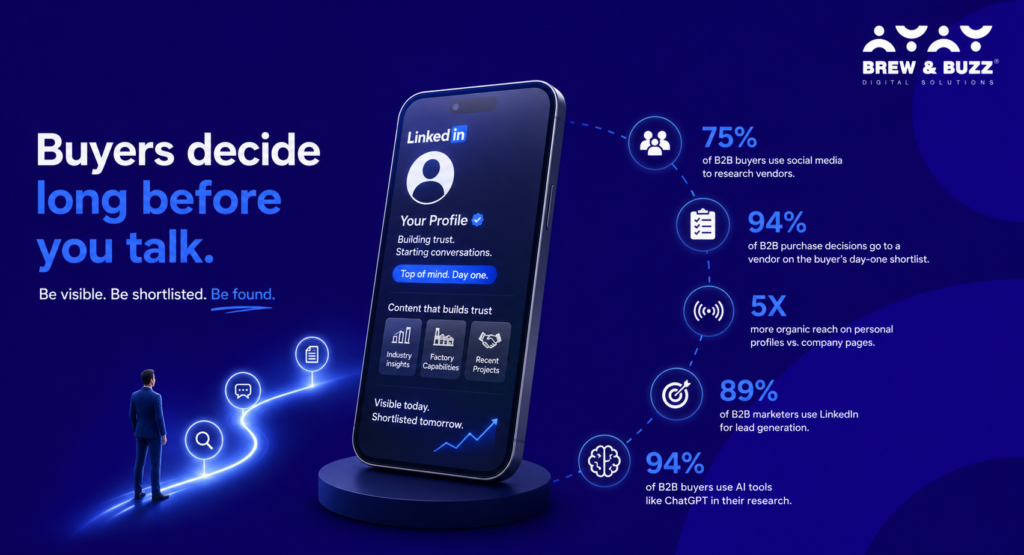
- 75% of B2B buyers now use social media – LinkedIn chief among them – to research vendors before they ever speak to a salesperson, and the average buyer works through roughly 13 pieces of content before requesting a conversation.
- 94% of B2B purchase decisions today go to a vendor that was already on the buyer’s shortlist on day one – which means a lot of the deciding happens before an RFQ is ever sent, on channels like LinkedIn.
- LinkedIn’s own distribution data shows personal profiles get roughly five times the organic reach of company page posts, which is the single biggest reason a founder’s or export manager’s personal profile matters more than the company page for actually getting found.
- 89% of B2B marketers already use LinkedIn as a lead-generation channel, so a manufacturer with no real presence isn’t neutral in that comparison – they’re invisible next to a competitor who is.
- 94% of B2B buyers now use AI tools like ChatGPT during their research, and those tools pull heavily from indexed, structured, entity-rich content – which is exactly what a well-built LinkedIn profile is, and a bare factory brochure PDF is not.
None of this means LinkedIn replaces trade fairs, sourcing platforms, or referrals. It means LinkedIn has become the place buyers go to vet the vendors they hear about everywhere else – and a profile that reads like a factory brochure fails that vetting step even when the factory itself is excellent.
The mistake almost every manufacturer’s profile makes
Most textile and apparel manufacturing profiles on LinkedIn are written for an internal audience – other people in the industry, or worse, no audience at all, just a copy-pasted “About Us” from the company website. The tell-tale signs:
- The headline says a job title and nothing else – Director at XYZ Textiles instead of what the company actually makes, for whom, and to what standard.
- The About section reads like a certificate of incorporation – founding year, mission statement, quality is our promise – with no product specificity, no MOQ, no certification, nothing a buyer can act on.
- Featured is empty, or has a single low-resolution factory photo.
- The last post is fourteen months old, usually a Diwali greeting.
- There is no proof of recent, real production anywhere on the profile – no fresh photos, no client mentions, no capacity updates.
None of these are difficult to fix. They are just never treated as marketing surface area, because manufacturers think of LinkedIn as a place for job-seekers and executives from other industries – not as the place their next buyer is currently doing due diligence.
The framework: entity SEO and topical authority for a manufacturing profile
Two ideas from modern SEO apply directly to a LinkedIn profile, and both matter more in 2026 than they did even two years ago, because both Google and AI search engines are increasingly answering questions by matching entities – specific, named things – rather than matching keywords loosely.
Entity SEO means the profile consistently names the exact things a buyer or an AI system would search for: the product category (not “textiles” but “cotton denim fabric, 12-14 oz”), the certifications (OEKO-TEX Standard 100, GOTS, BSCI, WRAP – named, not implied), the export markets served (not “we export globally” but “EU, GCC, and North America”), and the production capacity in real numbers. Every one of these is an entity a search engine or an AI Overview can match against a buyer’s query.
Topical authority means the profile and its activity consistently orbit the same handful of topics – fabric innovation, compliance, a specific product category, sustainable sourcing – rather than posting randomly about company culture one week and a stock market opinion the next. A profile that posts about GOTS certification, cotton sourcing, and dyeing technology repeatedly, over months, starts to read – to both humans and algorithms – as an authority on that specific corner of textile manufacturing. That’s what gets surfaced when someone searches the category, and increasingly, what gets pulled into an AI Overview answer about GOTS-certified cotton suppliers India.
Before and after: one profile, rewritten
| BEFORE – typical founder profile | AFTER – rewritten for buyers and search |
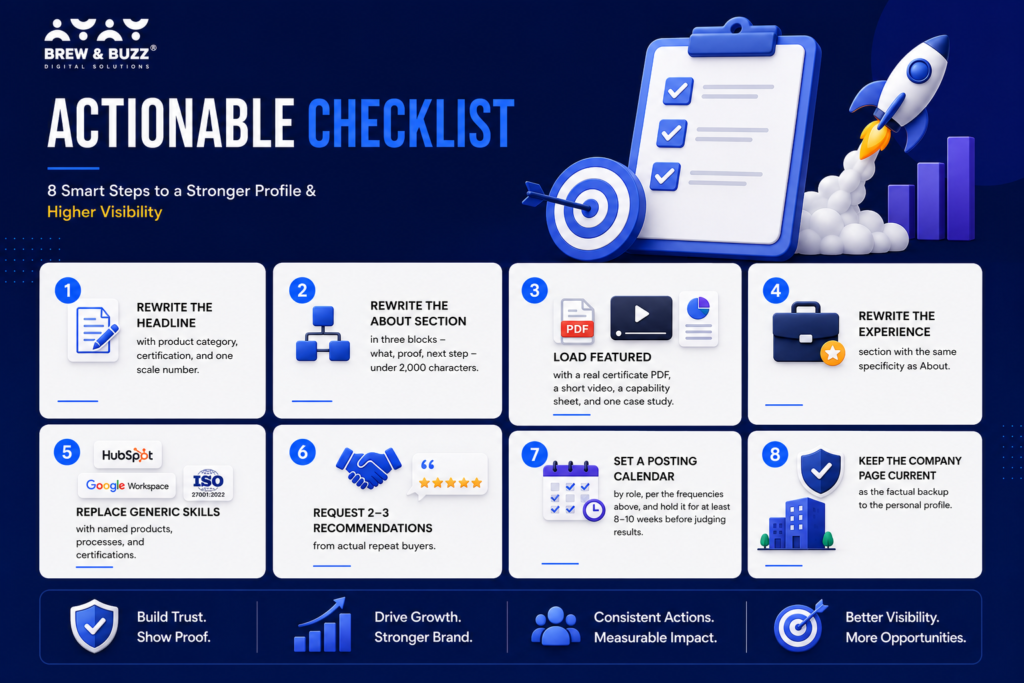
| Headline: Manufacturing GOTS-Certified Organic Cotton Knitwear for EU & GCC Retail Brands | 50,000 pcs/month | Shree Textiles | Headline (220 characters). Lead with product category + certification + one number that signals scale (capacity, MOQ, or years of export experience). Skip the job title as the first thing a buyer reads – it tells them nothing they can act on. |
| About: We manufacture GOTS and OEKO-TEX certified organic cotton knitwear for retail and private-label brands across the EU and GCC. Our facility in Tiruppur runs a 50,000-piece-per-month capacity across knits, with an in-house dyeing and finishing line that keeps lead times under four weeks for repeat orders. Certifications: GOTS, OEKO-TEX Standard 100, BSCI. MOQ starts at 500 pieces per style for new buyers, with lower minimums for repeat clients. Current clients include mid-market fashion labels in Germany and the UAE (references on request). If you’re evaluating organic cotton knitwear suppliers for AW26, message me directly – I personally handle the first call with every new buyer. | About (1,600-2,000 characters). Three blocks: what you make and for whom (one sentence), proof – certifications, capacity, named client categories if not named clients (two to three sentences), and a specific next step ( message me directly, not feel free to reach out ). The first two lines have to stand alone, since LinkedIn truncates the section after roughly three lines on mobile before a see more click. |
| Featured: GOTS certificate (PDF), 60-second factory floor video, one-page capability sheet, a case study on a repeat EU client | Featured: Three to five pinned items, refreshed quarterly: a compliance certificate as a PDF (not a claim in text – the actual document), a one-page capability or line-card sheet, a short factory or process video under 90 seconds, one client case study, and a link to the product catalogue. This is the section sourcing agents check second, right after the headline. |
| Recent activity: A post from two weeks ago on how the factory cut water usage 30% in its dyeing process, with photos Nothing here is invented – it’s the same factory, the same owner, the same certifications the company already holds. The only thing that changed is that the profile now names its entities specifically enough for a buyer, Google, or an AI Overview to match a real search query against it. | Recent activity (posts): This is the section that makes the rest of the profile believable, because it’s timestamped proof the business is actually running. A profile with a strong About section but no activity in a year reads as dormant – buyers notice. |
| Experience: Not Written | Experience: Write the current role’s description the same way as the About section – specific products, specific certifications, specific numbers – not a copy of a job description. This is also indexed text; treat it as a second About section, not a formality. |
| Skills & endorsements: Not Written | Skills & endorsements: List the actual product and process entities – Cotton Knitwear, GOTS Certification, Garment Dyeing, Export Documentation – not generic terms like Textile Industry or Leadership. Specific skills are what LinkedIn’s own search matches against. |
| Recommendations: Not Available | Recommendations: Two to three from actual buyers or long-term clients carry more weight with a sourcing agent than twenty from colleagues. Ask a repeat client directly – most will say yes if asked specifically what to mention (turnaround time, quality consistency, communication). |
Posting format and frequency, by role
Different profiles on the same factory floor should post differently, because they’re being read by different people for different reasons.
Founder / Owner / MD – posting frequency: 2-3x per week. Format mix: 40% industry commentary and thought leadership (a view on a compliance change, a trend in buyer behavior, a lesson from a failed order), 30% factory milestones with photos or short video (new machinery, a capacity expansion, a certification renewal), 20% team and culture (genuinely, not generic – a specific person’s story), 10% direct capability posts. This profile is read by buyers doing due diligence on who runs this company, so credibility content outweighs sales content.
Export Manager / Sales Head – posting frequency: 2-4x per week. Format mix: 40% product and capability updates (new fabric developed, a completed order with photos, a capacity update), 25% trade fair and buyer-facing content (booth photos, “we’ll be at X expo,” post-show follow-ups), 20% RFQ-relevant proof points (turnaround time case studies, compliance updates), 15% engagement with buyer and sourcing-agent content in the same niche. This is the profile buyers expect to actually message, so it should read as active and responsive – reply to every comment within the same day.
Plant Head / Production Head – posting frequency: 1-2x per week. Format mix: mostly process and quality content – a dyeing technique, a quality control checkpoint, a sustainability initiative on the floor. This profile builds the technical-credibility layer that a buyer’s technical or QA team checks before signing off, even when the commercial conversation is happening with the export manager.
Across all three, native LinkedIn video and carousel-style image posts consistently outperform plain text or external links in reach, because LinkedIn’s distribution favors content that keeps people on the platform. A 60-90 second factory-floor video outperforms almost anything else a manufacturer can post.
Personal profile vs. company page – they are not doing the same job
| Function | Personal Profile (Founder/Export Manager) | Company Page |
| Reach | Roughly 5x the organic distribution of a company page, per LinkedIn’s own 2025 data | Lower organic reach; works best paired with paid boosting |
| Trust | Buyers connect with and message a person, not an entity | Functions as the factual record – address, size, certifications |
| Best use | Relationship-building, thought leadership, day-to-day proof of activity | Static credibility – the “About” tab, employee count, official updates |
| Direct outreach | Can send and receive connection requests and DMs | Cannot message buyers directly |
The company page should still be complete and current – it’s where a buyer double-checks the personal profile’s claims – but it should never be the primary content engine. If a manufacturer only has time to build one thing well, it should be the founder’s or export manager’s personal profile, not the company page.
Thought leadership: writing for how buyers actually search for a person
Before a sourcing agent messages a founder, a large share of them will search that founder’s name – on LinkedIn, and increasingly by typing it into an AI assistant alongside the company name to get a quick summary before the call. What comes back matters as much as the pitch does.
Practically, that means treating the personal profile and its posting history as an answer to the implicit question: can I trust this person to run a reliable supply chain? The posts that do this best are not sales posts – they are specific, slightly technical, and occasionally admit a real difficulty and how it was solved (a shipment delay and what changed afterward, a compliance audit and what it required). Generic proud-to-announce posts do almost nothing for this; specific, slightly imperfect stories do a lot, because they read as written by a real operator rather than a marketing team.
Frequently asked questions
Between 1,600 and 2,000 characters, in three short blocks: what you make and for whom, proof (certifications, capacity, clients you can name), and a direct next step. The first two sentences have to work alone, since LinkedIn truncates the section on mobile.
Three to five items: a compliance certificate as an actual PDF, a one-page capability sheet, a short factory video under 90 seconds, one client case study, and a link to the product catalogue. Sourcing agents often check this before they check Experience.
Personal profiles get distributed roughly five times further than company page posts, and only personal profiles can send and receive direct messages. The company page is the factual record; the personal profile is where trust actually gets built.
Two to three times a week on the company page, two to four times a week on the founder’s or export manager’s personal profile, on staggered days so the presence never goes quiet for long.
Both, with different jobs – the owner’s profile carries credibility and thought leadership, the export manager’s profile carries the day-to-day proof and is where buyers expect to actually send a message.
The specific product category, the certification that matters to the target buyer, and the export markets served – specific entities outperform a generic title in both LinkedIn’s search and Google’s.
Yes – profiles and posts are indexed, and specific, entity-rich content (named products, certifications, locations) is far more likely to be surfaced or cited than generic marketing language.
They search by product and certification, open the top few profiles, check Featured and recent activity for proof of real, current production, glance at recommendations, and message directly – frequently without visiting the company website at all.