
How to build overseas buyer trust on LinkedIn before your first email or trade call
The buyer who never emailed back
A procurement manager at a mid-sized trading company in Riyadh is putting together a shortlist for a new packaging supplier out of India. She’s already sent three emails this week to companies she found on a B2B marketplace – none have replied yet, and she’s not going to wait around. So she does what most buyers in her position now do: she searches the product category on LinkedIn instead.
Four company names come up with reasonably active profiles. She opens the export manager’s profile at the one that posted a shipment update nine days ago – actual photos of pallets being loaded, a caption naming the destination port. His About section names the specific product line, the certifications the plant holds, and the GCC clients he already ships to. She sends a connection request with a short note. He replies within the hour, from his phone, between calls.
The three companies she emailed earlier that week may be perfectly capable suppliers. She’ll likely never find out, because she never had a reason to look twice. That’s the quiet shift happening across export sourcing right now – buyers aren’t waiting for a reply to a cold email anymore when they can see, in under two minutes on LinkedIn, whether a supplier looks active, credible, and worth messaging directly.
Why this is now core to export lead generation, not optional
A few data points explain why GCC and Southeast Asian buyers increasingly vet Indian exporters on LinkedIn before a single email exchange:
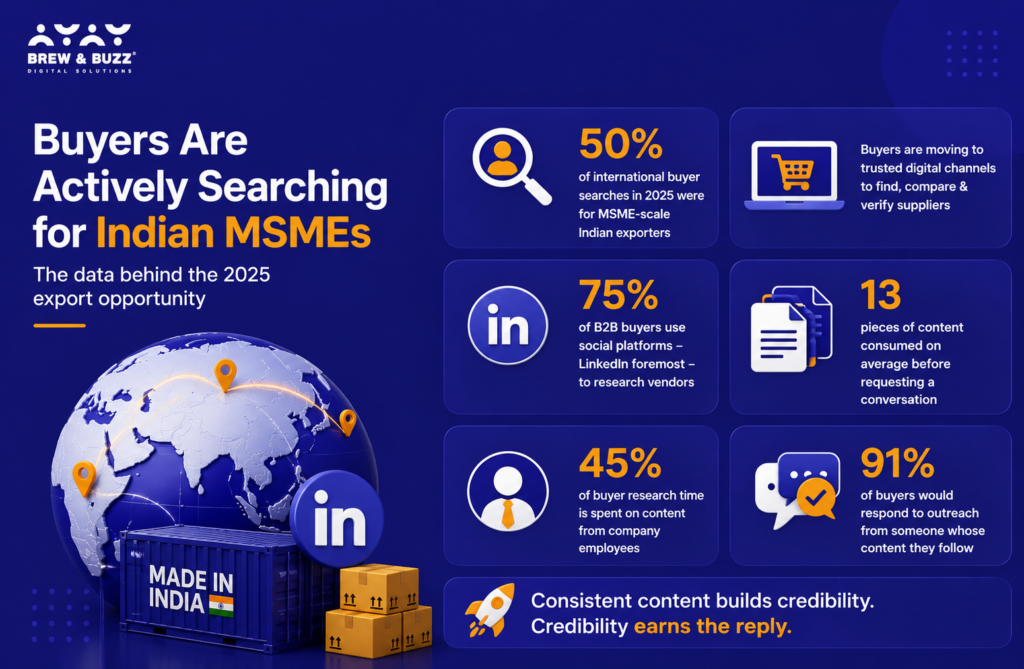
- Recent buyer-search data from one of India’s largest B2B export platforms found that almost half of all international buyer searches in 2025 were specifically directed at MSME-scale Indian exporters – a clear signal that overseas buyers are actively comfortable sourcing from smaller, less-established suppliers, provided they can verify credibility quickly.
- That same research points to a broader shift: global buyers are moving toward trusted digital channels to locate suppliers, compare pricing, and check credentials before making first contact – rather than working purely through agents or trade fairs, as was standard even five years ago.
- 75% of B2B buyers globally now use social platforms – LinkedIn foremost – to research a vendor before ever speaking to a salesperson, and the average buyer works through roughly 13 pieces of content before requesting a conversation.
- Buyers spend roughly 45% of their vendor research time on content from a company’s own employees rather than official marketing material, which is exactly why an export manager’s personal LinkedIn activity often carries more weight with an overseas buyer than the company website.
- 91% of B2B buyers say they’d respond to outreach from someone whose content they already follow – meaning an exporter who has been consistently posting for a few months has often already earned the reply before the first message is even sent.
None of this replaces IEC registration, export documentation, or a solid product. It changes what happens in the gap between a buyer finding a supplier and deciding whether that supplier is worth an email – and increasingly, that gap is closing on LinkedIn, not in an inbox.
Where most exporter profiles lose the buyer
- The headline says a job title only – Founder at Sunrise Exports – with no product category, no regions served, nothing a buyer can search against.
- The About section reads like a company brochure – leading exporter of quality products since 1998 – without naming a single product, certification, or market.
- Featured is empty, or holds a single company logo instead of any verifiable document.
- There’s no recent activity – the last post is a trade fair photo from over a year ago, which reads to a buyer as a business that may no longer be active.
- Nothing on the profile distinguishes the company from a trading intermediary – no proof of actual manufacturing, sourcing capability, or shipment history.
None of these require a new product line or a new certification to fix – they require the credentials the business already has to actually be visible and specific on the one channel a buyer is most likely to check first.
The framework: entity SEO and topical authority for an exporter profile
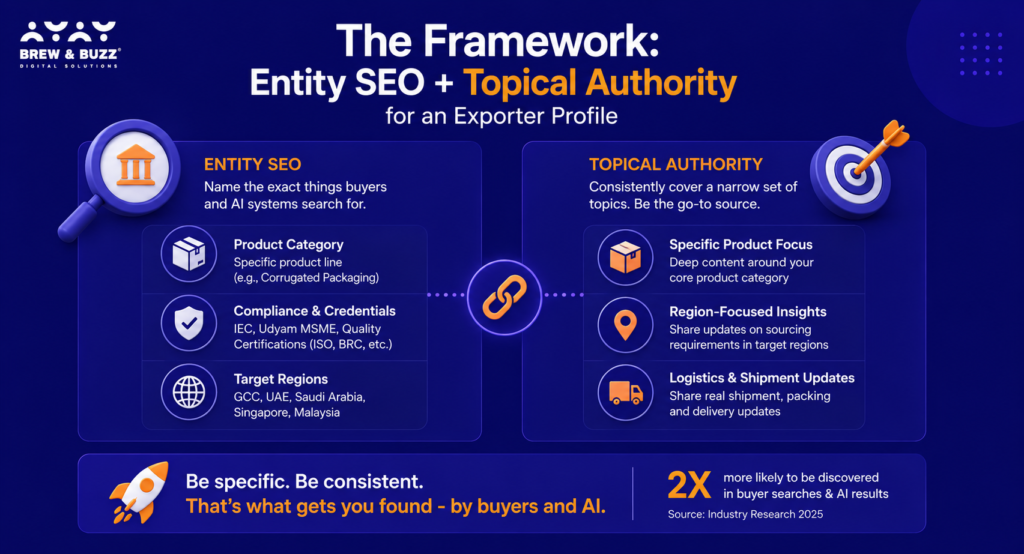
Entity SEO means naming the exact, specific things a buyer or an AI system would search for: the product category by name (not “textiles and goods” but the specific product line), the compliance and registration credentials that build trust (IEC, Udyam MSME registration, relevant quality certifications), and the target regions by name – GCC, specific Southeast Asian countries, rather than “exporting worldwide.” Each of these is a distinct entity a search engine, or increasingly an AI Overview, can match against a buyer’s specific query.
Topical authority means the profile’s posting history consistently orbits the same narrow set of topics – a specific product category, a specific region’s sourcing requirements, shipment and logistics updates – rather than jumping between unrelated company news. An export manager who posts regularly and specifically about, say, packaging exports to GCC retail buyers begins to read – to both buyers and algorithms – as a credible, current source on exactly that niche. That’s what increasingly surfaces when a buyer searches “packaging exporter India GCC” directly, or asks an AI assistant the same question.
Before and after: one profile, rewritten
| Before | After |
| Headline: Export Manager at Sunrise Exports | Headline: Exporting Home Textiles & Packaging Products to GCC & Southeast Asia | IEC & Udyam Registered | Sunrise Exports |
| About: Sunrise Exports is a leading exporter of quality products, committed to customer satisfaction and timely delivery. We have been serving clients for over 20 years. Feel free to connect with us. | About: We export home textile and packaging products from India to buyers across the GCC and Southeast Asia. Sunrise Exports is IEC and Udyam MSME registered, with our home textile line certified to OEKO-TEX Standard 100. We currently ship to repeat buyers in the UAE, Saudi Arabia, and Vietnam, with a typical order turnaround of 3-4 weeks depending on volume. MOQ starts at 500 units per SKU for new buyers. If you’re sourcing home textiles or packaging for the GCC or Southeast Asian market, message me directly – I handle every new buyer conversation personally. |
| Featured: (empty) | Featured: IEC and Udyam registration documents, OEKO-TEX certificate, a short shipment video, a testimonial from a repeat UAE buyer, product catalogue link |
| Last activity: A trade fair photo, 14 months ago. A buyer reading this cannot tell what Sunrise Exports actually sells, which markets it currently ships to, or whether it is even still active. There is no entity here for a search engine to match, and nothing an AI Overview could cite in answer to a specific product-and-region query. | Recent activity: A post from last week showing a container being loaded for a Jeddah shipment, with photos. The company hasn’t changed – only how specifically and verifiably it presents what it already has. That’s the difference between a profile a buyer scrolls past and one they message. |
The profile framework, section by section
Posting format and frequency, by role
Founder / Director – posting frequency: 2-3x per week. Format mix: 35% industry and trade commentary (a view on a shipping cost shift, a policy change relevant to export, a lesson from a difficult shipment), 30% company and capacity milestones (new certification, a capacity expansion, a new market entered), 20% team and culture content with specific people, 15% direct capability posts. This profile is checked by buyers assessing the company’s stability and direction, so credibility content should outweigh direct sales content.
Export Manager – posting frequency: 2-4x per week. Format mix: 40% shipment and product updates (a container being loaded, a completed order, a new SKU developed), 25% buyer-facing trade content (trade fair presence, “we’ll be at X expo,” post-show follow-up), 20% proof points relevant to sourcing decisions (turnaround time, compliance updates, a buyer testimonial), 15% engagement with buyer and sourcing-agent content in the target regions. This is the profile buyers expect to message directly, so responsiveness matters as much as posting frequency – reply to comments the same day.
Country Manager (GCC / Southeast Asia focused) – posting frequency: 2-3x per week, timed to overlap with the target region’s working hours rather than only Indian business hours. Format mix: mostly region-specific content – a market entry update, a buyer relationship milestone, region-specific sourcing trends – which builds the local-market credibility that a regional buyer specifically looks for over a generalist export profile.
Across all three roles, native video and photo-carousel posts of real shipments and production consistently outperform text-only updates or stock imagery, because they read as immediate, verifiable proof of an active business – exactly what an overseas buyer is trying to confirm before they reach out.
Personal profile vs. company page – different jobs, not competing ones
| Function | Personal Profile (Founder/Export Manager/Country Manager) | Company Page |
| Reach | Several times the organic distribution of a company page post | Lower organic reach; works best paired with paid boosting for specific regions |
| Trust | A buyer connects with and messages a person, not an entity | Functions as the static, verifiable record – registration details, certifications, product categories |
| Best use | Shipment proof, relationship-building, day-to-day responsiveness | Official facts a buyer cross-checks against what the team is posting |
| Direct outreach | Can send and receive connection requests and DMs | Cannot message buyers directly |
The company page should stay accurate and complete, since buyers will cross-check it – but the personal profiles of the people a buyer will actually deal with are what turn a search result into a message. If resources only allow building one thing well, build the export manager’s or country manager’s personal profile first.
Thought leadership: writing for how buyers actually search for a person
Before an overseas buyer sends a first message, many of them will search the export manager’s or founder’s name directly – on LinkedIn, and increasingly by asking an AI assistant to summarize what it finds about the company and the person before a call. What comes back shapes the first impression as much as any pitch would.
The posts that build this fastest aren’t sales posts – they’re specific, occasionally honest about a real challenge (a shipping delay, a documentation issue, and how it was resolved), rather than only ever posting good news. A founder who posts “here’s what we changed after a shipment got held up at customs” reads as more credible to a cautious overseas buyer than one who only posts flawless milestones, because the first sounds like someone who actually runs export operations day to day.
Actionable checklist
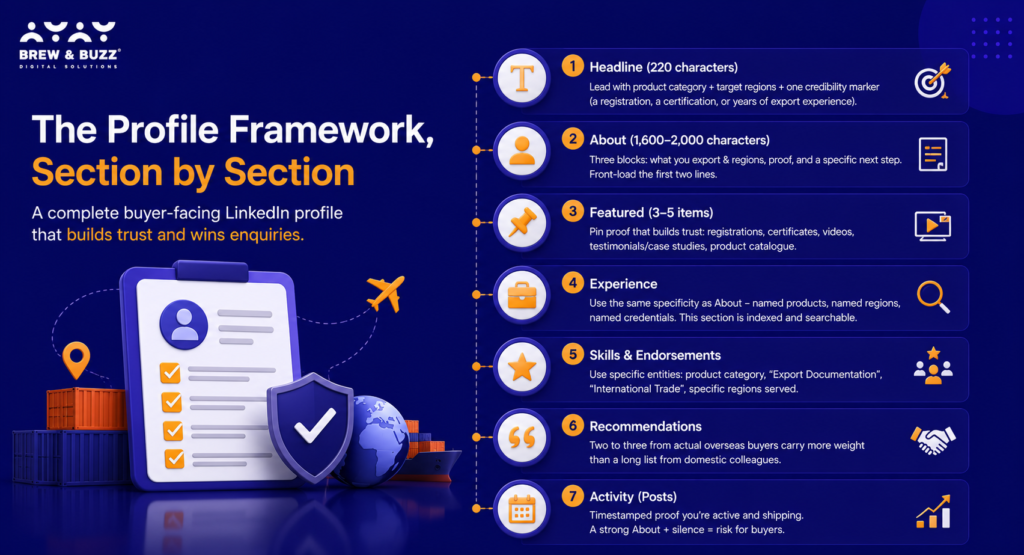
- Rewrite the headline with product category, target regions, and one credibility marker.
- Rewrite the About section in three blocks – what, proof, next step – under 2,000 characters, naming IEC/Udyam registration and any relevant certifications.
- Load Featured with registration documents, a certification, a shipment video, and one buyer testimonial.
- Rewrite Experience with the same specificity as About.
- Replace generic skills with named product categories, regions, and export-specific terms.
- Request two to three recommendations from actual overseas buyers.
- Set a posting calendar by role – Founder, Export Manager, Country Manager – per the frequencies above, timed to overlap with target-region working hours where possible, and hold it for at least 8-10 weeks.
- Keep the company page current as the factual backup to what the team is posting.
Frequently Ask Questions
Indian exporters should treat their LinkedIn profile as a digital business brochure rather than an online resume. Start with a professional profile photo and a banner that reflects your products, manufacturing capabilities, or export markets. Write a clear headline that mentions your industry, export specialization, and target countries instead of just your job title.
Your About section should explain what your company exports, which industries you serve, the countries you ship to, your certifications (such as ISO, FDA, CE, or GMP if applicable), and what makes your business different. Add product catalogs, company brochures, certifications, and case studies to the Featured section to build trust with international buyers. Regularly sharing industry insights, export success stories, and product updates also helps establish credibility and improves profile visibility.
Between 1,600 and 2,000 characters, in three blocks: what you export and to which markets, proof (IEC, Udyam registration, certifications, repeat buyer regions), and a direct next step. The opening two lines matter most, since LinkedIn truncates the section on mobile
Personal profiles reach further and are the only place a buyer can message directly. The company page is the static, verifiable record; the founder’s, export manager’s, or country manager’s personal profile is where trust actually gets built.
Visibility on LinkedIn comes from consistent activity and valuable content. Indian exporters should post regularly about new products, manufacturing processes, export milestones, quality standards, industry trends, and participation in trade fairs or international exhibitions.
Using relevant industry hashtags, engaging with potential buyers’ posts, joining export-related LinkedIn groups, and connecting with procurement managers, importers, distributors, and business owners can significantly increase your reach. Encouraging company leaders to post from their personal LinkedIn profiles also helps, as personal profiles often generate higher engagement than company pages.
The more meaningful interactions and educational content you create, the more likely your profile is to appear in LinkedIn searches and buyer recommendations.
The keywords you use should match the terms international buyers search for. Instead of generic words like Exporter or Business Owner, include industry-specific and product-specific keywords throughout your headline, About section, experience, and featured content.
Examples include:
Textile Exporter India,Pharmaceutical Manufacturer India,Food Processing Exporter,Engineering Components Supplier,Industrial Equipment Manufacturer,OEM Manufacturer,Private Label Manufacturer,B2B Exporter,Global Supplier,Import Export Business,Export Quality Products
ISO Certified Manufacturer.
Also include your target markets, such as USA, Europe, UAE, Saudi Arabia, UK, Australia, or Southeast Asia, if they are relevant to your business. This helps improve discoverability when international buyers search LinkedIn.
The most effective approach is to educate rather than simply promote. Instead of only posting product images, explain how your products solve customer problems, improve efficiency, or meet international quality standards.
Use high-quality product photos, factory videos, manufacturing process clips, customer testimonials, export packaging demonstrations, and behind-the-scenes content. Share success stories, certifications, participation in international exhibitions, and case studies that demonstrate your expertise.
The Featured section is an excellent place to add downloadable product catalogs, brochures, company profiles, and inquiry forms. Combining visual content with informative posts helps potential buyers understand your capabilities and builds confidence before they even contact you.
A consistent mix of educational content, product showcases, and customer success stories positions your business as a reliable export partner rather than just another supplier.
They search by product category and region, open the top few profiles, check Featured and recent activity for proof the business is currently active, look at testimonials from buyers in their own region, and message directly – frequently before ever visiting the company website or sending an RFQ by email.
Yes – profiles and posts are indexed, and specific, entity-rich content (named products, regions, certifications) is far more likely to be surfaced or cited than generic export language like “quality products worldwide.”