
Positioning a contract manufacturer as a capability partner rather than a low-cost production line
Contract manufacturers and OEM-ODM partners are used to being evaluated on cost. It’s the default lens brands apply: get three quotes, compare per-unit pricing, pick the cheapest option that meets spec. But the manufacturers actually winning long-term brand relationships in 2026 aren’t the ones competing hardest on price. They’re the ones who’ve made it obvious, before the first call even happens, that they’re a partner worth building a supply chain around.
LinkedIn is where that first impression is increasingly formed. A sourcing manager or brand founder scoping out potential manufacturing partners will look up your company and your leadership before they ever send an RFQ. If what they find looks like a generic factory listing, you’ve already been filed under vendor. If what they find looks like a capability partner with proof, certifications, and a real point of view, you’ve been filed somewhere much more valuable.
This guide is built for founders, MDs, and owners of contract manufacturing and OEM-ODM businesses who hold the budget for this kind of positioning work — and who are tired of being one line item in a spreadsheet comparison.
Why the Cheapest Quote Is a Losing Position — And How LinkedIn Changes the Game
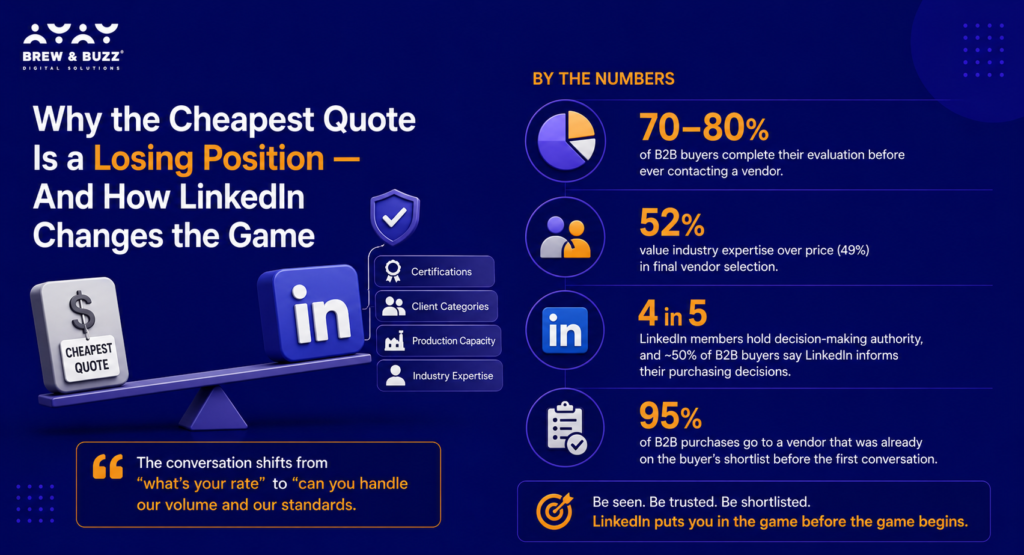
When a brand can only judge you on price, price is all they’ll ever negotiate on. The moment they can see your certifications, your existing client categories, your production capacity, and a founder who clearly understands their industry’s specific pressures — tooling costs, MOQs, lead times, quality consistency — the conversation shifts from what’s your rate to can you handle our volume and our standards.
By the numbers
- B2B buyers now complete roughly 70–80% of their evaluation before ever contacting a vendor — by the time they reach out, your LinkedIn presence has usually already done the persuading.
- Industry expertise (52%) has overtaken price (49%) as the top factor in final vendor selection, per Demand Gen Report’s 2025 research — direct evidence that a capability-and-credibility position outperforms a price position.
- Roughly 4 in 5 LinkedIn members hold some form of business decision-making authority at their organization, and about half of B2B buyers say LinkedIn specifically informs their purchasing decisions.
- 95% of B2B purchases go to a vendor that was already on the buyer’s shortlist before the first conversation — which is exactly the shortlist your LinkedIn presence needs to earn a place on.
That shift doesn’t happen by accident. It happens because the information a brand needs to trust you is sitting in plain sight on your company page and your leadership’s personal profiles, structured specifically to answer the questions a sourcing team is quietly asking
Building the Company Page as Your Proof Layer
Your company page is where operational credibility lives. Most contract manufacturing pages are static — a logo, a one-line description, and nothing else. Rebuilt properly, it becomes a running proof point:
- Certifications front and center: ISO, industry-specific quality certifications, compliance markers — displayed as visual proof, not buried in a PDF nobody downloads.
- Capability statements in buyer language — instead of we manufacture plastic components, specify tolerances, materials handled, tooling capabilities, and typical order volumes, so a brand can self-qualify whether you’re a fit.
- Case studies by client category — supported a consumer electronics brand through a 3x volume scale-up- tell a prospective client far more than a generic capabilities list.
- Active updates — facility expansions, new certifications, process improvements — signal that this is a live, growing operation, not a dormant listing.
The Founder or MD Profile: Where Trust Actually Gets Built
Certifications prove the facility is capable. They don’t prove the relationship will be easy. That’s the job of the founder or MD’s personal LinkedIn profile — and it’s the piece most contract manufacturers leave completely blank.
Headline: Name the Partnership, Not the Job Title
Managing Director at [Company] tells a brand nothing about whether you’re the right fit. A stronger headline names the category and the outcome: something closer to Helping consumer brands scale production through OEM/ODM partnerships | ISO-certified manufacturing | 15+ years. It filters for relevance the way a title never can.
About Section: Speak to the Brand’s Fear, Not Your Company History
Brands looking for a manufacturing partner are usually anxious about one of a few things: quality consistency, scaling reliably, communication breakdowns, or getting locked into a partner who can’t grow with them. An About section that opens by naming those concerns and then shows how your operation addresses them does more work than a paragraph of company history ever will.
Before / After: Headline, About Opener, and Company Page Description
| BEFORE | AFTER |
| Headline: Managing Director at Precision Molders Pvt. Ltd. About (opening line): We have been in the manufacturing business for over 18 years. Our company was founded in 2008 and has grown into one of the leading plastic component manufacturers in the region, serving clients across multiple industries. Company page description: We manufacture plastic components for various industries. Contact us for a quote. | Headline: Helping consumer electronics brands scale from prototype to 2M units/month | ISO 13485-Certified Precision Molding | 18 Years About (opening line): Most brands come to us after a previous manufacturer couldn’t hold tolerance past the first 50,000 units. If quality consistency at scale, communication during a production ramp, or getting locked into a partner who can’t grow with you is what’s on your mind — here’s how we handle it. Company page description: We run precision injection molding (±0.05mm tolerance) for consumer electronics and medical device brands, at volumes from 10,000 to 2M units/month. ISO 9001:2015 and ISO 13485 certified. Currently supporting three consumer electronics brands through pilot-to-full-production scale-ups. |
The before versions aren’t wrong, exactly; they’re just invisible. They read like every other manufacturer’s page. The after versions give a sourcing manager something to self-qualify against: a tolerance, a certification, a volume range, a named worry. That specificity is what gets a company shortlisted instead of scrolled past.
Featured Section: Certifications, Case Studies, and Facility Proof
This is where skepticism gets resolved without a call. Photos or short videos of the facility, certification documents, a one-page capability sheet, and client case studies (anonymized if needed) all belong here. A brand doing due diligence should be able to answer most of their own questions just by scrolling this section.
Authority Platforms Beyond LinkedIn
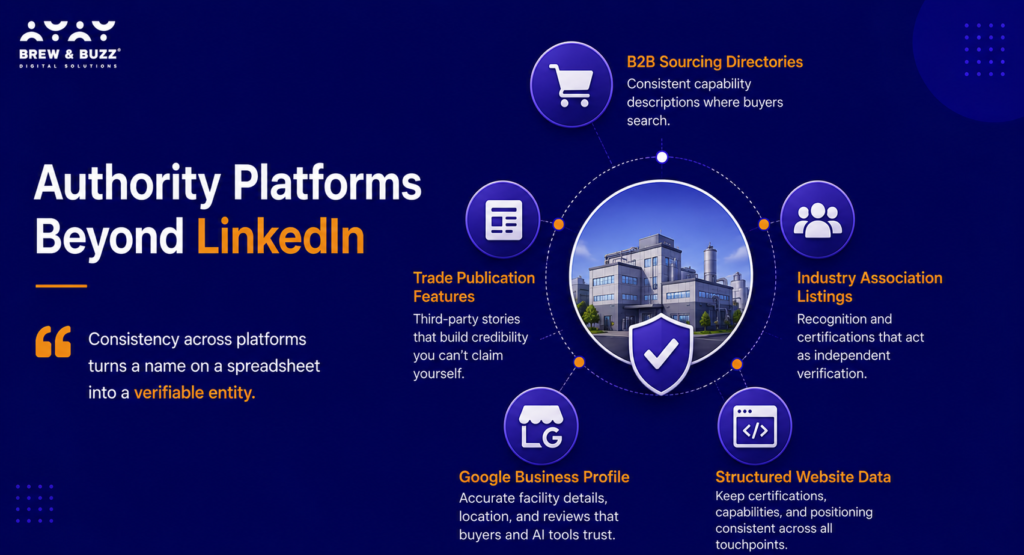
The same trust-building logic extends outward. Buyers and AI search tools alike cross-reference what a manufacturer claims on LinkedIn against what’s visible elsewhere:
- B2B sourcing directories and marketplaces relevant to your category, with consistent capability descriptions.
- Trade publication features or interviews, which carry far more credibility than self-published claims.
- Industry association listings and certification bodies, which act as third-party verification.
- Google Business Profile and structured data on your company website, keeping facility details, certifications, and positioning consistent everywhere.
Consistency across these platforms is what turns a manufacturer from a name on a spreadsheet into a verifiable entity that a brand’s procurement and legal teams feel comfortable signing off on.
Content Distribution That Reaches Actual Sourcing Teams
Repurpose facility and process content. A quality audit, a new certification, a facility expansion — each of these is raw material for a LinkedIn post, a company page update, a line item in your Featured section, and a talking point in outbound outreach. Manufacturers with limited marketing bandwidth get the most value by treating every operational milestone as content, not just an internal memo.
Engage in category-specific conversations. Sourcing managers and brand founders discuss supplier challenges in industry groups and comment sections. A founder who shows up in those conversations with a genuinely useful perspective, not a sales pitch, builds visibility with exactly the audience holding the RFQ budget.
Posting Format and Frequency, by Profile
Founder and MD profiles carry more weight than the company page: personal profiles on LinkedIn average around 2.6% engagement against roughly 1.7% for company pages, and the people behind a company collectively hold far more first-degree connections than the company page has followers. That’s why the founder profile should carry the higher posting cadence: the company page is the proof layer, the founder profile is the trust layer, and trust needs a more consistent presence to build.
| Profile | Frequency | Format mix |
|---|---|---|
| Founder / MD personal profile | 3–4 posts/week | 40% photo or carousel: shop-floor moments, in-process quality checks, before/after of a production run25% document/carousel posts: capability breakdowns, anonymized scale-up case walkthroughs20% short native video (60–90 sec): facility walkthroughs, tooling/MOQ explainers15% text-only POV posts: reactions to tariff shifts, raw-material cost swings, industry standardsPlus 15–20 min/day engaging in comments on posts from target buyers and sourcing consultants |
| Company page | 2–3 posts/week | Certification and milestone announcementsClient case-study carousels (anonymized where needed)Facility update photos/video (expansions, new lines, process changes)Monthly LinkedIn newsletter — newsletter open rates run 40–50%, roughly double a typical email send |
Best Posting Windows for India, GCC, and Southeast Asia Audiences
Across most B2B research, Tuesday through Thursday consistently outperforms Monday and Friday, with late-morning windows drawing the strongest engagement. Because BrewAndBuzz clients typically split attention across three regions with different work weeks, the schedule needs to be regionalized rather than run off a single global default:
| Target market | Best posting window |
|---|---|
| India (domestic B2B buyers) | Tuesday–Thursday, 11 AM–1 PM IST, with a secondary window around 7–9 PM IST for buyers checking LinkedIn after work hours |
| GCC (Saudi Arabia, UAE) | Sunday–Tuesday, late morning local time — the Gulf work week runs Sunday–Thursday, so a Thursday/Friday post lands in or right before the regional weekend and loses most of its reach |
| Southeast Asia | Tuesday–Thursday, 10 AM–noon local time, mirroring the broader midweek B2B pattern seen across markets |
A consistent cadence compounds: pages that post on a regular schedule tend to see meaningfully faster follower growth than those posting sporadically, and posts with a genuine visual — a facility photo, a short video, a real production line — consistently outperform text-only updates on reach.
Entity Trust: Making Your Company Verifiable, Not Just Visible
| Entity Signal | Why It Matters for Manufacturers |
|---|---|
| Consistent company name, certifications, and capability claims across LinkedIn, your website, and directories | Prevents red flags during a brand’s due diligence process |
| Structured data on your company website | Let’s search engines and AI tools surface accurate facility and capability details |
| Backlinks from industry associations and trade press | Provides third-party validation that self-published claims can’t match |
| Active, dated content and updates | Signals an operating, growing facility rather than a static listing |
This is the layer BrewAndBuzz builds directly into client sites through structured data and consistent cross-platform positioning — it’s what lets a manufacturer be found and trusted, not just found.
AI Visibility: Showing Up When Sourcing Teams Ask AI Instead of Google
Procurement and sourcing teams are increasingly asking AI tools questions like “how do brands evaluate contract manufacturers on LinkedIn” or “what makes a good OEM-ODM partner in [category]” instead of running a traditional search. Structuring your content to be picked up as the answer matters as much as ranking on Google now — close to nine in ten B2B buyers now say they use generative AI tools as part of their research, so a manufacturer that isn’t structured for AI retrieval is invisible to a growing share of the buying journey.
- Publish content in direct question-and-answer format that mirrors how buyers actually phrase these queries.
- Use FAQ schema so AI crawlers can read your answers as structured data, not buried prose.
- Keep capability claims, certifications, and company facts identical across every platform — AI models weigh consistency heavily when deciding what to trust.
- Publish original operational insight — a genuine point of view on quality control or scaling production — rather than generic manufacturing content that already exists everywhere.
Ethical Ranking Strategies for 2026
It’s tempting, especially in a competitive sourcing category, to chase shortcuts — bought followers, engagement pods, inflated capability claims. None of it holds up. LinkedIn’s detection of inorganic activity has improved significantly, and any brand doing real due diligence will catch inflated or unverifiable claims fast — which does far more damage to trust than a smaller, honest following ever would.
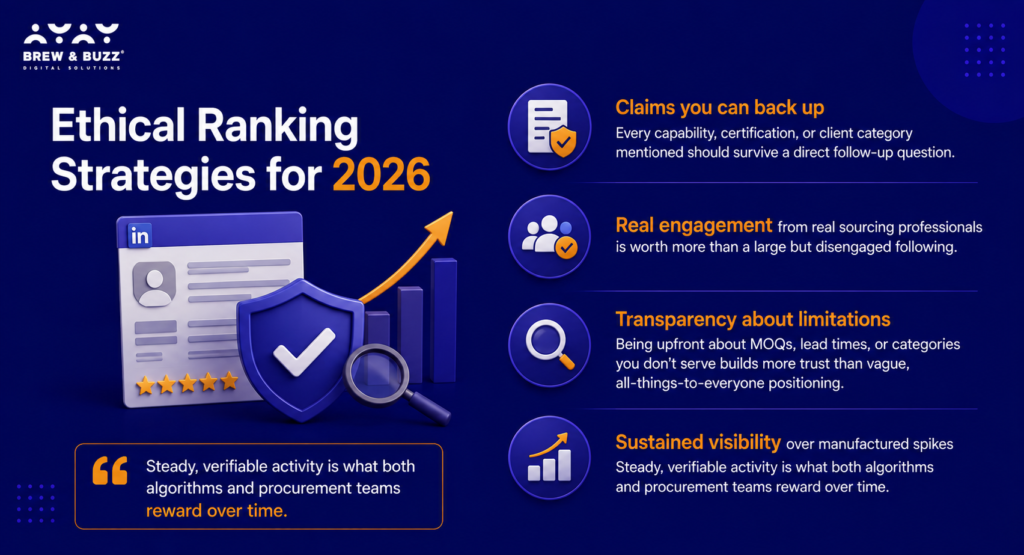
- Claims you can back up — every capability, certification, or client category mentioned should survive a direct follow-up question.
- Real engagement from real sourcing professionals is worth more than a large but disengaged following.
- Transparency about limitations — being upfront about MOQs, lead times, or categories you don’t serve builds more trust than vague, all-things-to-everyone positioning.
- Sustained visibility over manufactured spikes — steady, verifiable activity is what both algorithms and procurement teams reward over time.
Frequently Asked Questions
For contract manufacturing professionals, a LinkedIn profile should do more than simply mention your job title and company. It should quickly communicate what you manufacture, who you serve, and what makes your capabilities different.
Start with a clear headline that includes your expertise, such as Contract Manufacturing | OEM & ODM Solutions | Product Development | Private Label Manufacturing. Your About section should briefly explain your experience, manufacturing capabilities, industries served, and the type of partnerships you are looking for.
It is also important to showcase certifications, manufacturing capabilities, product categories, facilities, quality standards, and relevant projects. Use professional visuals wherever possible, including factory images, product development work, packaging, production processes, or finished products.
Most importantly, keep the profile client-focused. Instead of only saying what you do, explain how you help brands solve manufacturing challenges, improve product quality, reduce development time, or bring products to market more efficiently.
OEM-ODM companies can use LinkedIn to demonstrate expertise, credibility, and manufacturing capability, rather than treating it as just another promotional platform.
Start by creating a strong company page with a clear description of your OEM and ODM capabilities, industries served, product categories, certifications, and geographic reach. Then build a consistent content strategy around the questions potential clients actually ask.
For example, you can share content about:
How your OEM/ODM process works
Product development and formulation
Quality control and testing
Packaging and customization options
Manufacturing capacity and capabilities
Industry trends
Common sourcing and manufacturing mistakes
Client success stories and case studies
Behind-the-scenes manufacturing processes
You can also use employee and founder profiles to build trust. People often want to know who is behind the manufacturing company, not just what the company produces.
The goal is to make a potential client think, “This company understands my requirements and has the capability to execute them.
The best way to showcase contract manufacturing experience is to focus on results, capabilities, and real-world projects, rather than simply listing responsibilities.
Instead of writing:
Responsible for managing OEM manufacturing projects.
Try explaining what you actually achieved:
Managed end-to-end OEM manufacturing projects, working with brands from product development and formulation through production, quality checks, packaging, and final dispatch.
Where possible, add measurable details. For example, mention the number of products developed, markets served, production capacity, years of experience, industries worked with, or improvements achieved.
You can also use your Featured section to showcase product launches, case studies, factory videos, certifications, brochures, client projects, or industry articles.
Think of your LinkedIn profile as a mini business portfolio. A potential client should be able to understand your capabilities and experience without having to contact you first just to figure out what you actually do
Networking on LinkedIn works best when you focus on building relationships before trying to sell.
Start by identifying the people who influence manufacturing and sourcing decisions, such as:
Founders and Co-founders
Procurement Managers
Purchase Managers
Sourcing Managers
Supply Chain Heads
Product Development Managers
R&D Heads
Brand Owners
Category Managers
Operations Directors
Follow these professionals and engage with their content consistently. Leave thoughtful comments that add something useful to the conversation instead of comments like Great post or Nice insights.
When sending a connection request, personalize it. Mention something relevant about their company, industry, product category, or recent post.
After connecting, don’t immediately send a sales pitch. Share useful insights, answer questions, and start genuine conversations. Over time, this positions you as a knowledgeable manufacturing partner rather than someone simply looking for a lead.
You can also share your own expertise through LinkedIn posts, case studies, manufacturing insights, industry observations, and behind-the-scenes content. This helps industry leaders become familiar with your expertise before they ever need your services.
The biggest LinkedIn advantage for an OEM-ODM company is trust. When a potential client can see your expertise, capabilities, experience, and people before starting a conversation, the first sales conversation becomes much easier.
Entity trust compounds rather than converts overnight. Most B2B buyers are already 70–80% through their own research before contacting a vendor, so the goal in the first 60–90 days is to be complete and consistent enough to survive that silent evaluation — inbound interest typically builds from there as the profile and company page accumulate proof, certifications, and case studies.
The primary, detailed version belongs on the company page — that’s the entity record a brand’s procurement team will cross-check. The founder’s profile should reference the same facts (never contradicting figures across the two) but frame them narratively: a Featured PDF, a post about earning the certification, or a story about the client scale-up, rather than a repeated static listing.
Four to six pinned items are the practical range — enough to answer due-diligence questions without overwhelming a first-time visitor. A strong set typically includes: one certification document or badge graphic, a 60–90 second facility walkthrough video, one or two anonymized case study one-pagers, a capability sheet (materials, tolerances, MOQs, lead times), and the best-performing relevant LinkedIn post.
It leads with capability and reliability signals — certifications, capacity, quality systems, and named client categories — rather than a generic “we manufacture X” description, positioning the company as a production partner rather than a low-cost vendor option.