
Reaching dealers, cooperatives, and institutional buyers who now research farm equipment vendors online.
LinkedIn profile optimization for an agricultural machinery manufacturing founder means structuring your headline, About section, Featured documents, and Experience history so cooperatives, institutional buyers, and dealers can verify your testing and certification status, product category, and after-sales service reach — and so the AI tools now used in vendor pre-screening can extract and cite that information accurately.
This industry has run on dealer relationships and trade fair handshakes for decades. That’s not going away. But a growing share of your buyers never attend the trade fair, and they’re checking LinkedIn instead.
A procurement officer at a Farmer Producer Organization evaluating tractors for a cooperative purchase, or a state agriculture department official building a subsidy-linked empanelment list, doesn’t have the local dealer relationship a nearby farmer might. What they have is a shortlist and a search bar. Agricultural machinery manufacturers largely rely on dealer networks and trade fairs to build trust close to home, but institutional and cooperative buyers increasingly vet vendors on LinkedIn first, precisely because they’re buying from outside that local relationship web. If your profile can’t answer their two biggest questions — is this equipment tested and subsidy-eligible, and will service actually reach us after the sale — that shortlist moves on without you.
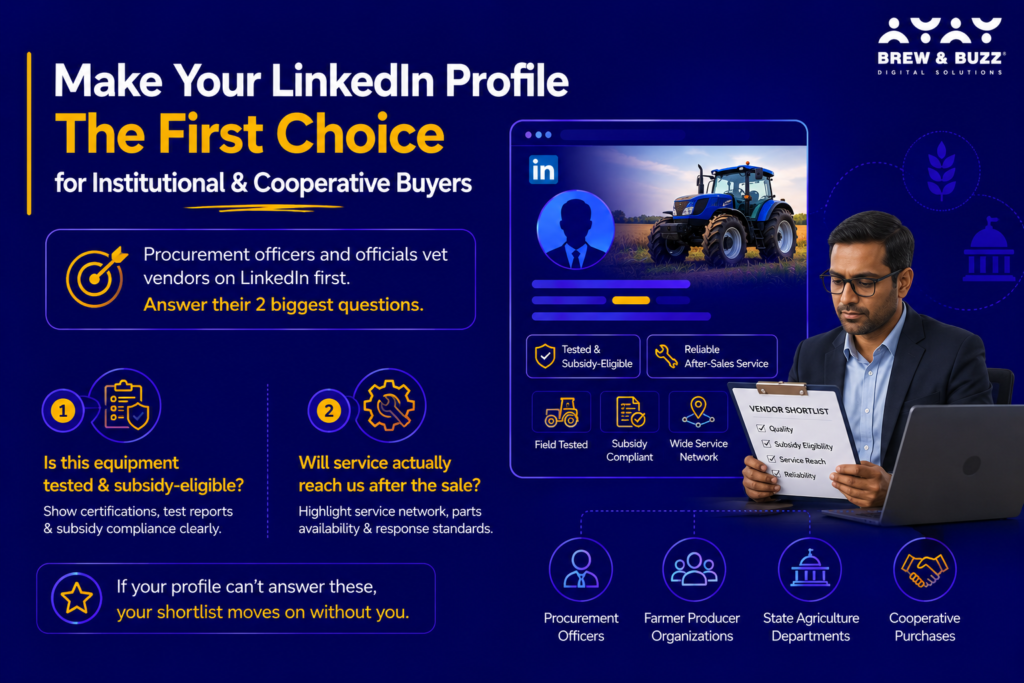
Those two questions matter more here than almost anywhere else in manufacturing, because farm equipment doesn’t get returned to a showroom when something breaks during sowing season. It gets fixed on-site, or it doesn’t get fixed at all that week. A founder’s profile that can speak credibly to service reach not just product specs, is answering the question a cooperative buyer is actually most anxious about.
Why Cooperative and Institutional Buyers Check LinkedIn Before They Check a Dealer.
Everything you already know about technical SEO applies directly to a LinkedIn profile — it gets crawled, it gets indexed, and it increasingly gets summarized by AI systems before a buyer opens it themselves. For an agricultural machinery manufacturer, this matters because the facts a buyer needs — testing status, certification, service coverage — are exactly the kind of structured, verifiable data these systems are built to extract cleanly.
Crawling: Who Reads Your Profile Before Your Buyer Does
Three systems crawl your profile before a human does: LinkedIn’s own search index, Google (public profiles routinely rank for “[Name] [Company]” searches), and AI answer engines pulling structured facts for a conversational answer. If your visibility settings are restricted, none of the three ever see your certifications, however strong they are.
Fix: Set your public profile visibility to fully open, per LinkedIn’s own public profile visibility settings (Settings → Visibility → Edit your public profile), and claim a clean custom URL. Nothing else here matters if this step is skipped.
Indexing: What Your Headline and About Section Need in the First Two Lines
LinkedIn’s algorithm — and anything summarizing your profile — weighs your headline and the first two lines of About far more heavily than anything below the fold. For an agricultural machinery manufacturer, that means product category and testing or certification status belong in those first two lines, not buried after a company founding story.
Fix: Open your About section with what you manufacture, your testing and certification status, and who you supply — dealers, cooperatives, institutional buyers — before any narrative.
Core Web Vitals for a Buyer With No Dealer to Call
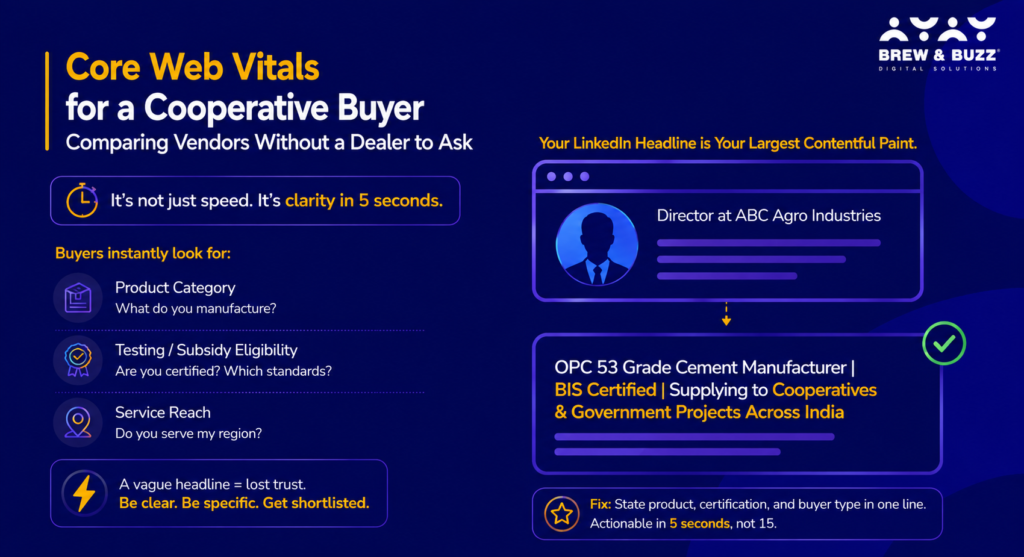
Core Web Vitals measures how fast a page becomes usable. The profile equivalent, for a cooperative or institutional buyer, is how fast they can confirm three things: product category, testing or subsidy eligibility, and service reach in their region. Someone building a shortlist without a local dealer to call for a second opinion doesn’t have time to decode a vague headline like “Director at ABC Agro Industries.” That’s a failed Largest Contentful Paint for a buyer who has nobody else to ask.
Fix: Rewrite your headline to state product category, certification status, and buyer type in one line — something actionable in five seconds, not fifteen.
Featured Section: Pin Your Test Reports and Service Maps, Not Just Photos
A page that only renders its real content after a click fails a crawler the same way a Featured section buried three scrolls down fails a buyer. In agricultural machinery specifically, this is where profiles lose the order before a call even happens: a CFMTTI test report mentioned in text but never pinned, a service network that genuinely covers a buyer’s region but is invisible because it only lives in a dealer’s private list.
Fix: Pin your testing report, certification documents, and a service-network overview directly to Featured, with a thumbnail and one line of text that makes sense with zero clicks. Treat this section as the trust substitute a dealer relationship would normally provide.
Structured Data for Humans: Name the Certification, Not the Adjective
Structured data works because it removes ambiguity for a machine. Your Experience section can do the same for a human reader. “Committed to farmer-first quality” tells a buyer nothing. A line like “Manufacture BIS-certified tractors tested at CFMTTI Budni, subsidy-eligible under SMAM, with service centers across 40 districts” (illustrative — use your own real figures) names the actual testing body, the actual scheme, and the actual service footprint — the profile equivalent of a properly typed schema field instead of a vague one. Name the credentials that actually apply: BIS/IS certification (IS 12207 and IS 4931 cover core tractor safety and PTO standards), CMVR type approval, and your listing status at CFMTTI Budni or one of the regional testing institutes (NRFMTTI, SRFMTTI, NERFMTTI). If your equipment is subsidy-eligible under the Sub-Mission on Agricultural Mechanization (SMAM), say so directly and name your state empanelment status — for a cooperative or institutional buyer, that single fact often determines whether your equipment is even a legal option for their purchase.
Fix: Audit your Experience bullets for any compliance claim written as an adjective (“certified,” “tested”) instead of a named testing body, scheme, and date.
AI Search Readiness: Writing Facts an AI Tool Can Actually Cite
Buyer research increasingly starts inside an AI tool rather than a search bar — a B2B buyer behaviour dataset puts the share of B2B buyers using LLMs like ChatGPT or Claude during vendor research at 94%. These tools, along with Perplexity and Google’s AI Overviews, favor plain, factual, specific language over marketing copy, because it’s easier to extract and safer to cite. “Committed to farmer-first quality” gives an AI tool nothing to quote. “CFMTTI-tested, SMAM-subsidy-eligible tractor manufacturer with service centers across 40 districts in Maharashtra and Karnataka” gives it an accurate, citable answer.
Fix: Write your certification and service-reach claims as complete, self-contained facts — testing body, scheme eligibility, and geographic coverage in one sentence — rather than scattered across vague lines.
Before and After: Rewriting a Founder’s About Section for Institutional Buyers
The name, company, and figures below are an illustrative composite, not a real client — built to show the rewrite pattern, not to be copied verbatim.
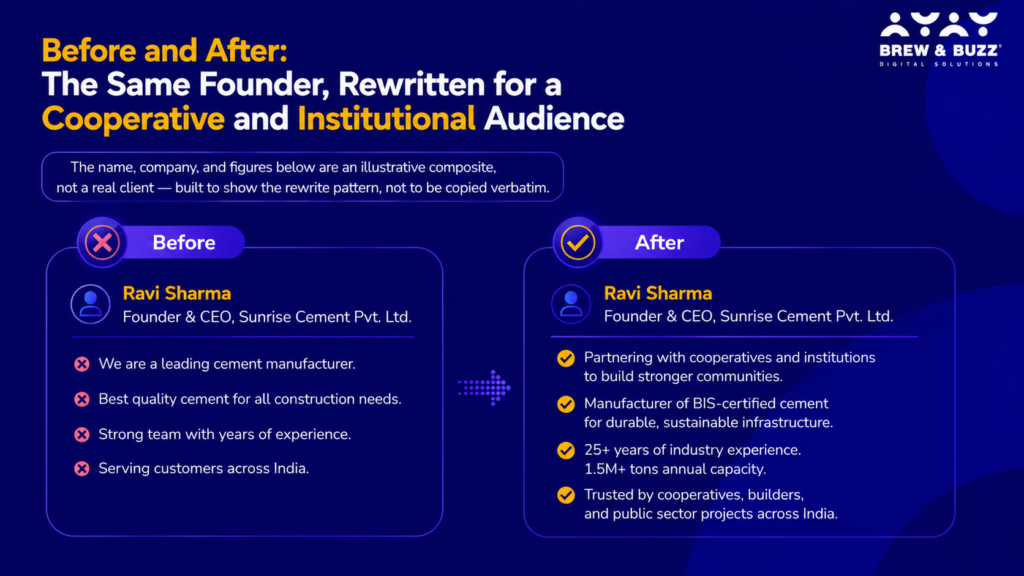
| Before (typical founder About section): | After (rewritten for a cooperative and institutional buyer audience): |
| “Third-generation family business serving Indian farmers with pride. We believe in quality, trust, and empowering the farming community. Our machines are built to last. Reach out to explore how we can work together.” No product category, no testing status, no subsidy eligibility, no service reach, no reason for a cooperative buyer without a local dealer to act on this before moving to the next vendor. | “I run a tractor and implement manufacturing unit in Punjab, CFMTTI Budni tested and BIS certified, subsidy-eligible under SMAM in 6 states, with authorized service centers across 40 districts and a 72-hour spare parts commitment. Before a cooperative or institutional order, most buyers want three things confirmed: testing and subsidy status, service reach in their district, and a technical contact who can actually resolve a breakdown during sowing season. All three are below — the CFMTTI report, the SMAM eligibility list, and our service network map, in Featured. If you’re a cooperative, FPO, or state agriculture department evaluating tractors for a bulk or subsidy-linked purchase, message me directly. I review every institutional inquiry myself.” Same founder, same company — but now there’s a verifiable testing status, a real service footprint, a named buyer segment, and a person taking direct accountability, not a nostalgic family-business pitch. |
Write the Profile Like a Leader, Not a Lead Magnet
This is the profile layer of what we build out fully in our B2B10x Framework — the founder or sales head’s own presence is treated as the first trust asset for buyers outside the existing dealer network, not an afterthought to the company page.
Cooperatives and institutional buyers are evaluating whether the person on the other end of a deal can be relied on for years of parts availability and service response, often in a region where the manufacturer has no dealer relationship to fall back on — not whether they can write a warm family-legacy post. A profile that reads like a sales page — “reach out to explore,” stock imagery of tractors in fields, no operational substance — signals a vendor chasing a single order, not a service partner for the equipment’s working life. A leader’s profile does three things differently:
- It shows operational judgment, not just heritage. A post about how you handled a spare-parts shortage during peak season, or why you expanded service coverage into an underserved district before being asked, builds more trust than another “farmer-first” post.
- It takes visible accountability for after-sales support. “I personally track every service ticket past 48 hours” reads very differently from “Our team is committed to customer satisfaction” — one is a person standing behind the promise, the other is brand copy.
- It talks to the sector, not just prospects. Occasionally posting about a mechanization policy update, a testing milestone, or a hard season for input costs signals someone who’s actually running the business — exactly the credibility a cooperative or institutional buyer is trying to verify before committing to equipment they’ll depend on for a decade.
Posting Format and Frequency for Agri Machinery Founders and Sales Heads
Institutional and cooperative buying in this sector tracks the agricultural calendar and subsidy cycles more than a fixed content schedule, so the cadence below is built around that rhythm:
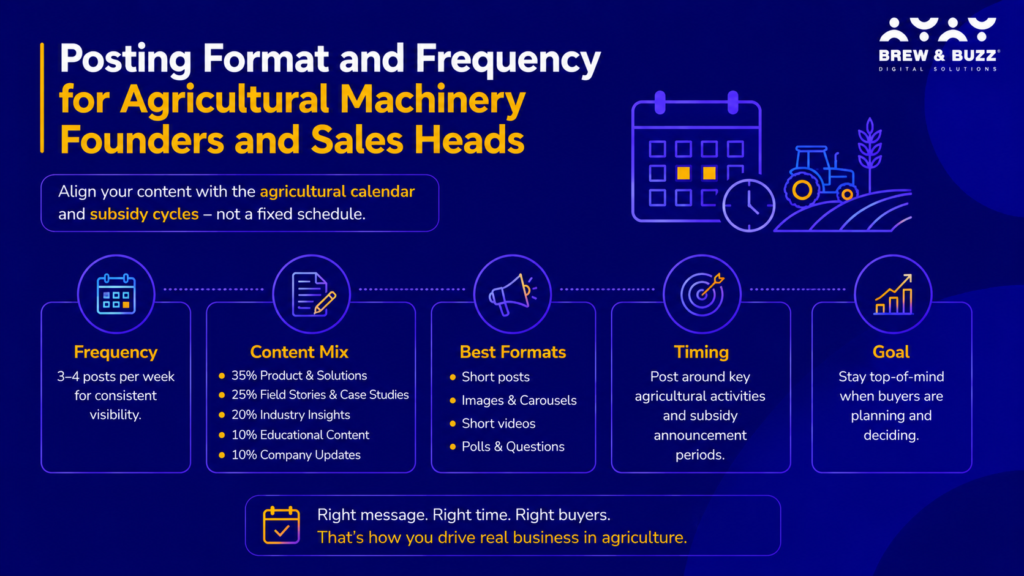
- Frequency: 2-3 posts a week, spaced at least a day apart, with extra attention around subsidy application windows and pre-sowing/pre-harvest seasons when institutional procurement actually happens. Daily posting reads as promotional; going quiet during a subsidy cycle means you’re invisible exactly when buyers are building shortlists.
- Best format mix per week: one plant or field-demo video (30-60 seconds, native upload, captioned — buyers trust what they see running over what they’re told), one written post on an operational decision (150-250 words — a service expansion, a testing milestone, a spare-parts logistics call you made and why), and one proof post — a new district added to your service network, a testing certification, a cooperative order fulfilled on time.
- Best posting windows for Indian agri-B2B audiences: Tuesday-Thursday, 9:30-11:00 AM IST, when institutional procurement officers and cooperative administrators are at their desks before field visits take over the day.
- Comment strategy: Spend 10-15 minutes after each post engaging with comments and commenting on 3-5 posts from target cooperative officials, FPO leaders, or industry peers. If you’re using LinkedIn Sales Navigator to track institutional and cooperative accounts, pull your weekly engagement list from those saved searches rather than commenting at random.
- Track it: LinkedIn’s Social Selling Index (SSI) is a rough but useful gauge — founders posting and engaging this consistently typically sit well above the platform average within a quarter.
- Avoid: Posting only finished-product glamour shots with no service substance, reposting the same certification more than once a quarter, and any quality or reliability claim made without naming the actual testing body or scheme behind it — vague “farmer-first” language reads as a red flag to a buyer who has no dealer to double-check it with, not reassurance.
The Data Behind LinkedIn’s Role in Agri Machinery Procurement
- India’s agricultural machinery market is valued at $19.65B in 2026, up from $18.15B in 2025, and projected to reach $29.27B by 2031 (an 8.28% CAGR) — Mordor Intelligence, 2026. SMAM subsidies covering 40-50% of individual machinery purchases, and up to 80% for custom-hiring centers, are named directly as a primary growth driver — which is exactly the institutional and scheme-linked buying this piece is about.
- 65M+ decision-makers on LinkedIn, 4 in 5 members with purchasing influence — LinkedIn Marketing Solutions, cited in Oktopost’s 2026 B2B social media benchmark report.
- 75% of B2B buyers use social platforms to inform purchase decisions; ~50% point to LinkedIn specifically — Folk research, cited in Martal’s 2026 LinkedIn statistics roundup.
- 94% of B2B buyers use LLMs like ChatGPT or Claude during vendor research; procurement is a decision-maker in ~53% of business buying cycles — B2B buyer behaviour dataset and Forrester’s State of Business Buying 2026.
- Personal LinkedIn profiles get meaningfully higher median engagement than company pages, a gap that’s widened structurally as LinkedIn’s algorithm has shifted toward favoring person-to-person content — consistent across multiple 2026 LinkedIn benchmarking analyses cross-referenced in this 2026 LinkedIn engagement benchmark guide. For a founder whose buyers don’t have a dealer relationship to lean on, that gap is the difference between being findable and not.
Figures above are third-party research current as of mid-2026; treat market projections as forecasts rather than settled numbers, and verify your own testing, certification, and scheme-eligibility status directly with CFMTTI or your state agriculture department before publishing it.
Frequently Asked Questions
1,300-1,900 characters (roughly 200-300 words). Long enough to state your product category, testing and certification status, and service reach — short enough that the first two lines, visible before “see more,” carry that signal on their own.
The proof a cooperative or institutional buyer would otherwise ask a local dealer for: your CFMTTI or regional testing report, BIS/IS certification, a service network overview, a product demo video, and a case study on after-sales support during an actual breakdown. Treat Featured as the trust substitute a dealer relationship would normally provide.
A company page holds your full product range and dealer locator. Your personal profile is where a buyer without an existing dealer relationship decides whether to trust the person behind the equipment — and personal profiles get meaningfully more organic reach than company pages do.
Yes — profiles are public, crawlable pages, and AI answer engines increasingly cite LinkedIn for company and credential queries. A profile stating testing status, product category, and service reach in plain factual language is easier for these systems to extract and quote accurately than one written in general marketing language.
Agricultural machinery manufacturers can strengthen their LinkedIn presence by optimizing their company and leadership profiles, showcasing machinery and applications, sharing technical insights, and publishing customer success stories. Consistent, industry-focused content helps build credibility with dealers, distributors, farmers, and B2B buyers.
Use a clear industry-specific headline, professional branding, and a keyword-rich About section. Highlight manufacturing capabilities, product categories, certifications, markets served, and key differentiators. Leadership profiles should also demonstrate expertise through regular industry insights and meaningful engagement.
Relevant keywords may include agricultural machinery, farm equipment, agricultural equipment manufacturer, farm machinery, tractor implements, harvesting equipment, precision agriculture, irrigation equipment, agricultural technology, OEM agricultural equipment, and agri machinery solutions. Keywords should reflect actual products, applications, target markets, and buyer intent.
Show products through high-quality visuals, short demonstration videos, technical specifications, application-based content, and real-world use cases. Instead of simply listing features, explain how the machinery improves productivity, reduces operating costs, saves time, or solves a specific agricultural challenge.
A strong strategy should combine educational, technical, industry, customer, and leadership content. Share machinery demonstrations, maintenance tips, market trends, case studies, manufacturing processes, customer results, and expert opinions. For B2B growth, prioritize content that helps buyers understand problems, solutions, and business outcomes rather than relying only on promotional posts.