
India’s procurement and purchase-manager community is one of LinkedIn’s most concentrated professional groups — here’s how to be found by it.
LinkedIn profile optimization, for a manufacturing founder, means structuring your headline, About section, Featured items, and Experience history so that procurement buyers — and increasingly the AI tools they use to shortlist vendors — can verify what you make, who you make it for, and why to trust you, in under ten seconds. That’s the whole discipline. The rest of this guide is how to actually do it.
A procurement head at a mid-size auto components buyer in Coimbatore doesn’t discover a new vendor through a website. He discovers them the way most B2B buyers now do: someone shares a post, he clicks the name, and he lands on a LinkedIn profile before he ever lands on a homepage. LinkedIn Marketing Solutions puts decision-makers on the platform at over 65 million people worldwide, with roughly four in five members reporting some influence over what their company buys. That profile — not the corporate site, not the PDF catalog — is the first real estate your business owns in that buyer’s evaluation.
Most manufacturing founders treat their LinkedIn profile like a digital visiting card: name, designation, a company logo, done. Meanwhile, the profile is functioning exactly like a webpage — it gets crawled, it gets indexed, it gets ranked in search, and increasingly, it gets read and summarized by AI tools before a human ever sees it. Everything you already know about technical SEO applies here. This piece walks through it section by section, and rebuilds a founder’s profile the way a procurement manager actually reads one — not as a lead magnet, but as proof that the person on the other end of the deal is worth trusting with a purchase order.
Your Profile Is a Web Page. Treat It Like One.
Skip the vanity metrics for a minute. A LinkedIn profile obeys the same mechanics as any page you’d audit for a client: something has to find it, something has to understand it, and something has to decide it’s worth surfacing. Here’s how each of those maps onto your profile.
Who’s Actually Reading Your Profile
Three separate systems “crawl” your profile: LinkedIn’s own search index, Google’s crawler (LinkedIn profiles are publicly indexable and frequently rank on page one for “[Name] [Company]” searches), and now AI answer engines pulling structured facts for conversational answers. If your profile is set to limited visibility, or your headline is just a job title with no context, you’re invisible to at least two of those three systems before a human ever gets involved.
Fix: Set your public profile visibility to fully open, per LinkedIn’s own public profile visibility settings (Settings → Visibility → Edit your public profile). Claim a clean custom URL (linkedin.com/in/yourname, not the default string of numbers). This alone determines whether Google and AI tools can even see the page.
Indexing: What Actually Gets Remembered
Not everything on your profile carries equal weight. LinkedIn’s algorithm — and by extension, anything summarizing your profile — weighs your headline and the first two lines of your About section far more heavily than your Experience descriptions or your skills list. Recent activity (posts, comments, articles) is treated as a freshness signal, the same way a crawler treats a recently updated page as more relevant than a static one from 2019.
Fix: Stop writing your About section as a company history. Write the first two lines as if they’re the only two lines anyone will ever read — because for a large share of visitors, they are.
Core Web Vitals, for a Human Reader
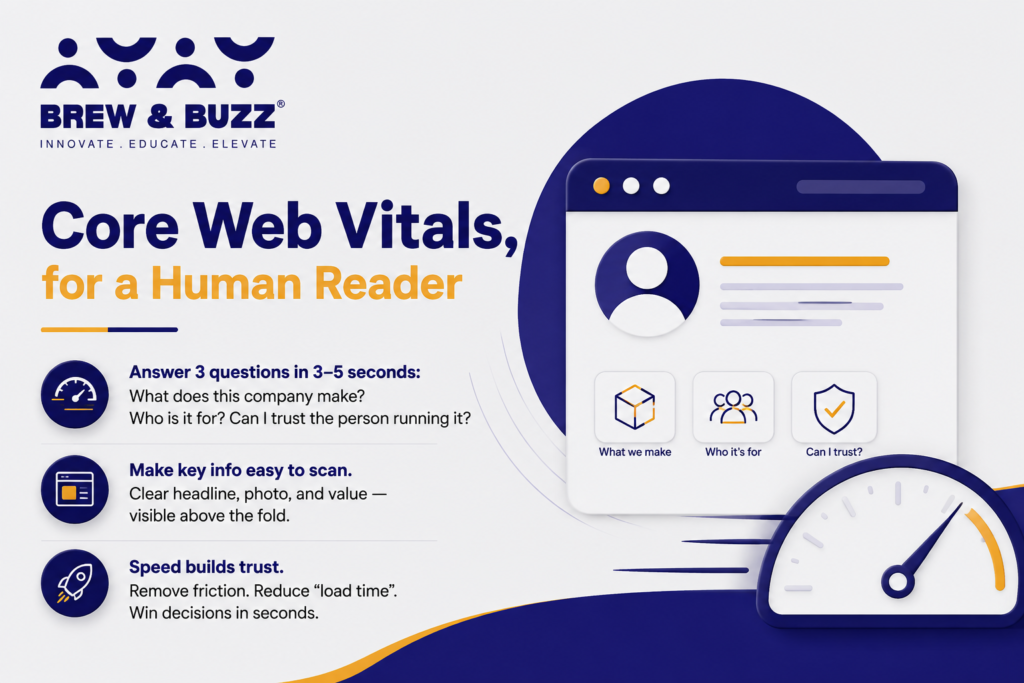
Core Web Vitals measures how fast a page becomes usable. The profile equivalent is how fast a procurement manager can answer three questions: What does this company make? Who is it for? Can I trust the person running it? If those answers aren’t visible in the first 3-5 seconds of scanning your headline and photo, you’ve failed your own version of Largest Contentful Paint. A wall of text in your About section, a headline that just says “Founder & CEO,” or a profile photo that’s a cropped group shot from a wedding — all of that adds “load time” to a decision a buyer is making in seconds, not minutes.
JavaScript SEO, Translated to Featured and Media
JavaScript-heavy pages fail SEO audits when the important content only renders after interaction — a crawler gives up before it sees it. The same failure happens on profiles that hide their strongest proof behind a click: a Featured section buried below three scrolls, a case study PDF with no preview thumbnail, a video with no caption or title. If it needs a click and a wait to render meaning, most visitors — human or algorithmic — never get there.
Fix: Treat your top 3 Featured items as content that has to make sense from the thumbnail and one line of text alone, with zero clicks. That’s your “server-side rendered” version of proof.
Structured Data: Your Experience Section as Schema Markup
Structured data works because it removes ambiguity — it tells a machine exactly what a field means instead of making it guess. Your Experience section can do the same job for a human reader. “Led operations” tells a procurement manager nothing. A line like “Cut order-to-dispatch time from 11 days to 6 across a 40,000 sq ft forging unit, supplying 3 Tier-1 automotive exporters” (illustrative — swap in your own real figures) tells them everything: scale, credibility, and relevance, in one line. Where relevant, name the actual certifications and standards behind the number — ISO 9001, IATF 16949, CE marking, an export recognition — the same way a structured data field names its exact schema type instead of leaving it implied. That’s the profile equivalent of clean, unambiguous markup: every line should answer a specific buyer question, not describe a job.
AI Search Readiness for 2026
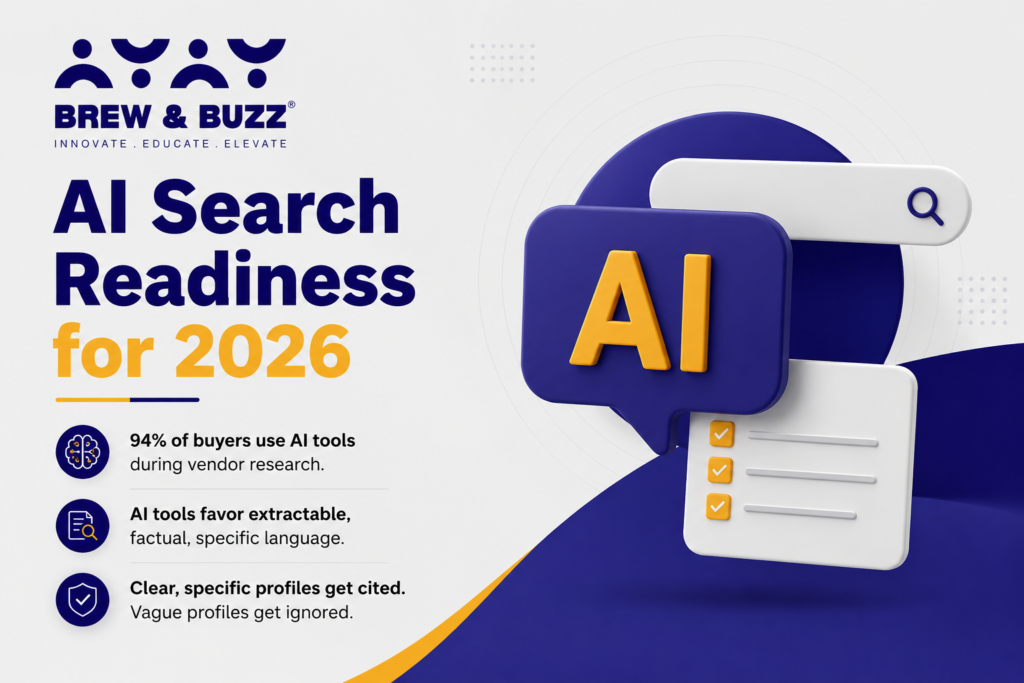
Buyer research now regularly starts inside an AI tool rather than a search bar — The SEO Works’ 2026 B2B buyer behaviour dataset puts the share of buyers using LLMs like ChatGPT or Claude during vendor research at 94%. Tools like ChatGPT, Perplexity, and Google’s AI Overviews favor extractable, factual, specific language over marketing copy, because vague language is harder to summarize accurately and riskier to cite. A profile that reads “passionate about delivering excellence” gives an AI tool nothing to quote. A profile that reads “runs a 25-year-old CNC machining unit in Pune, exporting precision components to Germany and the UAE” gives it a citable, accurate answer.
Before and After: The Same Founder, Rewritten for the Buyer Reading It
The founder, company name, and figures below are an illustrative composite, not a real client — built to show the rewrite pattern, not to be copied verbatim
| Before (typical founder About section): | After (rewritten for a procurement audience): |
| Rajesh Enterprises is a leading manufacturer of precision engineering components with over 20 years of experience. We are committed to quality, innovation, and customer satisfaction. Our state-of-the-art facility is equipped with the latest technology to serve clients across various industries. We believe in building long-term relationships based on trust and reliability. Connect with me to explore business opportunities.” This tells a procurement manager nothing they can act on. No product category, no plant capacity, no client type, no proof, no reason to reply. | I run a 28-year-old precision machining unit in Pune that supplies CNC-turned components to Tier-1 auto and hydraulics manufacturers across India and the GCC — currently at 94% on-time delivery across 40+ active client accounts. Before we ever get a PO, most buyers want three things answered: capacity, compliance, and who’s accountable when a batch fails spec. This profile is where I answer all three — plant videos, IATF certification, and every quality escalation I’ve personally handled are in Featured below. If you’re evaluating vendors for precision-turned or milled components, message me directly. I still review every new client inquiry myself.” Same founder, same company, same 20-plus years — but now there’s a number a buyer can verify, a category they can match to their sourcing need, and a person, not a brand voice, taking accountability. |
Write the Profile Like a Leader, Not Like a Lead Magnet
This is the profile layer of what we build out fully in our B2B10x Framework — the founder’s own presence is treated as the first trust asset in the funnel, not an afterthought to the company page.
This is the part most agencies get backwards. A founder’s profile that reads like a sales page — “DM me for a quote,” a headline stuffed with keywords, constant self-promotion — signals desperation to a procurement head, not authority. Procurement and purchase managers aren’t evaluating a pitch. They’re evaluating whether the person running the factory is someone their company can depend on for the next three years of orders, especially when something inevitably goes wrong.
A leader’s profile does three things a lead-gen profile doesn’t:
- It shows judgment, not just output. Posts about a decision you made and why — turning down an order that didn’t fit your capacity, choosing to invest in a certification before a client asked for it — do more for trust than another product showcase.
- It takes visible accountability. “I personally review every quality escalation” reads very differently from “Our team is committed to quality.” One is a person standing behind the work. The other is a brand line.
- It talks to peers, not just prospects. A profile that only ever talks to buyers looks like a salesperson. A profile that occasionally speaks to other founders, engineers, and industry peers — about supply chain shifts, hiring, or a hard year — reads like someone who actually runs the business, which is exactly the credibility a procurement manager is trying to verify.
Posting Format and Frequency for Founder Profiles Targeting Procurement Buyers
Volume without a format is noise. This is the cadence and content mix that works specifically for founder profiles being read by procurement and purchase managers, not general engagement-bait cadence:
- Frequency: 2-3 posts a week, at least a day apart. Procurement managers aren’t scrolling for entertainment — showing up too often reads as promotional, and too rarely means you’re not top-of-mind when a sourcing decision opens up.
- Best format mix per week: one plant-floor or process video (30-60 seconds, native upload, captioned — buyers trust what they can see over what they’re told), one written post that’s a specific operational insight or decision (150-250 words, no hashtag stuffing), and one lighter proof post — a certification renewal, a client shipment milestone, a team or shop-floor moment.
- Best posting windows for Indian B2B/manufacturing audiences: Tuesday-Thursday, 9:30-11:00 AM IST, when procurement and plant-head audiences are at their desks and before the day’s operational fires start.
- Comment strategy matters as much as posting: Spend 10-15 minutes after each post replying to comments and commenting on 3-5 posts from target buyers or industry peers. Engagement from your own account on relevant posts shows up in more procurement managers’ feeds than another solo post would. If you’re already using LinkedIn Sales Navigator to shortlist buyers, pull your weekly comment targets straight from those saved lists rather than commenting at random.
- Track it: LinkedIn’s Social Selling Index (SSI) is a rough but useful gauge of whether this is working — founders actively posting and engaging this way typically sit well above the average SSI score within a quarter.
- Avoid: Daily posting (dilutes each post’s reach and reads as automated), reposting the same case study more than once a quarter, and any post that’s purely promotional with no operational substance behind it.
The Stats That Make the Case
- 65M+ decision-makers, 4 in 5 members with purchasing influence — LinkedIn Marketing Solutions, cited in Oktopost’s 2026 B2B social media benchmark report.
- 75% of B2B buyers use social platforms to inform purchase decisions; ~50% point to LinkedIn specifically — Folk research, cited in Martal’s 2026 LinkedIn statistics roundup.
- 94% of B2B buyers use LLMs like ChatGPT or Claude during vendor research; procurement is a decision-maker in ~53% of business buying cycles — The SEO Works’ 2026 B2B buyer behaviour dataset and Forrester’s State of Business Buying 2026.
- Native video and first-person posts consistently outperform generic company-page content on reach — pattern confirmed across LinkedIn algorithm analyses covering 2M+ posts, including Metricool’s 2026 LinkedIn study.
Figures above are third-party research current as of mid-2026; treat them as directional benchmarks rather than guarantees, since platform algorithms and buyer behavior shift.
Frequently ASK Questions
1,300-1,900 characters (roughly 200-300 words). Long enough to state what you make, who it’s for, and why you’re credible — short enough that the first two lines, visible before “see more,” do the actual work.
Yes — LinkedIn Marketing Solutions counts more than 65 million decision-makers globally, and Forrester’s State of Business Buying 2026 puts procurement as a decision-maker in roughly half of all B2B buying cycles, engaging earlier than most other buyer roles. Manufacturing and export buyers in India sit inside that same concentration, which is why a founder’s profile carries more weight there than the company website.
Consistent content sharing is one of the most effective ways for manufacturing companies to increase visibility among procurement heads. Procurement professionals regularly use LinkedIn to evaluate suppliers, learn about industry developments, and identify reliable manufacturing partners before beginning the purchasing process. Rather than publishing only promotional posts, share educational content that helps procurement teams make better sourcing decisions. Topics such as manufacturing quality standards, production efficiency, supply chain resilience, material selection, cost optimization, sustainability initiatives, factory automation, export compliance, and industry regulations are highly relevant to procurement audiences.
Visual content—including factory walkthroughs, production videos, behind-the-scenes manufacturing processes, product demonstrations, customer case studies, certification updates, and trade exhibition highlights—often generates stronger engagement than text-only posts. Encourage founders, engineers, plant managers, and sales leaders to publish insights from their personal LinkedIn profiles. Employee advocacy significantly expands content reach and increases trust because buyers often engage with individuals before company pages.
Posting consistently, responding to comments, participating in industry conversations, and sharing practical expertise helps build authority over time. As engagement grows, LinkedIn is more likely to recommend your content to relevant professionals, improving your visibility among procurement heads, sourcing managers, and decision-makers looking for dependable manufacturing suppliers.
Optimizing a LinkedIn profile for procurement professionals requires focusing on trust, relevance, and expertise rather than promotional messaging. Procurement teams evaluate suppliers based on credibility, technical capabilities, and business reliability. Start with a professional company logo, an industry-focused banner image, and a headline that clearly explains what your manufacturing company produces and the industries you serve. Avoid vague statements like “Leading Manufacturer.” Instead, specify your products, capabilities, and target industries.
Complete every section of your profile, including company overview, specialties, website, certifications, awards, export markets, manufacturing facilities, and contact information. Add relevant documents such as brochures, product catalogs, technical specifications, and case studies to the Featured section. Encourage company leaders to optimize their personal LinkedIn profiles because many procurement professionals interact with founders and sales directors before engaging with the company page. Consistent branding across employee profiles strengthens credibility.
Publish content that addresses procurement concerns such as supplier quality, manufacturing processes, compliance standards, production efficiency, sustainability initiatives, and successful customer projects. Respond to comments, participate in manufacturing discussions, and engage with procurement communities to improve visibility.
A fully optimized LinkedIn presence increases the likelihood of appearing in supplier research, procurement searches, and industry recommendations.
Yes — profiles are public, crawlable pages, and AI answer engines increasingly cite LinkedIn for role and company queries. Specific, factual language extracts and quotes more accurately than vague marketing language, which is exactly why the About section rewrite above matters as much for AI visibility as it does for a human reader.
2-3 times a week, spaced out, sustained across 8-10 weeks. Consistency beats any single high-performing post.
Company pages get a fraction of the organic reach personal profiles do, and they can’t build trust the way a person can. Procurement managers vet the individual before the plant — a company page holds your catalog and job posts, but your personal profile is where the actual credibility gets built.