
Building credibility in a fast-moving supply chain where OEM buyers are actively scouting new vendors.
LinkedIn profile optimization, for an EV or EV component manufacturing founder, means structuring your headline, About section, Featured documents, and Experience history so OEM and Tier-1 sourcing teams can verify your component category, certifications, and localisation capability — and so the AI tools now used in vendor pre-screening can extract and cite that information accurately. EV OEMs aren’t waiting for a pitch. Sourcing teams are actively searching for vendors right now, and this guide is about making sure you’re findable and credible when they do.
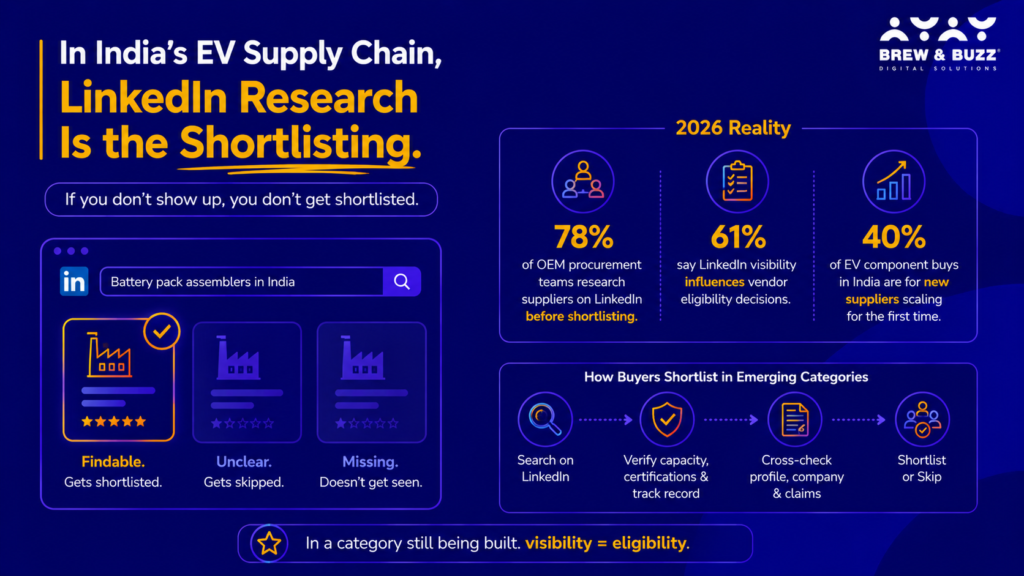
Somewhere inside an OEM’s supply-chain team, someone is running a search this week for battery pack assemblers, traction motor manufacturers, or power electronics suppliers — because an existing vendor can’t scale fast enough. That’s not a hypothetical. It’s the working reality of India’s EV component supply chain in 2026: large parts of it are still being built out. In a mature manufacturing category, buyers already know their supplier list, and LinkedIn research happens after shortlisting. Here, LinkedIn research often is the shortlisting. A profile that doesn’t show up, or doesn’t hold up once it’s found, gets passed over without a conversation.
Your Profile Is a Vendor Qualification Document
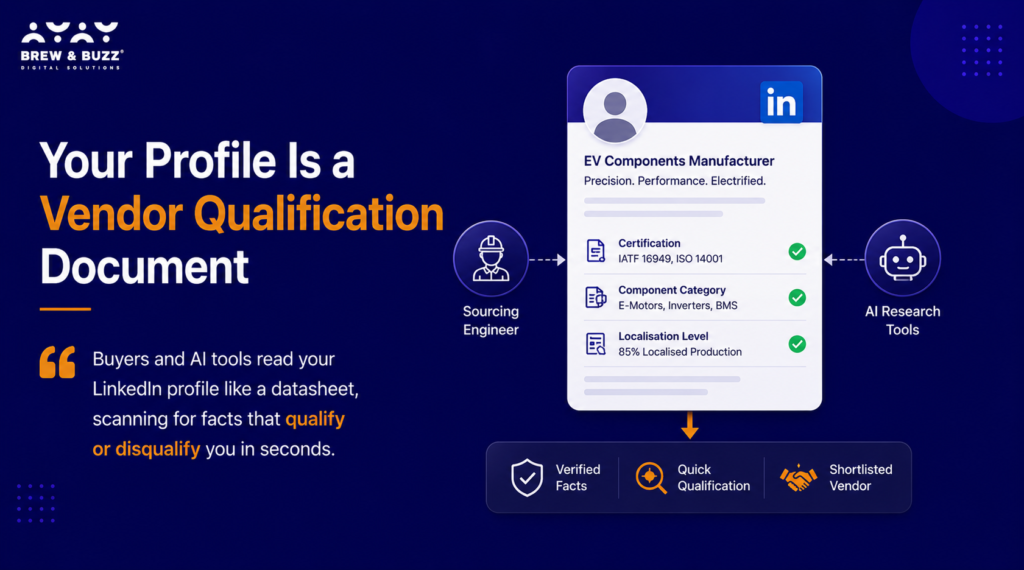
Buyers and AI research tools now read a LinkedIn profile the same way a sourcing engineer reads a technical datasheet: scanning for the facts that let them qualify or disqualify a vendor in seconds. For an EV component business, the facts that matter most — certification, component category, localisation level — are exactly the structured data these systems are built to extract. The sections below walk through what determines whether that extraction happens correctly, using the same underlying logic as technical SEO, translated to what actually shows up on a profile.
Visibility settings: the step that makes everything else possible
Three systems read a profile before a human buyer does: LinkedIn’s own search index, Google — public profiles routinely rank for “[Name] [Company]” searches — and AI answer engines pulling structured facts into a conversational response. If public visibility is restricted, none of the three ever see the certifications behind it, regardless of how strong they are. This is a one-time setting, and it’s the one most founders skip because it doesn’t feel like part of the profile itself.
Fix: Set public profile visibility to fully open Settings → Visibility → Edit your public profile — see LinkedIn’s own guidance below, and claim a clean custom URL. Every other fix in this guide assumes this one is already done.
LinkedIn’s public profile visibility settings
Headline and opening lines: what a fast scan actually retains
LinkedIn’s ranking logic — and any AI system summarizing a profile — weighs the headline and the first two lines of About far more heavily than anything further down. For an EV component manufacturer, component category and certification status belong in those first two lines, ahead of any company origin story. A sourcing engineer working against their own OEM’s production roadmap doesn’t have time to decode a headline like “Director at ABC EV Components.” They move to the next profile.
Fix: Rewrite the headline to state component category, certification, and buyer type in one line — something a stranger can act on in five seconds. Open About with what you manufacture, your certification status, and who you supply (OEM, Tier-1, aftermarket), before any narrative.
Featured section: proof that doesn’t require a follow-up email
This is where EV component profiles most often lose a shortlist before a call happens: an AIS 156 compliance document that’s mentioned in a bullet point but never pinned, an ISO 26262 functional safety report that’s genuinely real but invisible because it only lives in an internal folder no one outside the company has seen. A claim a buyer has to ask about is a claim that slows the vendor evaluation down — and slow evaluations lose to whichever competitor made verification effortless.
Fix: Pin certification documents, a test-bench or product demo video, and a one-page capability statement directly to Featured, each with a thumbnail and one line of text that makes sense with zero clicks. Treat this section as a pre-RFQ technical dossier, not a product gallery.
Naming the standard, not the adjective
“Ensure quality and safety compliance” tells a sourcing engineer nothing verifiable. A line like “Manufacture AIS 156-compliant battery packs for 2 EV OEM clients, IATF 16949 certified, at 38% domestic localisation” (illustrative figures — use your own) names the actual standard, the actual buyer count, and the actual localisation level. Standards worth naming explicitly, where they genuinely apply: AIS 156 for battery safety, ISO 26262 for functional safety in electronics, IATF 16949 for automotive quality management, UN 38.3 for lithium battery transport, and — for charging infrastructure manufacturers specifically — the CCS2 connector standard, alongside the Bharat AC-001 and DC-001 charging standards, with IEC 61851 as the broader EV charging system standard underneath all of them. ARAI certification and PLI or ECMS scheme registration are worth naming directly too — localisation percentage is one of the first numbers an OEM sourcing team checks against its own PLI eligibility.
Fix: Audit every compliance or capability claim in the Experience section. Any claim written as an adjective (“certified,” “compliant”) instead of a named standard and a real figure is a claim a buyer can’t act on.
Writing for the way buyers actually research now
Buyer research increasingly starts inside an AI tool rather than a search bar. puts the share of B2B buyers using LLMs such as ChatGPT or Claude during vendor research at 94%. These tools, along with Perplexity and Google’s AI Overviews, favor plain, specific, factual language over marketing copy, because factual language is easier to extract and safer to cite without risk of misrepresenting the source. “Driving the future of clean mobility” gives an AI tool nothing it can quote with confidence. “AIS 156-compliant battery pack manufacturer supplying two EV OEMs at 38% domestic localisation” gives it an accurate, citable answer.
Fix: Write certification and capability claims as complete, self-contained facts — standard, component category, and localisation level in one sentence — rather than scattered across separate, vaguer lines.
Before and After: The Same Founder, Rewritten for an OEM Sourcing Team
The name, company, and figures below are an illustrative composite, not a real client — built to show the rewrite pattern, not to be copied verbatim.
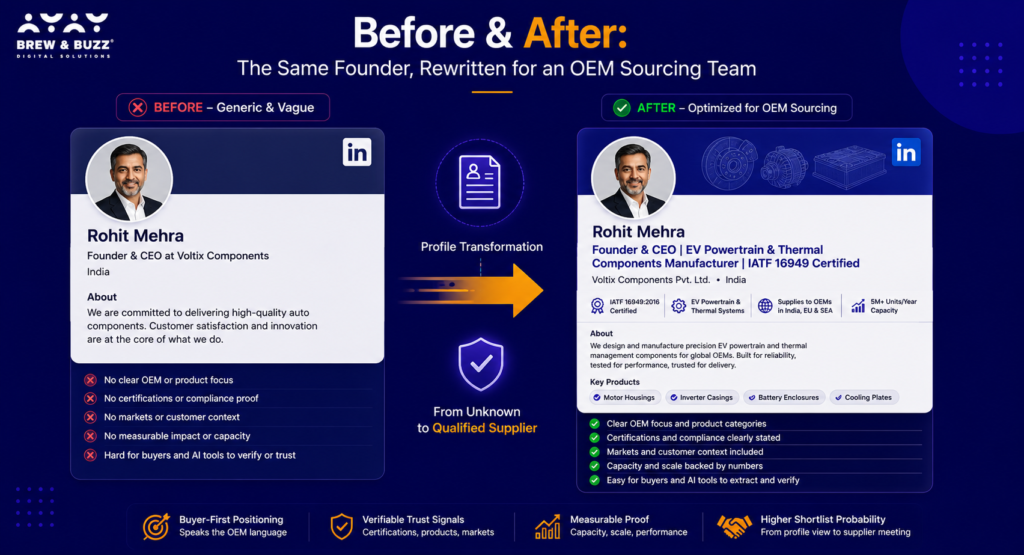
| Before (typical founder About section) | After (rewritten for an OEM and Tier-1 sourcing audience) |
| “Driving the future of clean mobility through innovation and sustainability. Passionate about building a greener tomorrow. Our team is dedicated to excellence in everything we do. Let’s connect and explore the EV revolution together.” No component category, no certification, no localisation figure, no buyer type — nothing for an OEM sourcing engineer to act on before moving to the next profile. | I run an AIS 156-compliant, IATF 16949-certified battery pack manufacturing unit in Pune, currently supplying 2 EV OEMs at 38% domestic localisation and scaling toward the 50% PLI threshold, with in-house BMS integration and UN 38.3-compliant transport handling. Before a design-in decision, most OEM sourcing teams want three things confirmed: safety certification, localisation trajectory, and a technical contact who can answer a BMS or thermal-management question directly. All three are below — AIS 156 and IATF certificates, our current localisation breakdown, and a plant video, in Featured. If you’re scouting a battery pack partner for a new platform or expanding an existing vendor base, message me directly. I review every technical inquiry myself.” Same founder, same plant — but now there’s a verifiable certification, a real localisation figure, a named buyer segment, and a person taking direct technical accountability, in place of a mission statement about clean mobility. |
Write the Profile Like a Leader, Not Like a Lead Magnet
This is the profile layer of what we build out fully in the B2B10x Framework — the founder or BD head’s own presence treated as the first trust asset in an OEM sourcing cycle, not an afterthought to the company page.
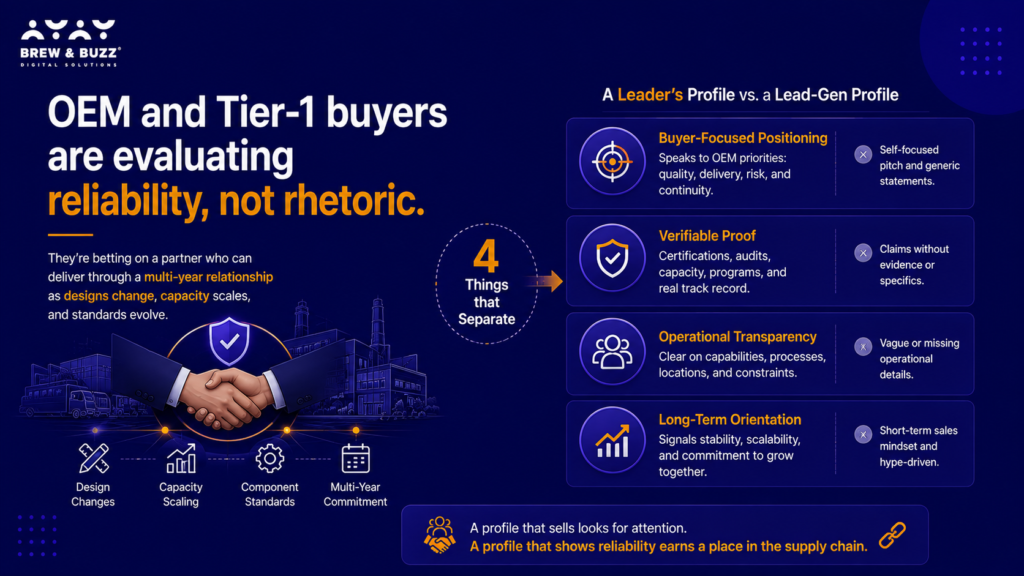
OEM and Tier-1 buyers are evaluating whether the person on the other end of a deal can be relied on through a multi-year vendor relationship in a supply chain that’s still forming — design changes, capacity scaling, a component standard that might shift under them — not whether they can write an inspiring mission statement. A profile that reads like a sales page signals a company chasing attention, not a supply chain partner. Four things separate a leader’s profile from a lead-gen one:
• Engineering judgment over ambition. A post about a thermal-management trade-off, or a decision to turn down an OEM engagement outside certified capacity, builds more trust than another “future of mobility” post — because it shows a real constraint being reasoned through, not just described.
• Visible accountability for safety and reliability. “I personally sign off on every battery safety test” reads differently from “Our team is committed to excellence.” One is a named person standing behind test data; the other is brand copy with no one attached to it.
• Speaking to the industry, not just prospects. A post about a localisation milestone, a standards update, or a hard call on chemistry or supplier choice signals someone actually building the plant — the credibility an OEM sourcing team is trying to verify before a multi-year commitment.
• Adaptability, not just current capability. An OEM isn’t only asking “can you deliver today’s spec” — it’s asking whether a vendor can keep pace as localisation thresholds rise, chemistries shift, and standards get revised under schemes like PM E-DRIVE and ECMS. A profile that already shows one such shift being navigated — a chemistry change, a certification pursued ahead of a mandate — makes that case without needing to state it directly.
Posting Format and Frequency
EV component manufacturing is one category where posting more consistently than most manufacturing sectors is genuinely warranted, because the buyer side is actively scouting rather than occasionally checking in.
• Frequency: 2–3 posts a week, spaced at least a day apart. Daily posting reads as promotional; going quiet for more than a week means being invisible during an active OEM vendor search — a real cost in this category that it isn’t in slower-moving industries.
• Weekly format mix: one plant, test-bench, or product demo video (30–60 seconds, native upload, captioned — buyers trust what they see over what they’re told); one written post on a technical or capability decision (150–250 words — a localisation milestone, a design trade-off, a certification pursued and why); one proof post — a new OEM engagement, a certification earned, a capacity expansion tied to a real number.
• Best posting windows for Indian EV/automotive B2B audiences: Tuesday–Thursday, 9:30–11:00 AM IST, before daily production and testing schedules take over sourcing teams’ and design engineers’ attention.
• Comment strategy: 10–15 minutes after each post engaging with comments, plus commenting on 3–5 posts from target OEM sourcing leads, Tier-1 engineers, or industry peers. If using LinkedIn Sales Navigator to track OEM supply-chain accounts, pull the weekly engagement list from those saved searches rather than commenting at random.
• Track it: LinkedIn’s Social Selling Index (SSI) is a rough but useful directional gauge — founders posting and engaging this consistently typically sit well above the platform average within a quarter.
• Avoid: posting only concept renders or vision-statement content with no technical substance; reposting the same certification more than once a quarter; any safety or compliance claim made without naming the actual standard behind it. Vague sustainability language reads as a red flag to a sourcing engineer who reads test reports for a living, not as reassurance.
The Stats That Make the Case
Figures below are cross-checked against the original research where a public source exists. Two independent market-sizing firms are shown side by side because their absolute figures diverge, as market research estimates often do — the point is the shared trajectory, not a single precise number.
• India’s EV component market: USD 7.80B in 2025, projected to reach USD 28.50B by 2030 (29.58% CAGR) — Marqstats, 2026. A separate estimate from IMARC Group puts the market at USD 4.0B in 2024, growing to USD 17.0B by 2033 (17.29% CAGR). Both independently confirm the same underlying story: a small current base with a sustained high-growth trajectory. Battery packs and BMS alone account for 30–45% of an EV’s total cost, per Marqstats’ component breakdown.
• Localisation remains genuinely low: battery packs are only 10–20% localised, traction motors 30–40%, power electronics 20–30%, and just 13% of EV models sold in India in 2025 met the PLI localisation threshold of 50% domestic value addition — Marqstats, 2026. That gap is precisely why OEMs are scouting new vendors rather than relying on an established supplier list — and precisely why a well-built profile matters right now.
• 65M+ decision-makers on LinkedIn, 4 in 5 members with purchasing influence — LinkedIn Marketing Solutions, cited in Oktopost’s 2026 B2B social media benchmark report.
• 94% of B2B buyers use LLMs like ChatGPT or Claude during vendor research; procurement is a decision-maker in roughly 53% of business buying cycles — and Forrester’s State of Business Buying 2026.
• Personal LinkedIn profiles get a median engagement of roughly 4.7%, against 1–2% for company pages. This figure is widely repeated across 2026 LinkedIn benchmarking write-ups, most tracing back to Sprout Social and Socialinsider analyses rather than a single primary report — treat it as a directional, widely-corroborated figure rather than an exact number, per this 2026 LinkedIn engagement benchmark roundup. Directionally, it’s consistent: a founder’s own profile, not the company page, is where a fast-scouting OEM is most likely to actually see you.
Figures above are third-party research current as of mid-2026. Treat market projections as forecasts rather than settled numbers, since platform algorithms and industry conditions shift — this section should be re-checked against source reports at least twice a year.
Frequently Ask Questions
Use a clear, keyword-rich headline and About section that explains your EV products, technologies, capabilities, and target markets. Showcase manufacturing expertise, certifications, projects, facilities, and customer outcomes. Use professional visuals and regularly publish content around EV technology, innovation, production, and industry trends.
1,300–1,900 characters (roughly 200–300 words) — long enough to state component category, certifications, and localisation or capacity level, short enough that the first two lines, visible before “see more,” carry that signal on their own.
The proof an OEM sourcing engineer would otherwise have to request before a vendor evaluation: AIS 156 or ISO 26262 documentation, IATF 16949 certification, a test-bench or product demo video, a capability statement covering localisation and capacity, and a case study on an existing OEM or Tier-1 relationship. Treat Featured as a pre-RFQ technical dossier, not a product catalog.
A company page holds the full product range and certifications library. A personal profile is where an OEM sourcing team decides whether to trust the person they’d be managing a vendor relationship with in a still-forming supply chain — and personal profiles get meaningfully more organic reach than company pages.
2–3 times a week, without going quiet for more than a week. Unlike slower-moving manufacturing categories, EV OEMs are actively scouting new vendors right now, so staying visible matters more here than in almost any other B2B manufacturing category.
Yes — profiles are public, crawlable pages, and AI answer engines increasingly cite LinkedIn for company and credential queries. A profile stating certification status, component category, and localisation level in plain factual language is easier for these systems to extract and quote accurately than one written in general marketing language.
Because the supply chain genuinely isn’t built out yet — battery packs, traction motors, and power electronics remain significantly under-localised, and only a small share of EV models currently meet PLI localisation thresholds. That gap means OEMs are expanding their vendor base rather than working from an established supplier directory, and LinkedIn is often where that search starts, well before a formal RFQ.
Position the company as a reliable technology and manufacturing partner, not just a component supplier. Showcase products such as battery systems, BMS, motors, chargers, connectors, power electronics, or thermal-management solutions. Share application-focused content, quality standards, production capabilities, case studies, and insights that matter to OEMs and procurement teams.
Use keywords relevant to your specific expertise and buyer audience, such as electric vehicles, EV manufacturing, EV components, battery technology, lithium-ion batteries, battery management systems, BMS, electric powertrain, EV charging, power electronics, thermal management, automotive electronics, EV supply chain, EV technology, automotive manufacturing, and sustainable mobility.
Focus on results and technical expertise, rather than simply listing responsibilities. Highlight EV projects, products developed, manufacturing improvements, cost reductions, quality achievements, certifications, patents, production volumes, and partnerships. Add relevant projects, media, presentations, or case studies to demonstrate practical experience.
Create content around EV trends, technology education, manufacturing insights, product applications, customer challenges, R&D, and company innovations. Use videos and visuals to demonstrate products and processes, involve technical leaders and executives in thought leadership, and actively participate in conversations with OEMs, suppliers, engineers, procurement professionals, and industry decision-makers.