
Published by BrewAndBuzz, a B2B digital marketing agency working with manufacturers, exporters, and B2B service firms across India, the GCC, and Southeast Asia.
Exporters find and win overseas B2B buyers on LinkedIn through three combined moves: an optimized company and personal profile, targeted search-and-outreach to procurement and sourcing decision-makers, and consistent follow-up tracking. In 2026, a fourth factor matters just as much: structuring that same profile and content so AI search tools (Google AI Overviews, ChatGPT, Perplexity, Gemini) can find and cite it when buyers ask them directly for supplier recommendations.
You’re an exporter. You know your product is good — maybe even the best in your category. But knowing that doesn’t matter if the right buyer in Rotterdam, Riyadh, or Ho Chi Minh City never finds out you exist. You’ve tried trade shows, you’ve tried cold emails that vanish into spam folders, and you’ve probably wondered: is there a way to be visible to buyers all the time, not just three days a year at an exhibition?
There is. And it’s sitting in a platform most exporters already have a profile on but rarely use properly — LinkedIn.
This isn’t another “post more content” article. It’s a practical breakdown of LinkedIn lead generation for exporters, written from the questions you’re actually asking — and it covers something most marketing content is still ignoring in 2026: how AI search engines and LLMs are quietly changing how buyers find suppliers like you in the first place.
The Part Most Exporters Are Missing in 2026: AI Search Is Changing How Buyers Find You
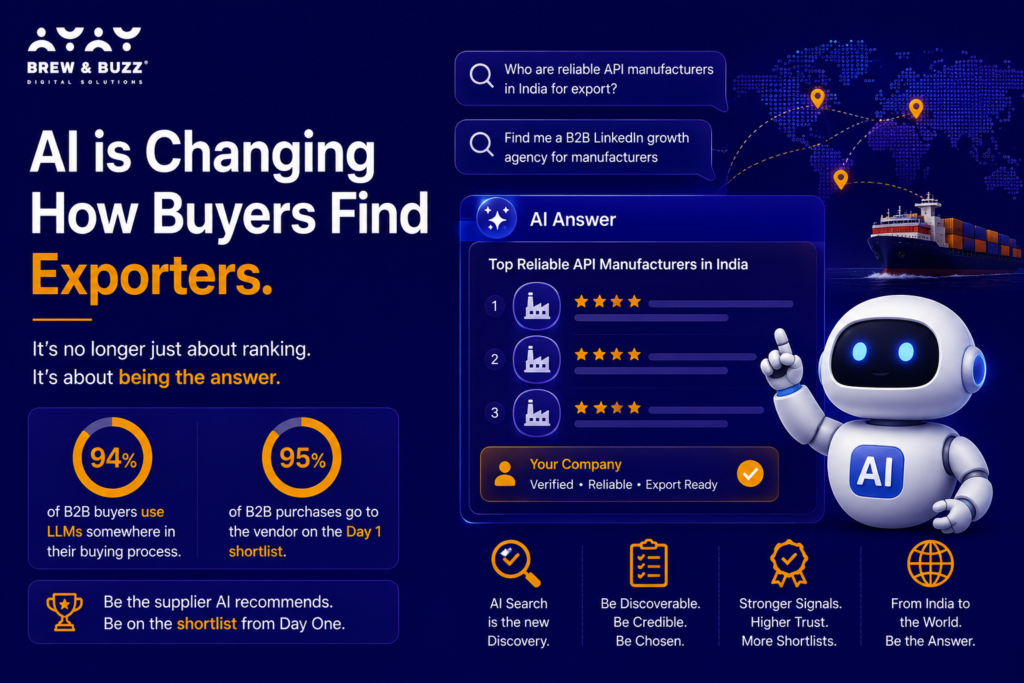
Buyers aren’t only searching on Google or LinkedIn anymore. A growing share are asking AI tools directly — who are reliable API manufacturers in India for export, find me a B2B LinkedIn growth agency for manufacturers, and getting a synthesized answer instead of ten blue links.
This isn’t a fringe behavior. According to the 6sense Buyer Experience Report, 94% of B2B buyers now use large language models somewhere in their buying process, and 95% of B2B purchases go to whichever vendor made the buyer’s shortlist on day one — before most competitors even know the deal is in motion.
That changes what ranking means for an exporter’s content and profile.
What’s Actually Happening
- Generative search engines summarize instead of listing. Google’s AI Overviews and assistants like ChatGPT, Perplexity, and Gemini pull from multiple sources and generate one direct answer. Content that isn’t structured to be extractable — clear headings, direct answers, organized facts — is less likely to be pulled into that summary, even if it would have ranked well the old way.
- LLMs favor clarity over keyword density. Stuffing a page with a keyword ten times doesn’t just fail to help anymore — it can actively work against you. AI systems reward content that answers a specific question plainly, with real expertise behind it.
- Authority signals are read across your whole footprint. AI systems weigh consistency and credibility across a company’s full digital presence — company page, published content, mentions elsewhere — not just one page’s keyword ranking. A strong, consistent LinkedIn presence contributes to this now, not just your website.
- Direct-answer content wins. Content structured as a clear question followed by a clear answer is more likely to be pulled into an AI-generated summary than a long, meandering narrative.
What You Can Practically Do About It
- Structure your content on your site and on LinkedIn around the actual questions your buyers ask, phrased the way they’d phrase them.
- Keep your company information (certifications, markets served, specialties) consistent everywhere it appears, since AI systems cross-reference this.
- Publish content that demonstrates real expertise, not generic filler AI systems and buyers are increasingly good at telling the difference.
- Don’t abandon traditional SEO it still matters, but stop treating it as the only channel. Being visible inside an AI-generated answer is becoming its own kind of ranking.
This is the layer most exporters aren’t thinking about yet, which means the ones who adapt now have a real head start.
The Question You’re Really Asking: “How Do I Find Buyers Who Are Actually Looking?”
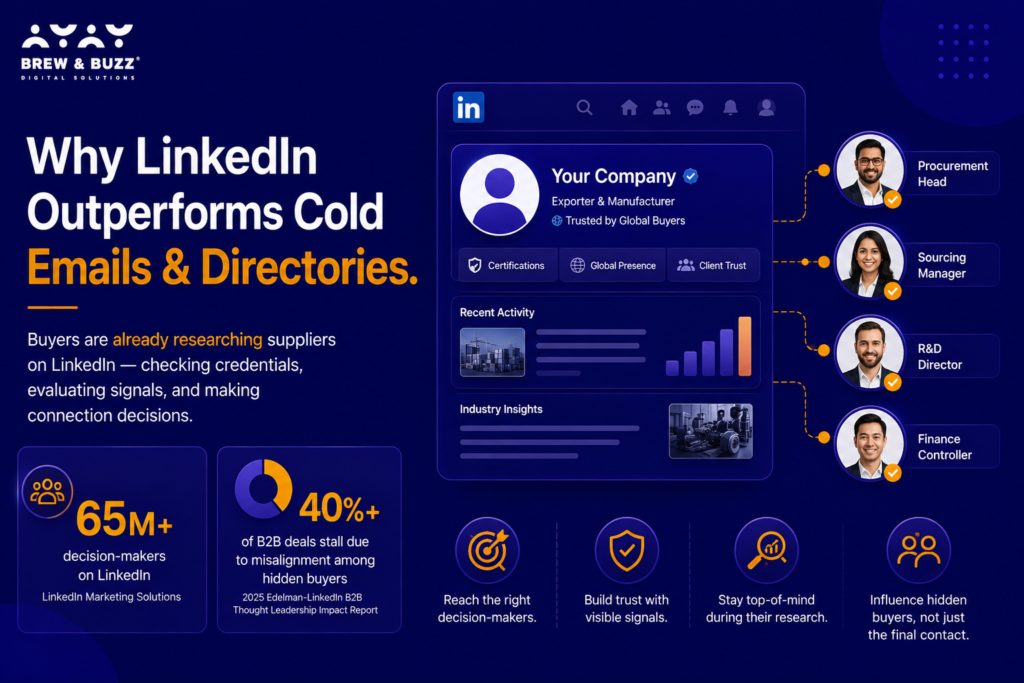
Every exporter has tried some version of mass emailing or directory listings. The response rate is usually miserable because you’re reaching people with zero context about who you are. LinkedIn flips that. It’s a platform where buyers procurement heads, sourcing managers, and founders are already researching suppliers, checking credentials, and making connection decisions based on visible signals: your profile, your company page, your posts, your network.
This is measurable, not just a feeling. LinkedIn Marketing Solutions puts the number of decision-makers among its members at over 65 million, and the 2025 Edelman-LinkedIn B2B Thought Leadership Impact Report — based on nearly 2,000 global professionals — found that more than 40% of B2B deals stall due to misalignment among internal “hidden buyers” who influence a purchase without ever contacting a vendor directly. Your visibility on LinkedIn reaches those hidden buyers too, not just the person who eventually messages you.
If you’re wondering how to find B2B buyers on LinkedIn, the answer starts with search behavior. Buyers use LinkedIn’s search bar the same way they’d use Google typing in what they need (“stainless steel components supplier India,” “contract manufacturer GCC export”) and scanning results. Your job is to be structured so you show up in that search and are credible enough that they click through instead of scrolling past.
That means:
- A company page with your export markets, certifications, and product categories stated clearly, not buried in a generic “About Us” paragraph.
- A personal profile (yours or your sales lead’s) that reads like an industry expert, not a static resume.
- Content that answers the exact questions your buyers are Googling — or asking an AI assistant.
How to Find Overseas Buyers Without Flying Anywhere
This is the part exporters underestimate. How to find overseas buyers used to mean trade missions, agent networks, or embassy trade desks, all slow, all expensive, all limited to whoever you could physically meet. LinkedIn’s search and filtering tools let you narrow down to specific job titles, industries, and regions directly. A procurement director at a manufacturing firm in Germany and a sourcing manager at a retail chain in the UAE are both searchable, both reachable, on the same platform, on the same afternoon.
The catch — and every exporter who’s tried this hits it eventually is that finding the right person is only step one. Reaching out to them one by one, remembering who replied, and following up consistently is where most manual efforts collapse.
International B2B Lead Generation Is a System, Not a Single Tactic
International B2B lead generation doesn’t come from one LinkedIn post going viral. It comes from a repeatable system: visibility (your profile and content are found), outreach (you proactively message the right people), and follow-through (nobody falls through the cracks). Most exporters have maybe one of these three working rarely all three, because doing it manually across GCC, Southeast Asia, and Europe simultaneously is a full-time job on its own.
This is exactly where a dedicated system changes the outcome — more on that shortly.
BrewAndBuzz’s 5-Step Buyer Access Framework
If you want a straightforward answer to how to find buyers on LinkedIn for export business, here’s the sequence we use with exporter clients:
- 1. Define. Set your ideal buyer profile — industry, job title, region, company size. The more specific, the better your search results.
- 2. Optimize. Fix your profile before you outreach. A buyer who gets a message from an incomplete profile ignores it your profile has to hold up to the scrutiny of someone about to place a large order.
- 3. Shortlist. Use LinkedIn’s search filters to build a real list of decision-makers, not a generic industry dump.
- 4. Message with context. Reference something specific — their company’s recent expansion, a shared connection, their industry’s current challenge — not a generic pitch.
- 5. Track. This is the step almost everyone skips, and it’s the one that determines whether you’re building a pipeline or just sending messages into the void.
Why This Gets Harder to Do Manually — And What Actually Solves It
Here’s the honest part: every step above is correct, and almost impossible to sustain by hand once you’re targeting more than a handful of buyers a week. You end up with warm leads sitting in your LinkedIn inbox, no record of who you followed up with, and no visibility into what’s actually working.
One Pune-based industrial components exporter we worked with was in exactly this position: real interest coming in from GCC buyers, but no consistent way to track who’d gone quiet versus who was ready for a follow-up. Once outreach and replies moved into a single dashboard, the bottleneck stopped being “finding buyers” and became “keeping up with the ones already responding” — a much better problem to have.
- A live view of every conversation and its stage — so you know at a glance who’s warm, who’s gone quiet, and who’s ready for a follow-up.
- Mass outreach built for exporters specifically — reaching procurement heads and sourcing managers across your target markets without manually sending each connection request.
- Lead tracking that replaces the spreadsheet — every buyer you’ve contacted, their status, and their history in one dashboard.
- Visibility into what’s actually generating replies — so you can double down on what’s working across GCC, Southeast Asia, or wherever your buyers are concentrated.
| Factor | Manual outreach | Dashboard-managed outreach |
| Tracking method | Memory, inbox scroll, or a spreadsheet | One live dashboard per buyer conversation |
| Follow-up consistency | Depends on who remembers to check back | Stage-based, so nothing is missed |
| Outreach volume | A handful of buyers per week, manually | Built for reaching procurement heads and sourcing managers at scale |
| Visibility into what’s working | Guesswork across markets | Reply and response data by market (GCC, SEA, etc.) |
| Realistic ceiling | Breaks down past a handful of active leads | Scales with the number of markets you target |
In practice, this turns I sent some messages this week into I know exactly where every buyer conversation stands right now — the difference between LinkedIn being a side activity and LinkedIn being a real lead generation channel for your export business.
Bringing It Together
You don’t need to be everywhere. You need to be visible where your buyers are actually looking — which increasingly means a well-optimized LinkedIn presence, content structured for both human readers and AI search systems, and a system behind the scenes making sure no warm lead goes cold. That last part is what turns LinkedIn from a platform you occasionally post on into an actual growth channel for your export business.
See how the dashboard brings all of this together for your business.
Frequently Ask Questions
Start by defining your ideal buyer profile — industry, job title, region, and company size — then use LinkedIn’s search and filtering tools to build a shortlist of decision-makers. Pair this with a fully optimized company page and personal profile, since buyers check credibility before responding to outreach.
LinkedIn lets you search and filter by region, industry, and job title directly, so you can identify procurement heads and sourcing managers in markets like the GCC, Southeast Asia, or Europe without traveling. The key is consistent, targeted outreach rather than a one-time push.
It’s the combination of three things working together: being visible (an optimized profile and content buyers can find), proactive outreach (messaging the right people directly), and follow-through (tracking every conversation so warm leads don’t go cold). Most exporters only have one of these three running consistently.
The buyers are spread across time zones, cultures, and sourcing norms, which makes consistency harder to maintain. Manual outreach that might work for a handful of domestic leads breaks down fast once you’re managing conversations across three or four regions simultaneously — which is why a tracking system matters more for exporters than for local B2B sellers.
Yes. Export buyers evaluate suppliers on credibility signals — certifications, markets served, past shipments, client mentions — before they’ll even reply to a message. Your outreach needs context and relevance, not a generic pitch, because these are considered high-value purchasing decisions, not impulse buys.
Buyers are increasingly asking AI tools direct questions (“find a reliable API manufacturer in India for export”) and getting a synthesized answer instead of a list of links. This means your content and LinkedIn presence need to be structured around clear, direct answers to real buyer questions — not just stuffed with keywords — to have a chance of being pulled into those AI-generated summaries.
Yes — traditional SEO isn’t going away, but it’s no longer the only channel. Ranking well on Google still helps buyers find you through search, while being structured for AI extraction helps you show up inside generative search summaries too. Exporters who optimize for both have an advantage over those focused on just one.
Yes — recent industry research (6sense’s Buyer Experience Report) found that 94% of B2B buyers now use large language models somewhere in their buying process, and the large majority of purchases go to whichever vendor made the buyer’s shortlist earliest. That’s why being structured for AI extraction, not just Google ranking, now affects whether you’re even considered.
Fix your profile and company page first — buyers check credibility before replying to anything. Then pick one region and one buyer title to target, run outreach consistently for a few weeks, and track every reply before expanding to more markets at once.
B2B exporters can attract global buyers by combining account-based targeting with consistent value-driven outreach. Start by using advanced search filters and Boolean operators to locate specific procurement heads, supply chain directors, and distributors in your target geographic markets. Build direct relationships through personalized, non-pitchy connection requests that focus on solving supply chain pain points. Consistently publish content showcasing product quality, manufacturing capacity, and compliance standards. Finally, engage regularly with key posts from potential buyers and industry trade hubs to stay visible.
To build trust with international buyers who cannot physically visit your facility, share content that proves capability and reliability. Key content types include behind-the-scenes factory or production videos, quality assurance process walkthroughs, international compliance and ISO certification announcements, export packaging/logistics updates, and detailed customer case studies highlighting cross-border shipments. Highlighting trade show participation and client testimonials also significantly reduces the perceived risk for foreign buyers.