
If you are a B2B founder or CMO in India, you are likely tracking your organic traffic with a sense of quiet anxiety.
You’ve poured lakhs into traditional Search Engine Optimization (SEO). Your dashboard says your core keywords rank on page one of Google. Yet, your pipeline tells a completely different story. Inquiries are slowing down, sales cycles are stretching, and the high-intent buyers you used to capture easily seem to have vanished.
They haven’t stopped looking for software or services. They’ve just stopped clicking links.
Welcome to 2026. The digital marketing landscape has fractured. Instead of scanning pages of blue links on a traditional Google results page, your buyers are treating AI engines like internal consultants. They are asking ChatGPT, What are the best enterprise payroll software options in India for mid-market companies? Or, ask Perplexity, compare the integration capabilities of Agency A vs. Agency B.
If your brand is missing from those conversational AI responses, you don’t exist to that buyer.
While almost zero digital marketing agencies in India are actively talking about this shift, a massive first-mover traffic and revenue opportunity is wide open. Winning this new playground requires moving beyond old-school SEO. You need GEO: Generative Engine Optimisation.
What is GEO and Why It Matters More Than SEO in 2026
To understand why traditional SEO is losing its grip on B2B lead generation, we have to look at how buyer behavior has changed over the last two years.
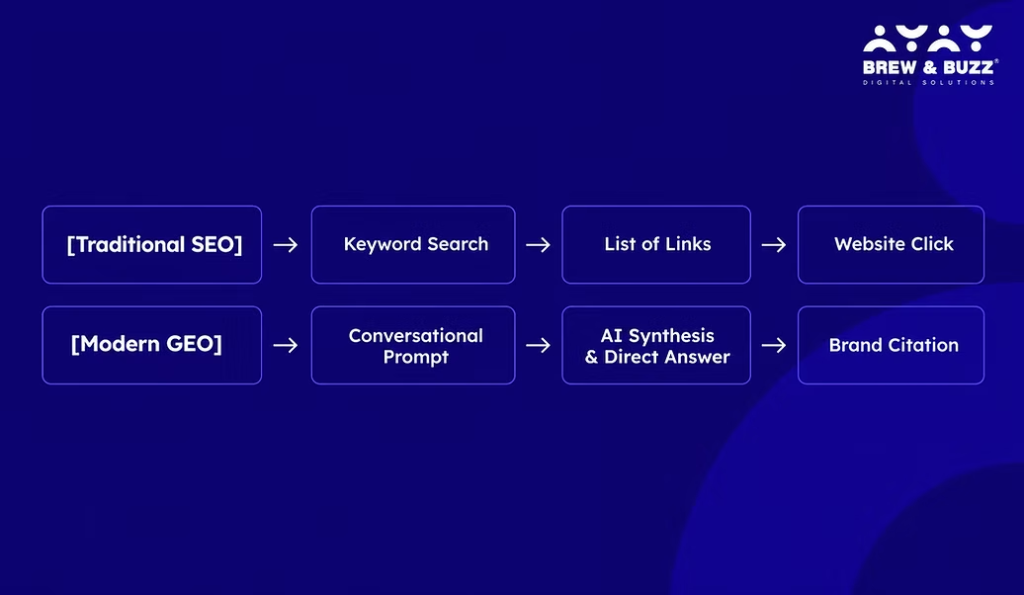
Traditional SEO was built on a simple promise: you optimize a webpage for specific keywords, Google ranks it, a user clicks your link, and they read your content. The core currency of SEO is the click.
GEO (Generative Engine Optimisation) is the process of structuring your company’s online content, data, and brand footprint so that Large Language Models (LLMs) like ChatGPT, Perplexity, and Google Gemini actively retrieve, synthesize, and cite your brand when answering user prompts. The core currency of GEO is the citation.
The Zero-Click Problem in India’s B2B Market
By 2026, more than half of all top-of-funnel informational queries will be resolved directly inside an AI chat interface or via search engines natively running AI answers. This creates a zero-click journey.
When a B2B buyer gets a flawlessly structured, objective comparison of enterprise platforms directly inside their chat window—complete with pros, cons, and pricing—they have zero incentive to click through to five different corporate websites.
If your marketing strategy is still optimized only to get them to click on your blog link, you are missing the conversion window entirely. You must optimize to be the data source that the AI trusts and summarizes.
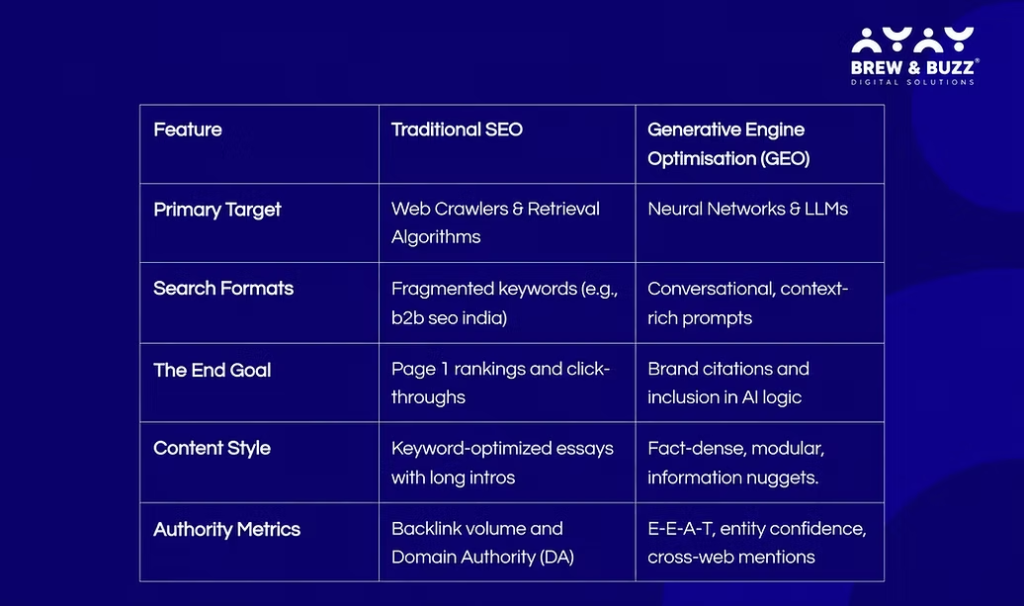
GEO vs SEO: 5 Radical Differences B2B Founders Must Understand
How Google SGE, ChatGPT, and Perplexity Decide What to Show
AI search engines do not look at your website the way Google’s old crawler did. They don’t just count how many times a keyword appears on a page. Instead, they act like research assistants working on a tight deadline.
When a buyer inputs a complex prompt, the AI engine triggers a process called Query Fan-out. It breaks a single prompt into 3 to 5 hyper-specific sub-queries, executes rapid real-time background web searches, gathers the top results, and dumps those results into its context window. It then scans that pile of information, extracts the absolute best facts, and builds a response.
However, different AI search platforms have unique preferences for what they pull into that context window
1. ChatGPT Search
ChatGPT heavily favors deep, definitive, and highly structured information. It values clear semantic definitions and authoritative domain logic.
It frequently relies on platforms where industry data is centralized (like G2, LinkedIn, or structured knowledge bases), alongside clear, crawlable corporate pages.
2. Perplexity AI
Perplexity is an analytical search engine with a massive recency bias. It pulls from a highly diverse set of live sources—often citing 6 to 10 different links in a single short response.
It prioritizes data freshness, objective editorial tones, and real-time statistics. If your industry data hasn’t been updated recently, Perplexity will pass you over for a competitor who updated their site days ago.
3. Google Gemini / AI Overviews
Gemini looks for strong, traditional E-E-A-T (Experience, Expertise, Authoritativeness, and Trustworthiness) markers balanced with structured schema data. Because it is natively tied to Google’s core index, it rewards clean technical site infrastructure and content that matches user search intent perfectly.
To crack these systems, your website’s content can no longer be a wall of generic marketing text. It has to be engineered for machine ingestion.
The 5 Content Rules for Appearing in AI Search Answers
If you want your B2B brand to show up as a trusted recommendation in an LLM output, your content team must abandon traditional corporate copywriting formulas. Here are the 5 content rules that dictate AI search visibility
Rule 1: Lead with the Information Nugget (The Inverted Pyramid)
Traditional B2B blogs use long, winding introductions to build context before answering a question 800 words down the page. AI engines absolutely hate this. They will look elsewhere before reading your fluff.
You must adopt an inverted pyramid style. Start every major heading with a direct, 2-to-3 sentence definitive answer to the core question. Use the exact phrase alignment a buyer would use in a prompt. Once the direct answer is clear, follow up with your deep contextual details and narrative.
Rule 2: Embrace the 40-Word Rule for Definitions
When an AI engine looks to define a term or category (e.g., What is headless architecture in digital commerce?), It searches for concise definitions that it can seamlessly quote. Ensure your core service and category pages feature an explicit, jargon-free definition under 40 words.
Rule 3: Structure Data inside Tables and Bulleted Lists
AI models are probabilistic text predictors; they look for patterns that make information easy to synthesize. A comprehensive study of real-world GEO performance showed that pages containing structured data tables, comparative lists, and clear bullet points experienced a 30% to 40% boost in AI citation frequency.
If you are comparing services, features, or pricing metrics, lay them out in a clean HTML table.
Rule 4: Radical Citations and Outbound Evidence
To prove to an AI engine that your content is trustworthy, you must back up your claims. Cite primary sources, include links to independent research reports, and use real statistical figures.
Paradoxically, linking out to highly authoritative external sources makes AI engines trust your page more, drastically increasing the likelihood that the AI will cite your page as a trustworthy summary node.
Rule 5: Drastically Shorten Paragraph Length
Keep your paragraphs to a maximum of 2 to 3 sentences. Long blocks of text confuse neural processing systems trying to parse individual semantic facts.
Treat every paragraph as a modular, standalone nugget of data that an AI can easily lift and paste into a chat response.
GEO Action Checklist: What to Change on Your B2B Website Today
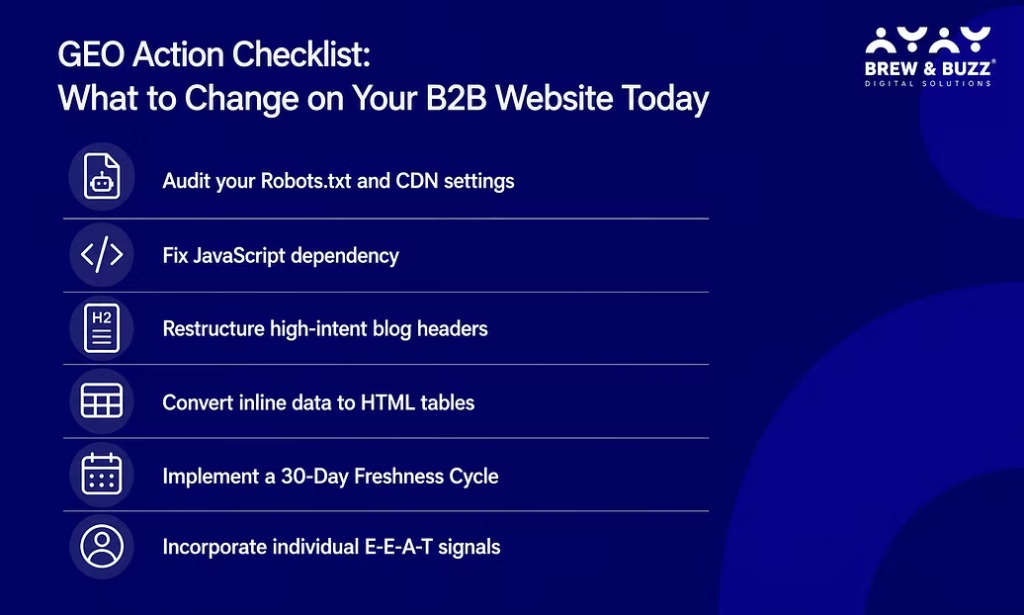
You do not need to rewrite your entire digital footprint overnight, but you must stop treating your B2B website like a static brochure. Use this checklist to begin shifting your asset architecture toward GEO today
- Audit your Robots.txt and CDN settings: Ensure you aren’t accidentally blocking AI search agents (like ChatGPT-User). Check your Cloudflare dashboard settings to make sure your AI crawl traffic isn’t blocked.
- Fix JavaScript dependency: Ensure that your pricing structures, product specifications, and core definitions are rendered server-side and are not buried behind interactive tabs, accordions, or login forms.
- Restructure high-intent blog headers: Take your top 10 traffic-driving B2B blog posts. Change their H2 headings into direct conversational questions, and immediately follow each heading with a crisp, 40-word direct answer.
- Convert inline data to HTML tables: Look at any core comparison text or feature descriptions across your site. Strip out the long-winded paragraphs and rebuild them into clean, scannable data comparison tables.
- Implement a 30-Day Freshness Cycle: AI engines have a massive recency bias. Update your high-value service pages, statistics blogs, and product feature pages at least once every month with updated dates (Last Updated), new case metrics, or fresh examples.
- Incorporate individual E-E-A-T signals: Add clear author bio boxes to all thought leadership content. Link those bios to your executive team’s real LinkedIn profiles and external publications to prove human expertise to the AI’s validation algorithms.
Secure Your First-Mover Advantage Before Your Competitors Do
The transition from traditional SEO to Generative Engine Optimisation is the most significant digital marketing shift of the decade. Right now, in 2026, the vast majority of enterprise B2B companies and legacy marketing agencies in India are completely asleep at the wheel.
They are chasing vanity keyword metrics on Google while their target buyers are quietly making million-dollar software and service procurement decisions inside AI chat interfaces.
Every week you delay optimizing your site for GEO is a week your competitors have to lock in their positions as the trusted authorities inside the context windows of ChatGPT, Perplexity, and Gemini.
Once an AI model firmly establishes your competitor as the baseline answer for a specific industry prompt, closing that visibility gap becomes exponentially harder.
Don’t let your B2B brand become invisible to the modern buyer.
Frequently Asked Questions (FAQ)
What is GEO in digital marketing?
GEO (Generative Engine Optimisation) is the practice of optimizing web content so that AI search engines and large language models (like ChatGPT, Perplexity, and Google Gemini) easily find, synthesize, and cite your brand when answering conversational user queries.
Is GEO replacing traditional B2B SEO?
No, GEO does not replace SEO; it expands it. Traditional SEO focuses on optimizing for keyword rankings and link clicks on search engines like Google. GEO optimizes for brand citations and inclusion inside conversational AI answers, adapting to users who no longer click traditional links.
How do I know if my website is optimized for ChatGPT search?
Your website is optimized for ChatGPT search if its content is structured in short, fact-dense paragraphs, avoids client-side JavaScript rendering blocks, uses explicit JSON-LD schema, and maintains high-authority mentions across third-party industry platforms like LinkedIn, G2, and reputable news sites.
Will AI search engines crawl my site if I block AI web scrapers?
If you completely block user-agents like GPTBot or PerplexityBot in your robots.txt file to prevent AI training, those engines cannot access your live site to pull real-time search citations. For GEO visibility, you must configure your site to allow AI search crawlers while restricting background model-training scrapers if desired.
How can a B2B startup outrank an enterprise competitor in Google AI Overviews?
AI Overviews prioritize information density, direct answers, and structured HTML formatting over raw domain authority. A nimble B2B startup can outpace a legacy enterprise competitor by publishing highly specific data tables, structured FAQs, and direct, 40-word expert definitions that are easy for an LLM to clip.