
Your website is getting traffic. Your Google Analytics shows hundreds of visits. But the enquiry box stays empty. If this sounds familiar, you are not alone, and you are not doing something terribly wrong. You are just doing what almost every B2B website in India does.
Let us start with a question that should bother every B2B founder in India: If 500 people visit your website this month, how many will actually contact you?
If your website is typical of most B2B companies in India, the answer is somewhere between 5 and 15. That means 485 to 495 people left. Silently. Without a word.
This is not a traffic problem. Most B2B founders spend money on ads, do SEO, get LinkedIn traffic — and still get nothing back. The traffic is there. The conversion is missing.
This article explains exactly why that happens, what B2B buyers are actually doing when they visit your website, and the specific fixes that move that 2% number up to 5%, 8%, or higher.
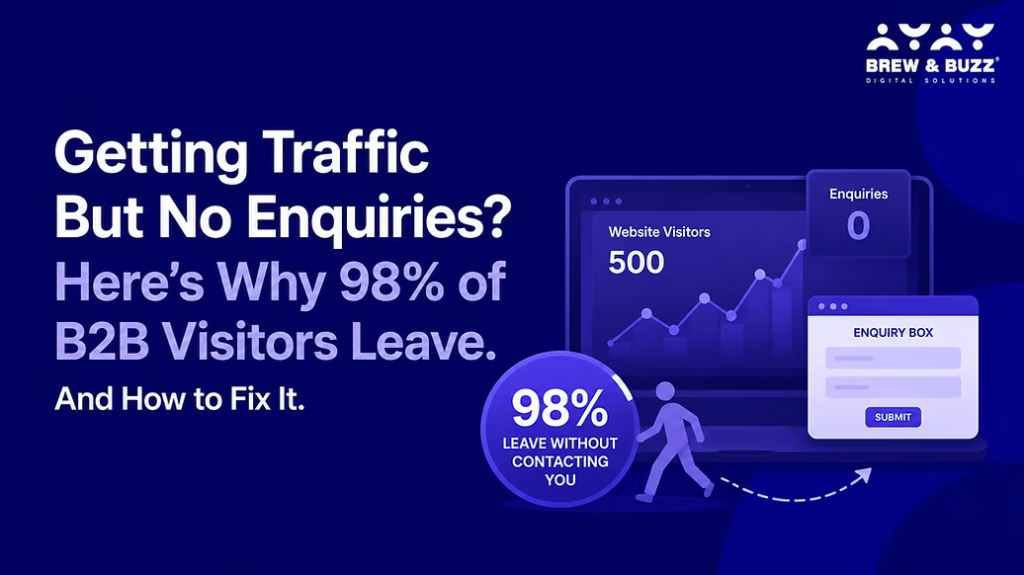
Why Only 2% of B2B Website Visitors Convert (2026 Data)
The 2% conversion rate is not a myth. It is backed by B2B benchmark research published in 2026 by Leadinfo, Lead Forensics, and multiple independent agencies. But here is what most people do not understand about that number: it is an average for companies that are already doing things correctly.
For Indian B2B companies — manufacturers, exporters, professional services firms — without a structured conversion system, the actual conversion rate is often below 1%. That means if 1,000 people visit your site, fewer than 10 enquire.
The reason this happens is structural. Most B2B websites in India were built to look good, not to convert buyers. They were designed like brochures – beautiful, informative, and completely passive. They wait for the visitor to take action. And B2B buyers, unlike B2C shoppers, almost never take action on the first visit.
This is the core insight that changes how you think about your website. Your visitors are not ready to buy. They are researching. And if your website does not have a system to capture, nurture, or follow up on that research interest, they disappear forever.
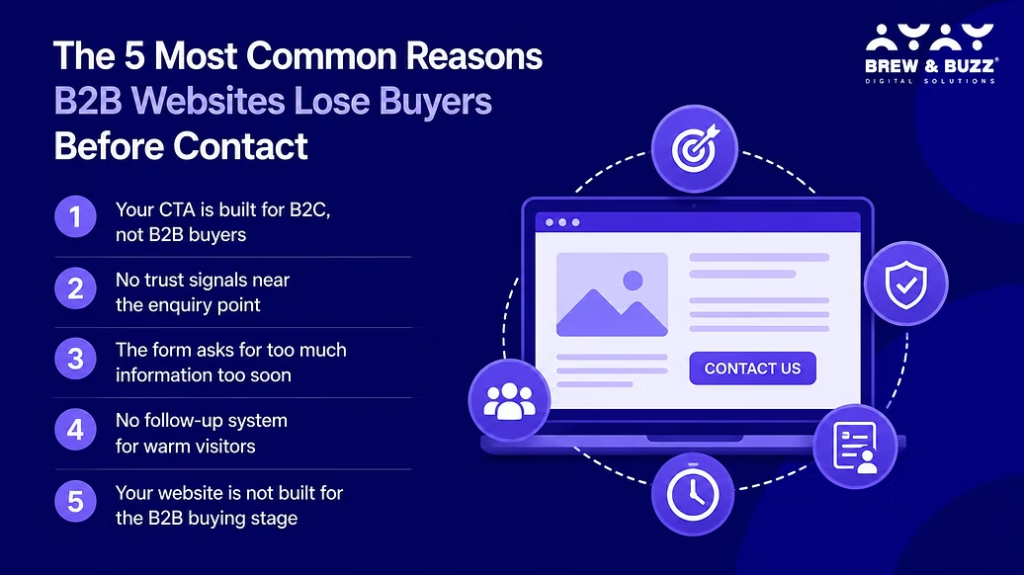
The 5 Most Common Reasons B2B Websites Lose Buyers Before Contact
After working with 20+ B2B clients across manufacturing, services, and exports, we have seen the same problems appear again and again. Here are the five reasons your B2B website is not converting:
1 Your CTA is built for B2C, not B2B buyers
Buttons that say Buy Now, Shop, or even a generic Contact Us do not speak to a B2B procurement manager evaluating vendors. B2B buyers need low-friction next steps — Get a Quote, Request a Capability Deck, Book a 15-Minute Call.” The wrong CTA creates mental friction, and they leave.
2 No trust signals near the enquiry point
Your contact form exists on a blank page. There are no client names, no case study results, no certifications, and no team photos near the form. B2B buyers are committing company money and reputation when they choose a vendor. If your form does not feel safe, they do not fill it.
3 The form asks for too much information too soon
A 12-field enquiry form asking for designation, company size, budget range, and timeline before a single conversation has happened is a conversion killer. In B2B, the first form submission is not a purchase. It is a handshake. Ask for name, company, phone number, and one question. That is all.
4 No follow-up system for warm visitors
Research shows that the probability of converting a B2B lead drops by 80% if follow-up takes longer than 5 minutes. Most Indian B2B companies respond to enquiries within 24–48 hours, if at all. By the time you call back, the buyer has already spoken to two competitors.
5 Your website is not built for the B2B buying stage
A first-time visitor doing research has very different needs from a buyer who is comparing vendors. Most B2B websites have one version of every page — there is no content for the early researcher, nothing for the mid-funnel comparator, and no urgency-driving content for the late-stage buyer. This means the website fails all three types.
What B2B Buyers Actually Do Before They Reach Your Contact Page
Understanding the B2B buyer journey is the most important thing a founder can do to fix their website.
Here is the truth: the moment someone fills your contact form, they have already made 80% of their decision. Everything before that contact moment happens invisibly on Google, on LinkedIn, on competitor websites, and in conversations you will never see.
The B2B Buyer Journey — Before They Ever Contact You
Stage 1 – Problem recognised
The buyer realises they have a need. They are not looking for vendors yet. They are searching for information on how to reduce logistics costs or the best finishing process for auto parts. Your website is invisible at this stage if you have no blog content.
Stage 2 – Anonymous research on Google
They search Google. They may land on your website, read one page, and leave. No form. No trace. This is why 98% of your traffic disappears — most visitors are at this stage, and your website has nothing to hold them.
Stage 3 – LinkedIn profile check
Before contacting you, most B2B buyers search your name and company on LinkedIn. They check your profile, your posts, and your recommendations. If your LinkedIn looks inactive or amateur, you lose the deal here, not on the website.
Stage 4 – Comparison and shortlisting
They visit 3–5 competitor websites and compare. They look at case studies, client logos, team pages, and pricing cues. The company that looks most credible and responsive wins the shortlist — often before a single conversation.
Stage 5 – Contact
The buyer fills the form or sends a WhatsApp. They are now 70–80% decided. Your response speed and quality in the next 5–60 minutes determines whether you close this deal or lose it to whoever responds faster.
This journey means your B2B website has to do two different jobs simultaneously: capture early-stage researchers who are not ready to contact you, and convert late-stage buyers who have already shortlisted you. Most websites do neither.
The Website Fixes That Improve B2B Conversion Rate Immediately
These are not theoretical recommendations. These are the specific changes we made to a Pune manufacturing client’s website that moved their conversion rate from 0.6% to 4.1% in 90 days. You can implement most of these without rebuilding your site.
Add a WhatsApp button that is always visible
Indian B2B buyers increasingly prefer WhatsApp over email for initial enquiries. A sticky WhatsApp button reduces friction by 60–70% compared to a form. Use a pre-filled message: Hi, I visited your website and want to enquire about [service].
Put one clear CTA above the fold on every page
Every page — home, services, about — should have a single, primary CTA visible without scrolling. Use action-oriented language specific to the buyer’s next step: Request a Capability Deck, Get a Free SEO Audit, See Our Manufacturing Portfolio.
Add trust signals directly next to your contact form
Place 2–3 client logos, a single result-focused testimonial, and your key credentials immediately above or beside your contact form. Trusted by Total Edge next to a form changes submission rates visibly.
Reduce your form to 3–4 fields maximum
Name, Company, Phone Number, and one open field (“What are you looking for?”). That is it for first contact. Collect everything else during the discovery call. Every extra field you remove increases submission rate by approximately 10–15%.
Install a pre-sales follow-up system with a 5-minute response target
This is the most impactful and most ignored fix. Set up an auto-acknowledgement via WhatsApp the moment a form is submitted. Then have a human — from your team or your agency’s pre-sales team — call within 5 minutes during business hours. This single change can triple your conversion rate on existing traffic.
Add a case study or result-focused content section to your home page
B2B buyers respond to proof, not promises. A single well-written case study (How we helped a Pune electronics manufacturer generate ₹18L in new orders in 4 months) is worth more than ten testimonials. Write it in a headline + 3 bullet points + result format.
Final Thought
If you take nothing else from this article, take this prioritised list. Do these in order. Do not skip to the complicated stuff before the basics are right.
First, add a WhatsApp button and reduce your form to 4 fields. This costs nothing and can be done today. Second – set up a 5-minute response target for every new enquiry.
This requires a person, a process, or an agency’s pre-sales team. Third – add trust signals next to every contact point. Fourth – write one case study and publish it on your home page. Fifth -start publishing early-stage content (blog posts) that answers the questions your buyers ask before they even know your name.
Done in this order, these five changes will move your B2B website conversion rate from 0.5–1% to somewhere between 3–5% — without spending a rupee more on ads.
Frequently Ask Questions
What is a good B2B website conversion rate in India?
The global average B2B website conversion rate is 2%, based on 2026 benchmark data from Leadinfo and Lead Forensics. For Indian B2B companies without a structured conversion system, the realistic baseline is under 1%. With optimised CTAs, trust signals, a simplified enquiry form, and a pre-sales follow-up process, Indian B2B companies can achieve 3–5%.
Why do B2B website visitors not convert into leads?
B2B website visitors do not convert because websites are built for B2C behaviour — they expect visitors to act immediately. B2B buyers complete 70–90% of their research anonymously before making contact. Most B2B websites lack stage-appropriate CTAs, trust signals near the enquiry form, and a follow-up system. When these three elements are missing, visitors leave without contacting you, regardless of how much traffic the website receives.
Why is my B2B website not generating leads even with good traffic?
A B2B website can receive strong traffic and generate almost no leads when the conversion infrastructure is missing. The most common causes are: a contact form that asks for too much information too early, no trust signals near the enquiry point, CTAs that do not match the B2B buyer’s mindset, and no follow-up system to respond quickly to new interest. Traffic and conversion are separate problems. Many Indian B2B companies fix the traffic problem through ads or SEO, but never fix the conversion layer — which means every rupee spent on traffic continues to generate almost no return.
How do I optimise a B2B landing page for more conversions?
To optimise a B2B landing page for conversions, focus on five elements: one single specific CTA above the fold; a headline that speaks to the buyer’s outcome rather than the product’s features; a form with no more than 4 fields; social proof in the form of client logos, case study results, or a testimonial placed immediately before the form; and a mobile-first layout since over 60% of Indian B2B decision-makers research vendors on mobile. Avoid multiple competing CTAs on one page — each additional CTA reduces conversion rate by approximately 10–15% by creating decision paralysis.
What do B2B buyers check before filling out an enquiry form?
Before filling an enquiry form, B2B buyers typically check the company’s LinkedIn profile, look for recognisable client names or industry credentials on the website, read at least one case study or project description, and verify that the company has an active digital presence. Research from 2026 B2B buyer behaviour studies shows that buyers visit a vendor’s website an average of 3–5 times before making contact. Companies with active LinkedIn profiles, visible case studies, and specific trust signals near their contact form consistently outperform companies that rely only on a static website.