
Turning a technical, compliance-heavy business into a profile buyers can evaluate at a glance.
LinkedIn profile optimization for a chemical manufacturing founder or technical sales head means structuring your headline, About section, Featured documents, and Experience history so a procurement or QA team can verify your compliance posture, product categories, and supply reliability, and so the AI tools now doing vendor pre-screening can extract and cite that same information accurately. Chemical buyers do more diligence before a first call than almost any other manufacturing category. This guide is about winning that diligence before it starts.
A procurement lead at a mid-size paints and coatings company doesn’t shortlist a specialty chemical supplier off a product catalog PDF. Before a sample request even gets discussed, someone on the buying side is checking who they’d actually be dealing with, pulling up the founder or technical sales head’s LinkedIn profile to see if the compliance claims on the website match the person making them. Chemical procurement is judged on safety data sheets, REACH and BIS compliance, and supply consistency long before quality gets discussed, and a profile that can’t answer those questions in the first ten seconds doesn’t make it to the RFQ stage.
This matters more here than in most manufacturing categories because specialty chemical buying is relationship-driven in a way commodity chemical selling isn’t. A commodity buyer is largely price-shopping a spec sheet. A specialty buyer is committing to a formulation; switching suppliers later means requalifying the chemistry, which is expensive and slow. That risk is exactly why buyers vet the technical credibility of the person behind the product before they vet the product itself, and it’s why a founder’s profile carries disproportionate weight in this industry specifically.
Your Profile Is a Technical Document. Google and AI Tools Read It Like One.
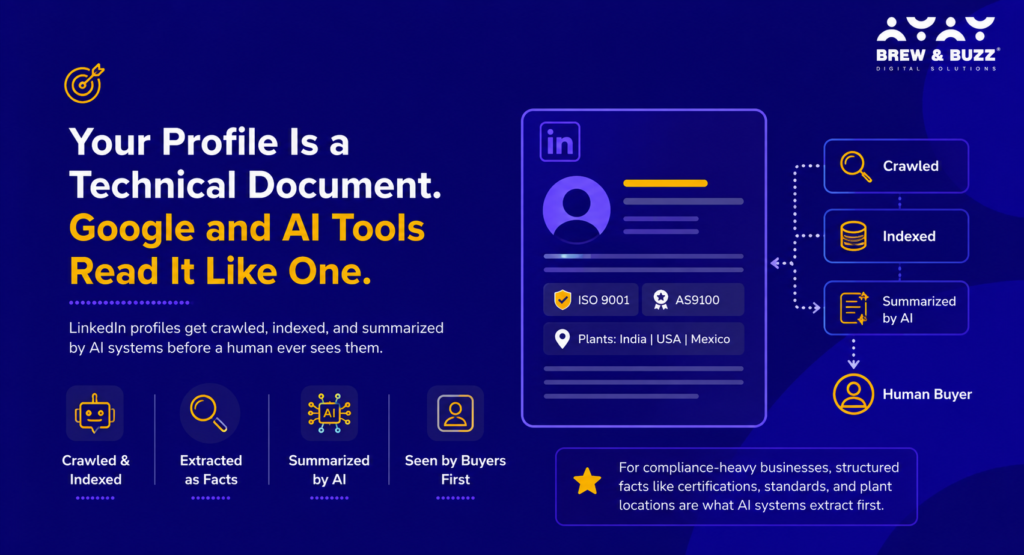
Everything you already know about technical SEO applies directly to a LinkedIn profile — it gets crawled, it gets indexed, and increasingly it gets summarized by AI systems before a human buyer ever opens it. For a compliance-heavy business, getting this layer right matters more than most industries, because the proof points buyers need (certifications, standards, plant locations) are exactly the kind of structured facts these systems are built to extract.
Who’s Reading Your Profile Before Your Buyer Does
Three systems crawl your profile before a human does: LinkedIn’s own search index, Google (public LinkedIn profiles routinely rank for “[Name] [Company]” searches), and AI answer engines pulling structured facts for a conversational answer. If your visibility settings are restricted, none of these three ever see your compliance credentials, no matter how strong they actually are.
Fix: Set your public profile visibility to fully open, per LinkedIn’s own public profile visibility settings (Settings → Visibility → Edit your public profile), and claim a clean custom URL. This is the precondition for everything else in this guide.
What Gets Remembered From a Compliance-Heavy Profile
LinkedIn’s algorithm — and anything summarizing your profile — weighs your headline and the first two lines of About far more heavily than anything further down. For a chemical manufacturer, that means your product category and compliance posture need to be in those first two lines, not buried in paragraph three after a company history nobody asked for.
Fix: Open your About section with what you make, the standard you’re certified to, and who you supply — in that order, before any narrative.
Technical Buyer Under Deadline
Core Web Vitals measures how fast a page becomes usable. The profile equivalent, for a chemical buyer, is how fast they can confirm three things: product category, compliance standard, and supply capacity. A QA manager evaluating five suppliers in an afternoon doesn’t have time to decode a vague headline like “Director at XYZ Chemicals.” That’s a failed Largest Contentful Paint for a buyer working against their own deadline.
Translated to Compliance Documents in Featured
A page that only renders its real content after a click fails a crawler the same way a Featured section buried three scrolls down fails a buyer. In chemical manufacturing specifically, this is where most profiles lose the sale before a conversation even starts: an SDS mentioned in text but not pinned, a REACH certificate that exists only as an email attachment nobody outside your company has seen.
Fix: Pin your compliance documents and plant video directly to Featured, with a thumbnail and one line of text that makes sense with zero clicks. Treat this section as your pre-RFQ document exchange, not a portfolio.
Naming Your Actual Standards, Not Describing Them
Structured data works because it removes ambiguity for a machine. Your Experience section can do the same for a human reader. Ensure product quality, and compliance tells a buyer nothing. A line like Manage REACH and BIS compliance across a 12,000 MT/year specialty additives plant supplying 3 export markets (illustrative — use your own real figures) names the actual standards, the actual scale, and the actual markets; the profile equivalent of a properly typed schema field instead of a vague one. Name the real standards that apply to your business: REACH (administered by the European Chemicals Agency, ECHA), BIS, GHS classification, ISO 9001, ISO 14001, Responsible Care certification, and CAS numbers where relevant to your product line. Naming them specifically is what makes the claim verifiable instead of decorative.
Fix: Audit your Experience bullets for any compliance claim written as an adjective ( compliant, certified ) instead of a named standard. Replace each one with the specific regulation or certification body it refers to.
AI Search Readiness for 2026
Buyer research increasingly starts inside an AI tool rather than a search bar. The SEO Works’ 2026 B2B buyer behaviour dataset puts the share of B2B buyers using LLMs like ChatGPT or Claude during vendor research at 94%. Tools like ChatGPT, Perplexity, and Google’s AI Overviews favor plain, factual, specific language over marketing copy, because it’s easier to extract and safer to cite. Committed to safety and quality gives an AI tool nothing to quote. “REACH-compliant specialty additives manufacturer supplying paints and coatings formulators across the EU and GCC” gives it an accurate, citable answer.
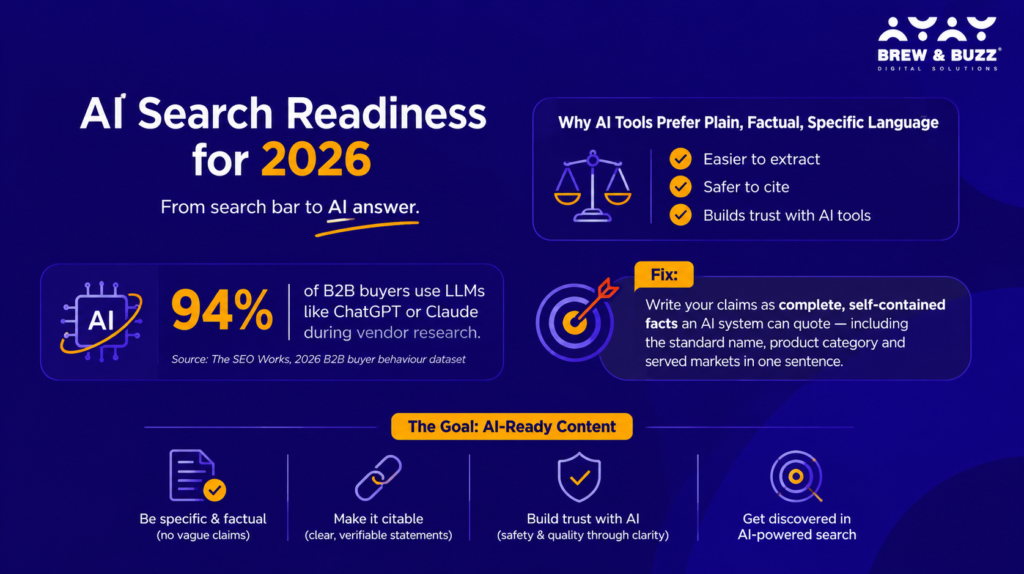
Fix: Write your compliance and category claims as complete, self-contained facts an AI system could quote directly — standard name, product category, and served markets in one sentence — rather than splitting that information across multiple vague lines.
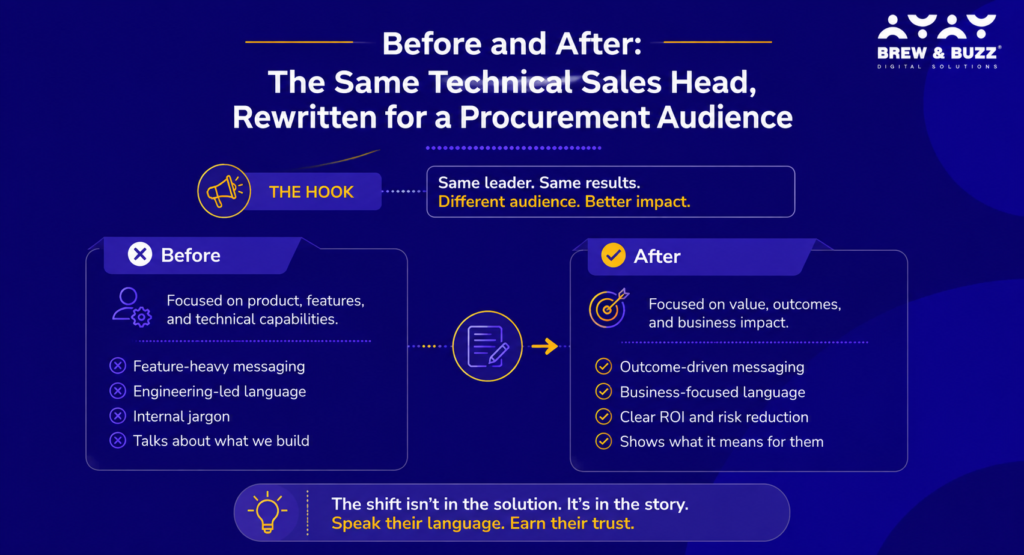
Before and After: The Same Technical Sales Head, Rewritten for a Procurement Audience
| Before | After |
| About section (typical technical sales head About section): Experienced professional in the specialty chemicals industry with a strong background in sales and business development. Passionate about building relationships and delivering value to customers. Committed to quality, safety, and sustainability. Open to new opportunities and collaborations. No product category, no compliance standard, no plant, no scale, no reason for a procurement team to act on this before closing the tab. | About section (rewritten for a chemical procurement audience): I lead technical sales for a REACH and BIS-compliant specialty additives manufacturer in Gujarat, supplying paints, coatings, and adhesives formulators across India, the EU, and GCC — currently running a 99.2% on-spec batch record across our last 40 shipments. Before a sample even ships, most buyers want three things confirmed: compliance documentation, batch consistency, and a technical contact who can actually answer a formulation question, not route it to someone else. All three are below: SDS format, ISO 9001 and REACH certificates, and a short plant video, in Featured. If you’re evaluating additive suppliers for a new formulation or resourcing an existing line, message me directly — I handle technical queries myself, not through a general sales inbox. Same role, same company, but now there’s a verifiable compliance claim, a real production metric, and a named person taking direct accountability for the technical relationship, not a generic sales pitch. |
Write the Profile Like a Technical Leader, Not Like a Lead Magnet
This is the profile layer of what we build out fully in our B2B10x Framework — the founder or technical sales head’s own presence is treated as the first trust asset in a chemical buying cycle, not an afterthought to the company page.
Chemical procurement teams are evaluating whether the person on the other end of a deal is someone they can escalate a compliance question or a batch issue to for the next several years — not whether they can write a good pitch. A profile built like a sales page — DM me for a quote, constant catalog reposts, no technical substance — reads as unreliable to a QA manager who’s used to reading data sheets, not ad copy. A leader’s profile does three things differently:
- It shows technical judgment, not just output. A post about how you handled a REACH re-registration deadline, or why you turned down an order outside your certified capacity, builds more trust than another product announcement.
- It takes visible accountability for compliance and quality. I personally review every deviation report reads very differently from Our team is committed to quality — one is a person standing behind the batch record, the other is brand copy.
- It talks to peers and regulators’ language, not just prospects. Occasionally posting about regulatory changes, industry standards, or a hard supply-chain year signals someone who actually runs technical operations, which is precisely the credibility a procurement or QA team is trying to verify before they trust you with their formulation.
Posting Format and Frequency for Chemical Manufacturing Founders and Technical Sales Heads
Avoid: Posting only product catalog images, reposting the same compliance certificate more than once a quarter, and any post that makes a safety or compliance claim without naming the actual standard behind it — vague safety language reads as a red flag to a technical buyer, not reassurance.
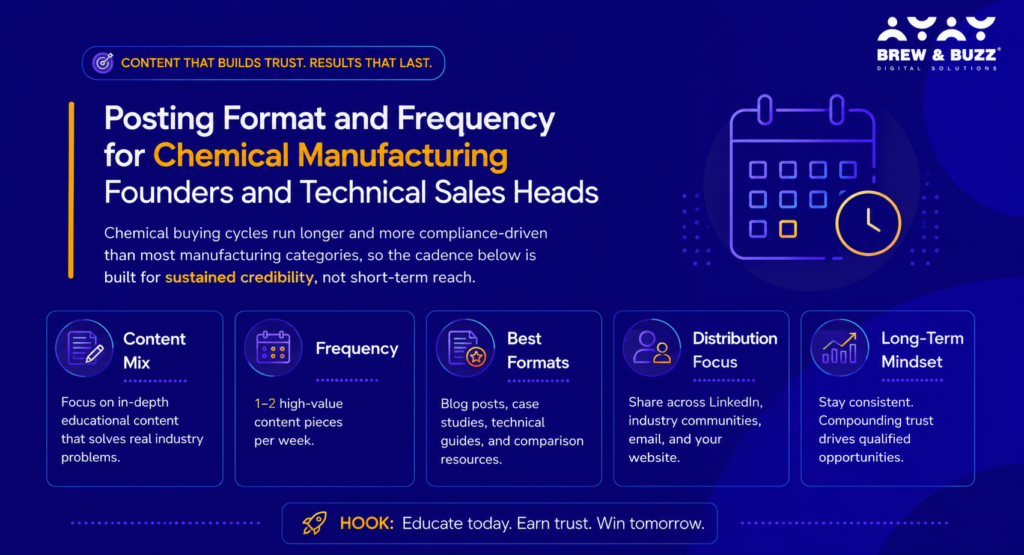
Frequency: 2-3 posts a week, spaced at least a day apart. Posting daily reads as promotional to a technical buyer; posting less than twice a week means you’re not visible when a sourcing or reformulation decision opens up.
Best format mix per week: one plant, lab, or QA-process video (30-60 seconds, native upload, captioned — buyers trust what they can see over a claim in text), one written post breaking down a technical or regulatory decision (150-250 words — a REACH update, a formulation trade-off, a supply-chain call you made and why), and one proof post — a certification renewal, an export milestone, a client outcome tied to a real number.
Best posting windows for Indian chemical/export B2B audiences: Tuesday-Thursday, 9:30-11:00 AM IST, when technical buyers and plant heads are at their desks before the day’s production issues take over.
Comment strategy: Spend 10-15 minutes after each post engaging with comments and commenting on 3-5 posts from target buyers, formulators, or industry peers. If you’re using LinkedIn Sales Navigator to track buyer accounts, pull your weekly engagement list straight from those saved searches rather than commenting at random.
Track it: LinkedIn’s Social Selling Index (SSI) is a rough but useful gauge — technical sales heads posting and engaging this consistently typically sit well above the platform average within a quarter.
The Stats That Make the Case
- India’s specialty chemicals market was valued at $64.5B in 2024 and is projected to reach $92.6B by 2033, with India ranked 14th globally in chemical exports — India Brand Equity Foundation (IBEF), 2026. That scale of buyer activity is exactly what makes a founder’s discoverability on LinkedIn a real commercial lever, not a nice-to-have.
- 65M+ decision-makers on LinkedIn, 4 in 5 members with purchasing influence — LinkedIn Marketing Solutions, cited in Oktopost’s 2026 B2B social media benchmark report.
- 75% of B2B buyers use social platforms to inform purchase decisions; ~50% point to LinkedIn specifically — Folk research, cited in Martal’s 2026 LinkedIn statistics roundup.
- 94% of B2B buyers use LLMs like ChatGPT or Claude during vendor research; procurement is a decision-maker in ~53% of business buying cycles — The SEO Works’ 2026 B2B buyer behaviour dataset and Forrester’s State of Business Buying 2026.
- Video posts run a 5.90% engagement rate versus lower rates for static/text formats, per Q2 2026 data — Socialinsider’s 2026 LinkedIn organic benchmarks. Native documents and carousels currently lead all formats — worth testing alongside video for technical, step-by-step content like a compliance walkthrough.
Frequently Ask Questions
1,300-1,900 characters (roughly 200-300 words). Long enough to state your product category, your compliance standard, and your plant or capacity — short enough that the first two lines, visible before “see more,” carry that signal on their own.
The documents a procurement or QA team would otherwise request by email: a sample SDS/MSDS format, your REACH/BIS/ISO certificates, a plant or lab walkthrough video, a capability statement, and a case study on supply consistency. For chemical manufacturers, Featured functions as a pre-RFQ document exchange, not a portfolio.
A company page holds your product catalog and documentation library. Your personal profile is where a buyer decides whether to trust the human they’d be escalating a compliance or batch issue to — and personal profiles get meaningfully more organic reach than company pages do.
2-3 times a week, sustained across a full quarter. Chemical buying cycles are longer and more compliance-driven than most categories, so consistency matters more than any single post’s performance.
Yes — profiles are public, crawlable pages, and AI answer engines increasingly cite LinkedIn for company and credential queries. A profile that states compliance standards, plant location, and product categories in plain factual language is easier for these systems to extract and quote accurately than one written in general marketing language.
Specialty chemical buying is relationship- and trust-driven, since formulations and compliance requirements are technical and switching suppliers carries real reformulation risk. Buyers vet the technical credibility of the person behind the product before they vet the product itself — which is exactly what a well-built profile is positioned to demonstrate.