
Positioning technical manufacturing capability for buyers who evaluate specs before they evaluate price.
LinkedIn profile optimization for an electronics or electrical equipment founder means structuring your headline, About section, Featured documents, and Experience history so OEM engineers, industrial buyers, and export partners can verify your certifications, design capability, and reliability data — and so the AI tools now used in vendor pre-screening can extract and cite that information accurately.
Electronics buyers evaluate specs before they ever discuss price. This guide is about making sure your profile survives that spec review.
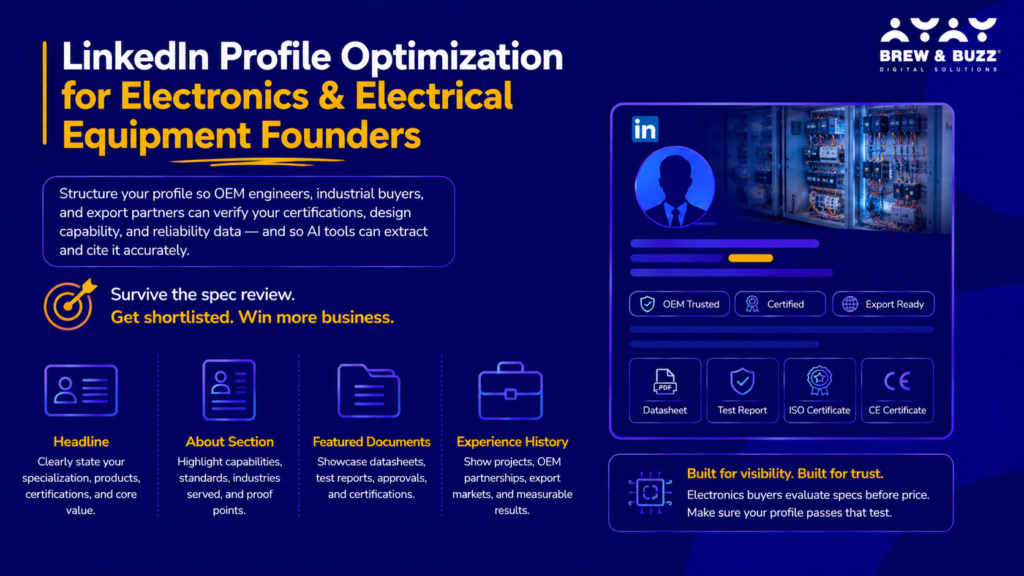
A sourcing engineer at a mid-size industrial OEM doesn’t shortlist an electronics component supplier off a datasheet PDF alone. Before a design review is even scheduled, someone checks who’s actually behind the plant, pulling up the founder’s or technical head’s LinkedIn profile to see if the certification claims match the person making them. Electronics and electrical equipment manufacturers compete on certification (BIS, CE, UL), design capability, and reliability data — not on relationship alone. A profile that can’t answer those three questions fast doesn’t make it to the next round.
This buyer split is what makes electronics different from most manufacturing categories: you’re writing for two audiences in the same profile. An engineering evaluator wants design and test capability, PCB layout, EMI/EMC compliance, and MTBF data. A commercial buyer or procurement lead wants certification, capacity, and delivery reliability. Most founder profiles in this space are written for neither, generic enough to satisfy nobody’s actual checklist.
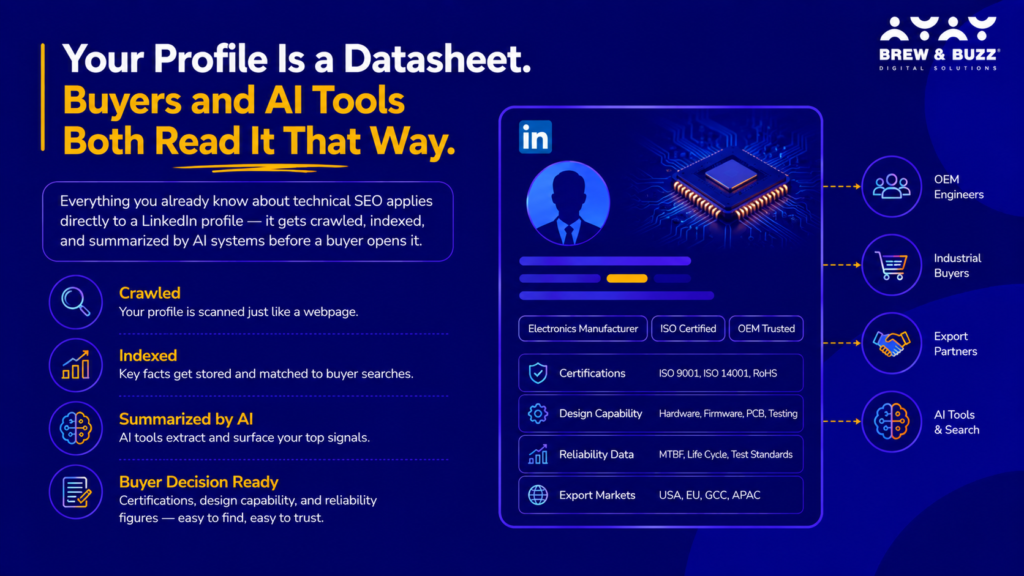
Your Profile Is a Datasheet. Buyers and AI Tools Both Read It That Way.
Everything you already know about technical SEO applies directly to a LinkedIn profile — it gets crawled, it gets indexed, and it increasingly gets summarized by AI systems before a buyer opens it themselves. For an electronics business, this matters because the facts a buyer needs — certification, design capability, reliability figures — are exactly the kind of structured data these systems are built to extract cleanly.
Who’s Reading Your Profile Before Your Buyer Does
Three systems crawl your profile before a human does: LinkedIn’s own search index, Google (public profiles routinely rank for “[Name] [Company]” searches), and AI answer engines pulling structured facts for a conversational answer. If your visibility settings are restricted, none of the three ever see your certifications, however strong they are.
Fix: Set your public profile visibility to fully open, per LinkedIn’s own public profile visibility settings (Settings → Visibility → Edit your public profile), and claim a clean custom URL. Nothing else here matters if this step is skipped.
What Gets Remembered From a Spec-Heavy Profile
LinkedIn’s algorithm — and anything summarizing your profile — weighs your headline and the first two lines of About far more heavily than anything below the fold. For an electronics manufacturer, that means product category and certification status belong in those first two lines, not buried after a company history nobody asked for.
Fix: Open your About section with what you manufacture, your certification status, and who you supply — OEM, industrial, export — before any narrative.
Core Web Vitals, for an Engineer Comparing Datasheets
Core Web Vitals measures how fast a page becomes usable. The profile equivalent, for a sourcing engineer, is how fast they can confirm three things: product category, certification, and design or reliability capability. An OEM procurement lead comparing five suppliers in an afternoon doesn’t have time to decode a vague headline like “Director at ABC Electronics.” That’s a failed Largest Contentful Paint for someone working against their own design deadline.
Fix: Rewrite your headline to state product category, certification, and buyer type in one line — something actionable in five seconds, not fifteen.
Translated to Test Reports in Featured
A page that only renders its real content after a click fails a crawler the same way a Featured section buried three scrolls down fails a buyer. In electronics specifically, this is where profiles lose the RFQ before a call even happens: a CE certificate mentioned in text but never pinned, an EMI/EMC test report that’s real but invisible because it only lives in a sales folder nobody outside the company has seen.
Fix: Pin your certification documents, a reliability or test summary, and a product demo video directly to Featured, with a thumbnail and one line of text that makes sense with zero clicks. Treat this section as your pre-RFQ technical dossier.
Naming the Actual Standard, Not Describing It
Structured data works because it removes ambiguity for a machine. Your Experience section can do the same for a human reader. “Ensure product quality and compliance” tells a buyer nothing. A line like “Design and manufacture CE and UL-certified power supply units for 8 industrial OEM clients, MTBF rated above 100,000 hours” (illustrative — use your own real figures) names the actual standards, the actual reliability figure, and the actual buyer type — the profile equivalent of a properly typed schema field instead of a vague one. Name the real standards that apply to your business: BIS registration under the Compulsory Registration Scheme (CRS) for the Indian market, CE marking for EU exports, UL certification for the US market, RoHS compliance, relevant IEC standards, and ISO 9001/14001. For assembly and workmanship quality specifically, name your IPC standard compliance (IPC-A-610 is the one most OEM buyers check by name) — it’s more electronics-specific than a general ISO certificate and often the first thing a quality auditor asks about. If you manufacture energy-consuming appliances, name your BEE star rating directly.
Fix: Audit your Experience bullets for any compliance claim written as an adjective (“certified,” “compliant”) instead of a named standard or test result.
AI Search Readiness for 2026
Buyer research increasingly starts inside an AI tool rather than a search bar — The SEO Works’ 2026 B2B buyer behaviour dataset puts the share of B2B buyers using LLMs like ChatGPT or Claude during vendor research at 94%. These tools, along with Perplexity and Google’s AI Overviews, favor plain, factual, specific language over marketing copy, because it’s easier to extract and safer to cite. “Committed to innovation and quality” gives an AI tool nothing to quote. “CE and BIS-certified power electronics manufacturer supplying industrial OEMs across India and the EU” gives it an accurate, citable answer.
Fix: Write your certification and capability claims as complete, self-contained facts — standard, product category, and buyer segment in one sentence — rather than scattered across vague lines.
Before and After: The Same Founder, Rewritten for an OEM Audience
The name, company, and figures below are an illustrative composite, not a real client — built to show the rewrite pattern, not to be copied verbatim.
| Before (typical founder About section): | After (rewritten for an OEM and industrial buyer audience): |
| “Innovative electronics manufacturer with a passion for engineering excellence. We deliver cutting-edge solutions to clients across industries. Committed to quality, reliability, and customer satisfaction. Open to new collaborations and partnerships.” No product category, no certification, no design capability, no buyer type, no reason for a sourcing engineer to act on this before closing the tab. | “I run a BIS and CE-certified power electronics manufacturer in Pune, designing and supplying switch-mode power supplies to industrial OEMs across India and the EU — MTBF rated above 100,000 hours across our current production line, with in-house PCB design and EMI/EMC testing. Before a design-in decision, most OEM buyers want three things confirmed: certification documentation, reliability data, and a technical contact who can answer a design query directly. All three are below — CE and BIS certificates, our latest EMC test report, and a line demo video, in Featured. If you’re evaluating a power electronics partner for a new product or resourcing an existing line, message me directly. I review every technical inquiry myself.” Same founder, same company — but now there’s a verifiable certification, a real reliability figure, a named buyer segment, and a person taking direct technical accountability, not a generic innovation pitch. |
Write the Profile Like a Technical Leader, Not Like a Lead Magnet
This is the profile layer of what we build out fully in our B2B10x Framework — the founder or technical head’s own presence is treated as the first trust asset in an OEM buying cycle, not an afterthought to the company page.
OEM and industrial buyers are evaluating whether the person on the other end of a deal can be relied on through a multi-year product life cycle — design changes, quality escalations, component obsolescence — not whether they can write a good pitch. A profile that reads like a sales page — “DM me for a quote,” constant product photos, no engineering substance — signals a vendor chasing one-off orders, not a design partner. A leader’s profile does three things differently:
- It shows engineering judgment, not just output. A post about a design trade-off you made for thermal performance, or why you turned down a spec you couldn’t certify to, builds more trust than another product photo.
- It takes visible accountability for reliability. “I personally review every EMC test failure” reads very differently from “Our team is committed to quality” — one is a person standing behind the test bench, the other is brand copy.
- It talks to engineers, not just buyers. Occasionally posting about a standards update, a component shortage you navigated, or a design decision explained in plain terms signals someone who actually runs the technical side — exactly the credibility an OEM evaluator is trying to verify before a design-in commitment.
Posting Format and Frequency for Electronics Manufacturing Founders and Technical Heads
OEM and industrial sourcing runs on long evaluation cycles, not fast decisions, so the cadence below is built for sustained technical credibility:
- Frequency: 2-3 posts a week, spaced at least a day apart. Daily posting reads as promotional to a technical buyer; fewer than two a week means you’re not visible when a design-in or sourcing decision opens up.
- Best format mix per week: one product or test-lab video (30-60 seconds, native upload, captioned — buyers trust what they see over what they’re told), one written post on a technical or design decision (150-250 words — a component trade-off, a certification you pursued and why, an EMC challenge you solved), and one proof post — a new certification, an OEM partnership milestone, a reliability figure tied to a real product.
- Best posting windows for Indian electronics/export B2B audiences: Tuesday-Thursday, 9:30-11:00 AM IST, when OEM sourcing teams and design engineers are at their desks before daily production issues take over.
- Comment strategy: Spend 10-15 minutes after each post engaging with comments and commenting on 3-5 posts from target OEM buyers, design engineers, or industry peers. If you’re using LinkedIn Sales Navigator to track OEM accounts, pull your weekly engagement list from those saved searches rather than commenting at random.
- Track it: LinkedIn’s Social Selling Index (SSI) is a rough but useful gauge — founders posting and engaging this consistently typically sit well above the platform average within a quarter.
- Avoid: Posting only finished-product glamour shots with no engineering substance, reposting the same certification more than once a quarter, and any reliability or compliance claim made without naming the actual standard or test result behind it — vague quality language reads as a red flag to a technical buyer who reads datasheets for a living, not reassurance.
The Stats That Make the Case
- India’s electronics manufacturing sector has grown roughly six-fold over the past 11 years and created 25 lakh (2.5 million) jobs, with the government targeting a $500B domestic electronics manufacturing ecosystem by 2030-31 — Press Information Bureau, Government of India, February 2026. This figure covers the sector broadly, including large-scale mobile phone and IT hardware PLI beneficiaries — the more directly relevant piece for a mid-size industrial or power electronics manufacturer is the Electronics Components Manufacturing Scheme (ECMS), which specifically targets domestic component and sub-assembly manufacturers and had its outlay increased to ₹40,000 crore in the 2026-27 budget. Either way, it’s the scale of policy-backed buyer activity a well-built profile is competing to be visible inside.
- 65M+ decision-makers on LinkedIn, 4 in 5 members with purchasing influence — LinkedIn Marketing Solutions.
- 75% of B2B buyers use social platforms to inform purchase decisions; ~50% point to LinkedIn specifically.
- 94% of B2B buyers use LLMs like ChatGPT or Claude during vendor research; procurement is a decision-maker in ~53% of business buying cycles.
- Video posts run a 5.90% engagement rate, with native documents and carousels currently leading all formats
Figures above are third-party research current as of mid-2026; treat market projections as forecasts rather than settled numbers, since platform algorithms and industry conditions shift.
Frequently Ask Questions
Use industry-specific keywords, clearly highlight your products and manufacturing capabilities, showcase certifications, and add relevant projects, achievements, and technical expertise. Keep your profile professional, complete, and regularly updated.
Manufacturers can share technical insights, project success stories, product applications, certifications, and industry updates. An optimized company and founder profile can also help build credibility with OEMs, procurement teams, and industrial buyers.
Relevant keywords may include electronics manufacturing, electrical equipment, OEM manufacturing, PCB assembly, industrial automation, power electronics, control panels, switchgear, embedded systems, ISO, BIS, CE, and RoHS, depending on the company’s actual capabilities.
Highlight projects using measurable results, technologies used, industries served, certifications, and customer outcomes. Use the Featured section to showcase case studies, product catalogues, certifications, factory videos, and project images.
Avoid generic headlines, keyword stuffing, incomplete profiles, excessive promotional content, and failing to showcase certifications or technical capabilities. Keep your LinkedIn profile consistent with your website and other digital platforms.
1,300-1,900 characters (roughly 200-300 words). Long enough to state your product category, certification status, and design or reliability capability — short enough that the first two lines, visible before “see more,” carry that signal on their own.
The proof an OEM or technical buyer would otherwise request before a design review: your BIS/CRS registration, CE or UL certification, a reliability or EMI/EMC test report, a product demo video, and a case study on a successful OEM partnership. Treat Featured as a pre-RFQ technical dossier, not a product gallery.
Yes — profiles are public, crawlable pages, and AI answer engines increasingly cite LinkedIn for company and credential queries. A profile stating certification status, design capability, and reliability data in plain factual language is easier for these systems to extract and quote accurately than one written in general marketing language.
Name the ones your actual buyer checks: BIS/CRS for the Indian market, CE for EU exports, UL for the US market, RoHS compliance, relevant IEC standards, ISO 9001/14001, and IPC-A-610 for assembly and workmanship quality. Add a BEE star rating if you manufacture energy-consuming appliances. Naming the specific standard, not just the word “certified,” is what makes the claim checkable.
OEM buyers are often evaluating a design partner, not just a production line — they need to know if a supplier can handle PCB design, embedded firmware, or EMI/EMC compliance in-house, since that determines how much engineering work stays with the buyer. A profile that only shows finished products misses the exact question an OEM technical evaluator is trying to answer first.