
Moving beyond a bag-of-cement listing to a profile that shows structural and material expertise
In short: LinkedIn profile optimization for cement and building materials manufacturers means structuring a founder’s or technical sales head’s profile headline, About, Featured, Experience, and posting activity so it gets surfaced by three systems at once: LinkedIn’s own search, Google’s index, and AI answer engines like ChatGPT and Perplexity. For manufacturers selling into EPC contractors, structural engineers, architects, and government infrastructure buyers, this profile is what separates another cement brand on the tender list from the technical partner the site engineer trusts.
A structural engineer on a high-rise project is comparing cement suppliers for a tender. Every listed manufacturer has BIS certified, quality-assured, and trusted by builders somewhere on their LinkedIn. None of them says anything that tells this engineer who actually understands the difference between OPC 43 and OPC 53 grade for a specific load-bearing application, or which supplier’s technical team will show up on-site when a batch test result comes back questionable.
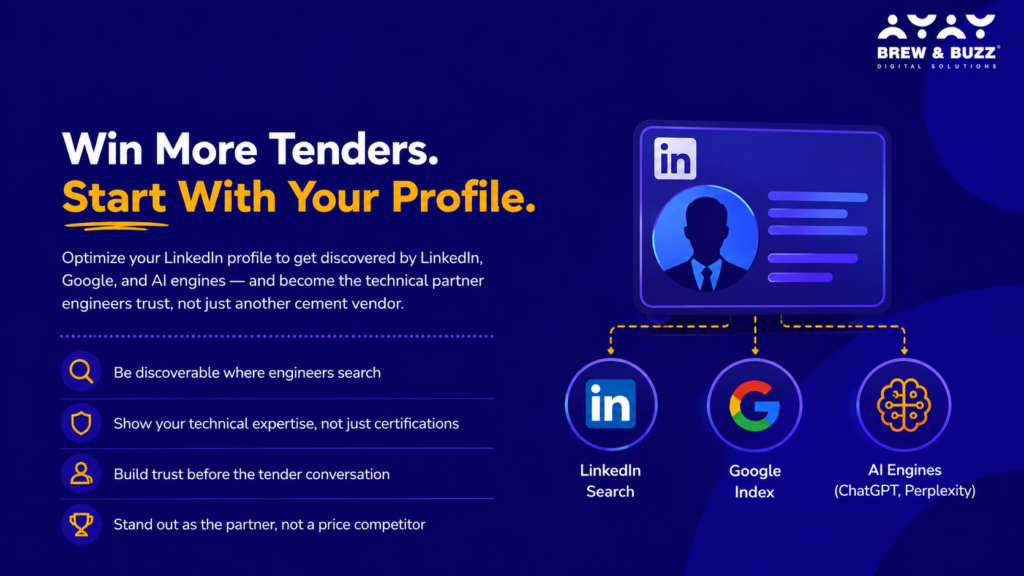
That’s the exact moment cement and building materials manufacturers lose tenders they were technically qualified to win. Not on price. Not on capacity. On perception because a commodity-sounding profile gets treated like a commodity vendor, and commodity vendors get compared purely on price per bag or per tonne.
This guide fixes that perception problem at the source: the founder’s, technical sales head’s, or plant head’s LinkedIn profile built to get crawled, indexed, and surfaced by LinkedIn’s own search, Google, and AI answer engines in 2026.
Why this matters more than your website homepage right now
Buyers in construction research online before they call anyone
This is happening against the backdrop of a genuinely large industry: global cement production reached roughly 4.1 billion metric tons in a recent full year, and the global cement market has been valued at over $405 billion, with independent industry analysis projecting continued growth through the end of the decade. An industry that size, spread across residential, commercial, and infrastructure segments, means a large and constantly refreshing pool of buyers actively re-qualifying suppliers.
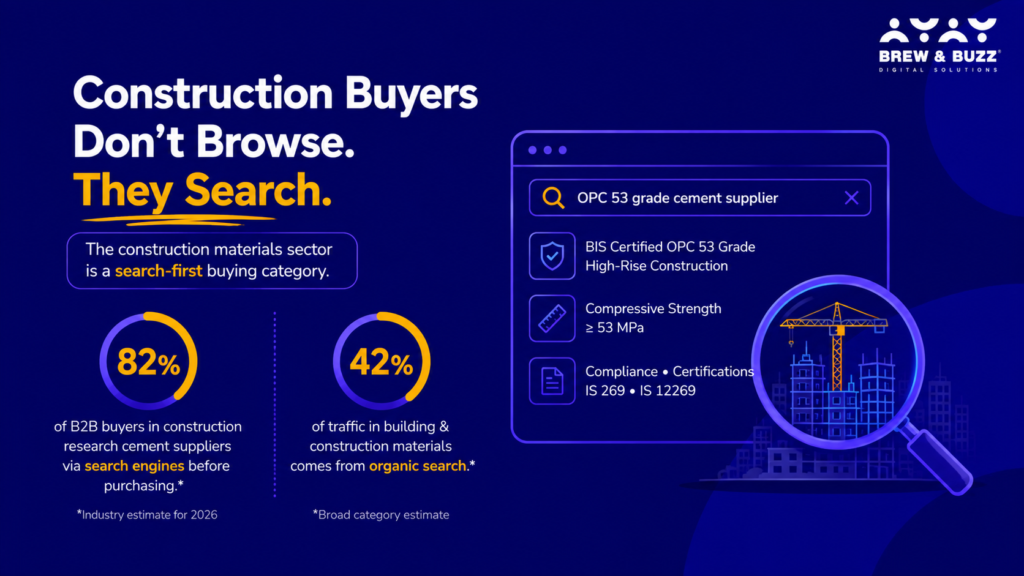
The construction materials sector has also quietly become a search-first buying category. One industry estimate compiled for 2026 cement-sector marketing puts the figure at roughly 82% of B2B buyers in construction researching cement suppliers via search engines before purchasing a figure worth treating as directionally indicative rather than precisely verified, since it traces to a single aggregated source, but one that lines up with a separately reported estimate that organic search drives roughly 42% of traffic across the broader building and construction materials category. Either way, buyers in this category are demonstrably typing technical queries product grades, compliance certifications, compressive strength specs not browsing casually.
Sustainability has become part of that research too: an estimated 65% of construction companies now prioritize sustainable materials in how they evaluate and communicate about suppliers, and the green cement segment specifically is projected to grow toward $66 billion by 2030 as carbon-conscious specification becomes standard on larger projects. In practice, this shows up as architects and developers specifying against named green-building standards — IGBC (Indian Green Building Council) certification or LEED — which means a manufacturer’s LinkedIn presence increasingly needs to say something specific about fly ash content, GGBS blends, or IGBC/LEED-relevant carbon data, not just “eco-friendly.”
The buyer decision-makers are specific, technical roles
Unlike a general consumer category, the people evaluating a cement or building materials manufacturer have precise job functions: structural engineers verifying grade and strength specifications, architects who — per the same 2026 cement-marketing research — increasingly expect suppliers to provide downloadable BIM (Building Information Modeling) objects, EPC procurement heads managing bulk-supply contracts, and government tender officers evaluating BIS-certified suppliers for infrastructure projects. Each of these roles researches differently, but all of them are now doing that research on LinkedIn and Google before a sales call happens.
Personal profiles outperform company pages for this kind of technical trust-building
The pattern holds here the same way it does across other B2B manufacturing categories: LinkedIn’s algorithm has been shown to distribute content from personal profiles roughly five times further than the same content from a company page, and buyers spend a disproportionate share of their vendor-research time on content from a company’s own people rather than its official marketing. LinkedIn’s own Social Selling Index (SSI) data shows sellers with a strong professional presence generate 45% more sales opportunities and 51% higher quota attainment than those with a weak one.
Put simply: a BIS certification gets a manufacturer onto the tender list. A founder’s or technical sales head’s LinkedIn profile is what gets that manufacturer read as the partner an engineer actually wants on a difficult project — not just the lowest bid in a comparison sheet.
How LinkedIn profiles actually get crawled and indexed — the technical layer nobody explains
Treat the profile like a webpage, because functionally, it is one. It has a URL, it gets crawled, and it competes for ranking position across three separate systems.
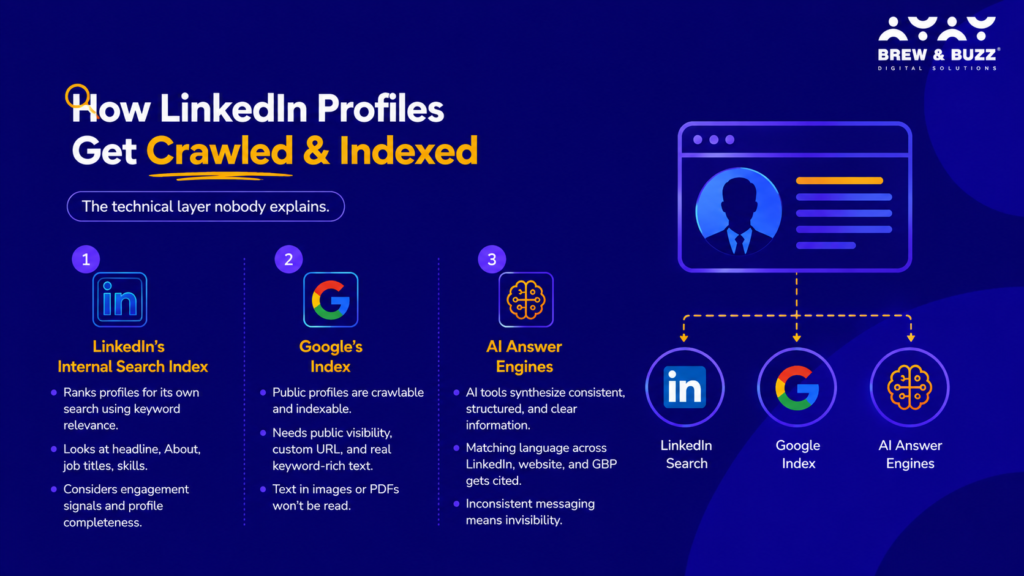
1. LinkedIn’s internal search index. LinkedIn ranks profiles for its own search bar using keyword relevance in the headline, About section, job titles, and skills — plus engagement signals like connection relevance, post activity, and profile completeness. This is the closest equivalent to on-page SEO a founder manages directly.
2. Google’s index. Public LinkedIn profiles are crawlable and indexable by Google, meaning a profile can rank for searches like “cement manufacturer founder” plus a location, or a buyer typing a company name plus “LinkedIn.” Crawlability depends on public visibility, a custom URL (not the default numeric string), and headline/About text written as genuine, keyword-relevant sentences — not text buried inside an image or a spec-sheet PDF.
3. AI answer engines. ChatGPT, Perplexity, and Gemini don’t rank a profile — they synthesize an answer from whatever text is clearly structured, consistently repeated across the web, and unambiguous. A profile that states the same specialization, in matching language, across the LinkedIn About section, the company website, and the company’s Google Business Profile has a far better chance of being cited when someone asks an AI assistant “which cement manufacturers supply BIS-certified OPC 53 grade for high-rise construction.” A profile that describes itself differently in each place is invisible to this layer — not blocked, just unreadable as one consistent entity.
The structured data of a human profile
On a website, structured data (schema markup) tells search engines exactly what a page is about, in a format machines can parse without guessing. A LinkedIn profile has no schema markup a founder can edit directly — but five sections function as that structured data, because they’re the fields LinkedIn, Google, and AI crawlers weight most heavily and parse most literally:
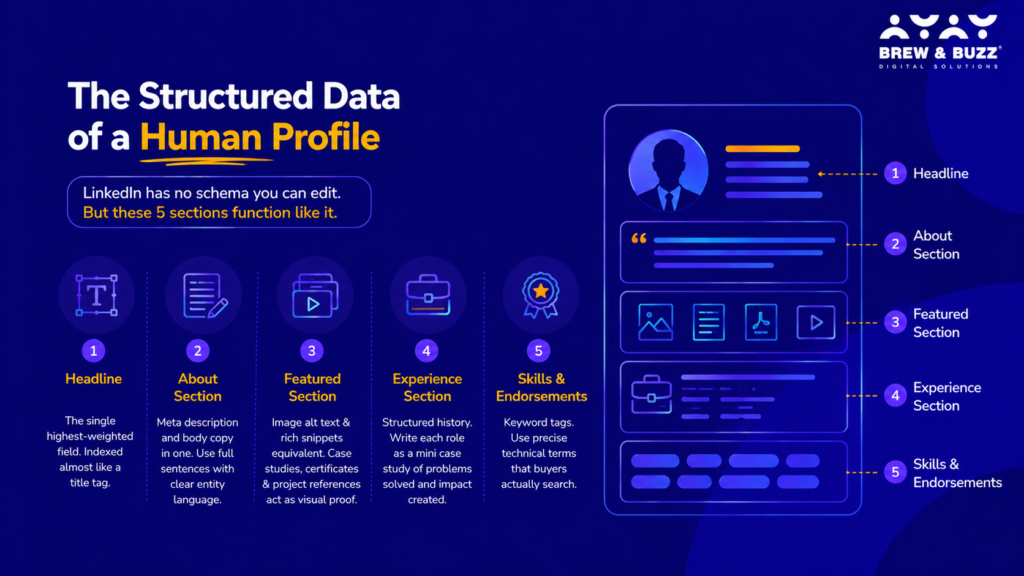
- Headline — the single highest-weighted field. Indexed almost like a title tag.
- About section — meta description and body copy in one. Entity language (grades produced, certifications held, plant capacity, industries and project types served) needs to appear in full sentences, not fragments.
- Featured section — the image alt text and rich snippets equivalent. Case studies, test certificates, and project references placed here surface as visual proof directly in search results.
- Experience section — structured history. Each role should read like a mini case study of a project or problem solved, not a job description copied from an appointment letter.
- Skills & endorsements — keyword tags. One of the most underused fields, and the easiest place to add searchable technical terms: cement grades (“OPC 43,” “OPC 53,” “PPC,” “PSC”), material categories (“Ready-Mix Concrete,” “GGBS,” “fly ash-based cement”), and capability terms (“BIS certification,” “compressive strength testing,” “batch quality control,” “bulk logistics”). Worth being precise here: cement grade (OPC 43, OPC 53) refers to the cement product itself, while concrete grade (M25, M30, etc.) refers to the mix design a structural engineer specifies using that cement — using the two terms interchangeably reads as a credibility gap to a technical reader, so keep them distinct in the profile’s language.
Profile Core Vitals — the equivalent of Core Web Vitals for a human page
Google ranks pages partly on load speed, stability, and interactivity. LinkedIn ranks profiles on a parallel set of signals worth naming as its own framework — Profile Core Vitals: four signals that determine whether LinkedIn’s algorithm and Google’s crawler treat a profile as active and authoritative, rather than dormant and low-priority. This framework, and the overall structure of this guide, is the shared methodology we use across every industry-specific LinkedIn optimization piece in this series — deliberately, so the format becomes recognizable across your content library. What changes piece to piece is the entity vocabulary and proof points; the underlying four signals hold regardless of sector.
| Web Core Vital | Profile Equivalent | What it means for a founder or technical sales head |
| Loading speed | Profile completeness | All-Star/complete profiles get prioritized in search and get more search appearances |
| Interactivity | Response & engagement rate | Founders who reply to comments and messages promptly are surfaced higher in feed distribution |
| Visual stability | Consistency of positioning | Same grades, same certifications, same numbers across headline, About, and posts — no contradictions |
| Mobile-friendliness | Post readability | Short paragraphs, no dense text blocks — engineers and architects are scanning between site visits |
Two things founders consistently get wrong here. First, a plant or batching-plant photo used as the profile banner is not cosmetic — it’s a completeness and trust signal that materially affects both algorithmic reach and a stranger’s decision to click through. Second, dormant profiles decay in search relevance over time; a founder who posts once every eight months is functionally invisible to LinkedIn’s ranking system regardless of how well-written the About section is.
The content that looks good but can’t be read by machines
In web SEO, JavaScript SEO deals with content that renders visually but isn’t accessible to crawlers unless it’s server-rendered as real text. LinkedIn profiles have their own version of this problem, and it’s a common mistake in this industry specifically:
- Test certificates and grade specification sheets embedded only as images or scanned PDFs in the Featured section look authoritative but are invisible to search indexing. A well-designed certificate graphic listing BIS approval and grade specs carries none of that text into search unless it also exists as readable text somewhere on the profile.
- Acronym-heavy or vague headlines (“Cement Business | BIS Approved | Quality First”) waste the single most crawled field on the profile without stating an actual specialization.
- Headlines that state only a job title (“Director at ABC Cement Ltd”) give search systems nothing to match against a buyer’s actual query.
Make sure the information that matters exists as real, readable text — not as a visual layer sitting on top of it.
Why project-specific proof is the trust signal in this industry specifically
Every B2B category has its own version of proof, and cement and building materials has a distinct one: named projects and grade specificity substitute for a brand a buyer doesn’t already know. A structural engineer isn’t reassured by trusted quality cement — they’re reassured by a stated grade (“OPC 53, IS 12269 compliant”), a named project type the material has been used on (“supplied ready-mix concrete for three metro rail viaduct segments”), or a specific compressive strength figure. Trusted by builders is unverifiable; 43 MPa compressive strength at 28 days, third-party lab tested, is a claim an engineer can check against their own spec sheet.
This is why the same About-section formula that works in other B2B categories under-delivers here if it stays at the adjective level. The fix is swapping every unverifiable adjective for one verifiable number or named reference: plant capacity and grade range instead of large-scale production, named certifications and IS codes instead of quality-focused, a specific project type instead of trusted across India.
Writing the founder profile: the leadership framework
Here’s the mindset shift this guide is built around: a founder’s or technical sales head’s LinkedIn profile is not a longer version of the company’s About Us page. It’s a leadership document. EPC buyers, structural engineers, and government procurement teams aren’t looking for a vendor listing — they’re evaluating whether the person behind the plant understands the structural and compliance stakes of what they’re building, not just the tonnage they can supply. Write from that seat.
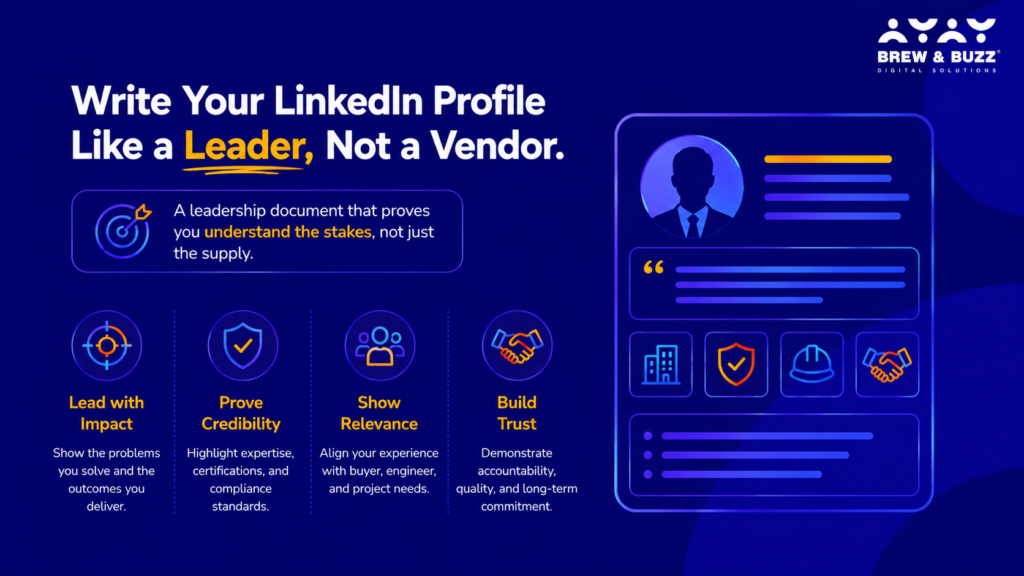
Headline
Formula: Who you help + the specific technical or project problem you solve + your differentiator.
Weak: “Managing Director at ABC Cement Ltd” Strong: “Helping EPC Contractors & Structural Engineers De-Risk High-Rise & Infrastructure Projects with Consistent-Grade Cement | Founder, ABC Cement | BIS Certified”
About section
Structure it in four movements, written in first person, as a leader speaking — not a brochure describing a company:
- Open with the technical or project problem you saw, not your job title. (“Most cement suppliers sell a grade. I got tired of watching site teams deal with batch-to-batch variation nobody flagged until a strength test came back short.”)
- Establish authority with specifics, not adjectives. Plant capacity, grades produced, certifications held, named project types — these carry weight that “trusted” or “quality-focused” don’t.
- Show the technical thinking, not just the output. A founder who explains how they approach batch consistency, fly ash blending, or compliance testing signals expertise a generic sales profile can’t fake.
- Close with a direct, low-friction invitation. Not “Contact us for a quote” — closer to “If your project needs a supplier who’ll walk through batch test reports with your site engineer, happy to talk before the tender closes.”
Featured section
This is the visual proof layer. Include: one project case study showing a specific supply relationship (as a document or LinkedIn-native post, not a locked PDF), one certification or compliance credential (BIS/ISI mark, relevant IS code compliance), and one piece of original technical content — a post or short article where the founder took a position on grade selection, sustainable blends, or a quality-control practice.
Experience section
Rewrite each role as a short case study: what the business achieved under this leadership, in numbers where possible, framed around the buyer’s outcome — consistent batch quality across a large order, on-time bulk delivery for a tight construction schedule, a fly ash or GGBS blend that helped a project meet a green-building requirement — rather than internal operations language.
Before / After: the same founder, two very different profiles
| Before | After |
| Headline: Managing Director at Shivam Cement Industries | Headline: Helping EPC Contractors & Structural Engineers De-Risk High-Rise & Infrastructure Projects with Consistent-Grade Cement | Founder, Shivam Cement | BIS Certified, IS 12269 & IS 1489 Compliant |
| About: Shivam Cement is a leading manufacturer of Portland cement established in 1995. We serve builders and contractors across the region with quality products and timely delivery. We have state-of-the-art plant facilities and a dedicated team committed to customer satisfaction. Feel free to connect for business inquiries. | About: In 28 years running a cement plant, I’ve seen more project delays trace back to batch-to-batch variation than to any single bad delivery — usually because nobody flagged a strength test result until it was already poured. I started building Shivam Cement’s quality process around that problem. We produce OPC 43, OPC 53, and PPC grades from a plant with third-party lab testing on every batch, and our technical team reviews grade selection with a project’s structural engineer before supply begins — not after a dispute. We’re not the cheapest per-tonne quote in the region, and I don’t try to be. We’re the supplier a site engineer calls when a batch test comes back borderline, because we’ll walk through the report with them instead of just replacing the bags. Currently supplying ready-mix concrete for two metro-rail viaduct segments and a fly ash-blended PPC order for a green-certified commercial project. If your project needs a cement partner who’ll stand behind the grade on paper, I’m glad to talk before your tender closes. |
Notice what changed: no adjectives doing the work (“leading,” “quality,” “state-of-the-art”) — specific grades, IS code compliance, and named project types doing it instead. The headline states the technical problem solved, not just a title. The About section opens with a failure mode the reader recognizes, not a company founding date
Posting format and frequency — specific to this audience
Generic “post 3x a week” advice ignores who’s reading a cement manufacturer’s founder or technical sales profile: structural engineers, architects, EPC procurement heads, and government tender officers who check LinkedIn in short bursts between site visits and tender submissions — not scrolling for entertainment.
Frequency: 2 original posts per week from the founder/technical sales profile, plus 2–3 comments per week on posts from target-account employees (structural engineers, architects, EPC procurement leads at target firms). The comments matter as much as the posts — they put a name in front of a buyer’s network without asking for anything.
Format mix that performs for this audience:
- Plant/batch quality visuals (1x/week): short video or carousel from the plant — a batch test in progress, a fly ash blending process, a bulk loading operation. Buyers evaluating a technical partner trust what they can see running, more than any claim on a brochure.
- Point-of-view technical posts (1x every 2 weeks): a founder’s take on a grade-selection trade-off, a sustainability shift (fly ash content, GGBS adoption), or a compliance change — written as a technical opinion, not a press release. This is the content type that builds the “leader who understands the structure” positioning.
- Project case study/outcome post (1x/month): a specific supply relationship, named where the client allows it — consistent quality across a large order, on-time delivery for a tight schedule, a blend that helped a project hit a sustainability requirement.
- Avoid: generic “Happy [festival]” posts, repost-only activity with no commentary, and stock images with no plant or project visible — none of these carry any of the entity or keyword signal this guide is built around.
Best posting windows for this specific buyer: weekday mornings (8:30–10 AM IST) before site visits and meetings begin, and early afternoon (1–2:30 PM IST) during the post-lunch scroll — both windows consistently outperform evening posting for B2B industrial and construction audiences.
AI search readiness for 2026: the layer most founders are ignoring
AI answer engines are increasingly the first stop in vendor research, and they work on entity consistency, not keyword density. Three concrete actions matter here:
- Say the same thing everywhere. The LinkedIn About section, the company website’s About page, and the Google Business Profile description should describe the specialization in matching language — same grades produced, same certifications, same project types served. AI models cross-reference these; contradictions reduce the confidence with which a model will cite the profile.
- Answer the question directly, in your own content. To be surfaced when someone asks an AI assistant “which cement manufacturers supply BIS-certified OPC 53 grade for infrastructure projects,” a LinkedIn post or article needs to state that specialization in plain language — not imply it through a client logo carousel.
- Build citation-worthy content, not just promotional content. AI engines pull from content that answers a question or states a fact — an original data point, a specific compliance explanation, a clear technical opinion. A post that just says “proud to serve the construction industry” gives a model nothing to extract.
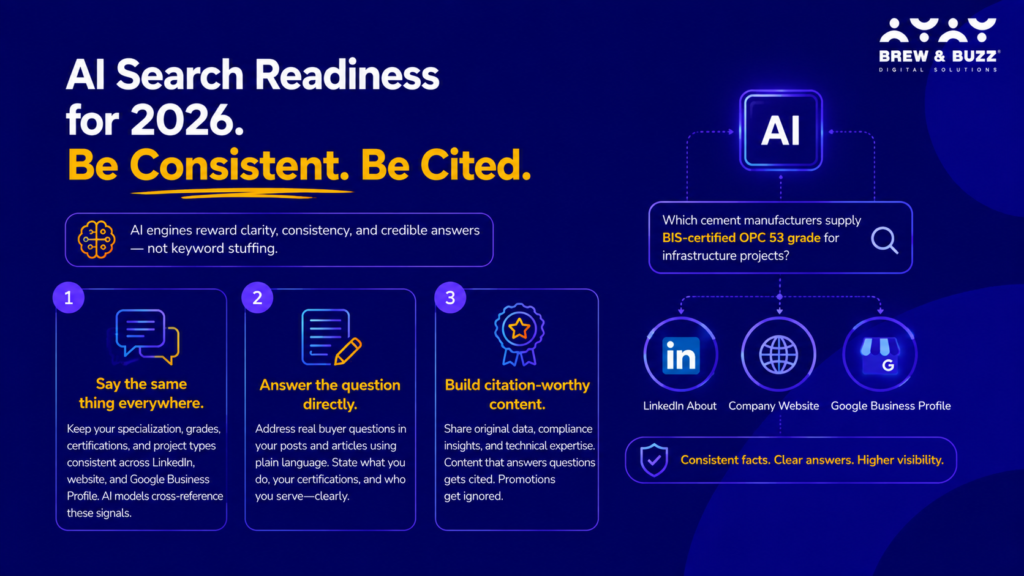
What this looks like in practice: when someone asks an AI assistant to find a BIS-certified cement manufacturer for a high-rise project, the model is scanning for a name it can attach to a clear, repeated claim — not a company it has to infer. A founder whose LinkedIn, website, and Google Business Profile all state the same specialization (“BIS-certified OPC 43/53 and PPC production, third-party batch testing, technical support for structural engineers on high-rise and infrastructure projects”) gives the model a complete, attributable answer it can surface with confidence. A founder whose LinkedIn says cement manufacturer, whose website says “building materials supplier,” and whose Google listing says “construction products” gives the model three weakly related fragments instead of one entity — and the model defaults to a competitor with cleaner signal, even if the underlying quality is a stronger fit.
One entity worth naming precisely here: BIS, the Bureau of Indian Standards, is the national body that certifies cement grades against IS codes (such as IS 269 for OPC 33, IS 12269 for OPC 53, and IS 1489 for PPC). Founders who reference specific IS code compliance — rather than “certified quality” as a vague term signal both regulatory fluency and topical relevance to buyers and to AI models parsing the content, since IS code compliance is precisely the term structural engineers and government tender officers search for when qualifying a supplier.
Frequently Ask Questions
Aim for 150–300 words. Long enough to establish specificity and a real technical point of view, short enough that the first two lines (the only part visible before “see more”) already state who you help and what problem you solve.
Optimize your LinkedIn profile by clearly mentioning your cement products, manufacturing capabilities, target markets, certifications, and industry expertise. Use relevant keywords such as cement manufacturer, building materials, bulk cement, construction materials, and B2B cement supplier in your headline, About section, and experience. Add project achievements, certifications, product information, and customer-focused content to build credibility with procurement managers, contractors, and distributors.
Companies should use keywords that reflect their products, capabilities, applications, and target markets. Examples include cement manufacturer, cement supplier, building materials manufacturer, construction materials, ready-mix concrete, infrastructure materials, bulk cement, concrete solutions, sustainable building materials, and B2B construction products. Location-specific terms such as cement manufacturer in India can also help improve relevant search visibility.
Showcase expertise by highlighting your years of industry experience, manufacturing capabilities, certifications, major projects, technical knowledge, and measurable achievements. Instead of only promoting products, share practical insights about cement quality, construction applications, sustainability, infrastructure trends, and procurement. Case studies and project-based posts can also demonstrate real-world expertise and build trust with potential B2B buyers.
A strong LinkedIn content strategy should combine educational, industry, company, and customer-focused content. Share manufacturing insights, product applications, project case studies, quality and sustainability initiatives, industry trends, FAQs, and expert opinions. For senior executives, thought-leadership posts about construction, infrastructure, procurement, and market trends can help build personal authority while supporting the company’s B2B lead-generation efforts.
Yes — government and PWD (Public Works Department) tender evaluators tend to search for specific certification and compliance terms (BIS approval, IS code numbers, past government project references) rather than brand language. Making sure those exact terms appear in the About and Featured sections, in addition to the leadership narrative, helps the profile surface for this specific buyer segment.
A founder’s profile should carry more strategic and industry point-of-view content — sustainability shifts, regulatory changes, where the market is heading. A technical sales head’s profile should skew toward grade-specific content, project case studies, and direct engagement with individual engineers’ and architects’ posts and questions
Writing it like a company brochure instead of a technical leader’s perspective — describing the business in the third person, using generic adjectives instead of specific grades and certifications, and never stating a point of view on quality control, sustainability, or where the industry is heading.
AI tools synthesize answers from consistent, clearly stated information across multiple public sources. A profile with a clear, specific, consistently repeated positioning statement is more likely to be referenced when someone asks an AI assistant for supplier recommendations in a given grade or project category.