
By BrewAndBuzz Digital
B2B buyers increasingly shortlist vendors by asking ChatGPT, Perplexity, or Gemini before contacting anyone. AI tools recommend brands they can verify across many sources, not just their own website. Being referenceable, meaning credibly mentioned in many places, now matters as much as being findable.
Recently, a manufacturing client told me something I haven’t stopped thinking about. His last three inbound enquiries all began the same way: the buyer had asked an AI assistant which companies do this kind of work, and his firm’s name came back. No search, no referral, no form fill-in first.
It made me realise I had been drawing buyer-journey maps around a starting point that no longer applies.
Where does the B2B buyer journey start now?
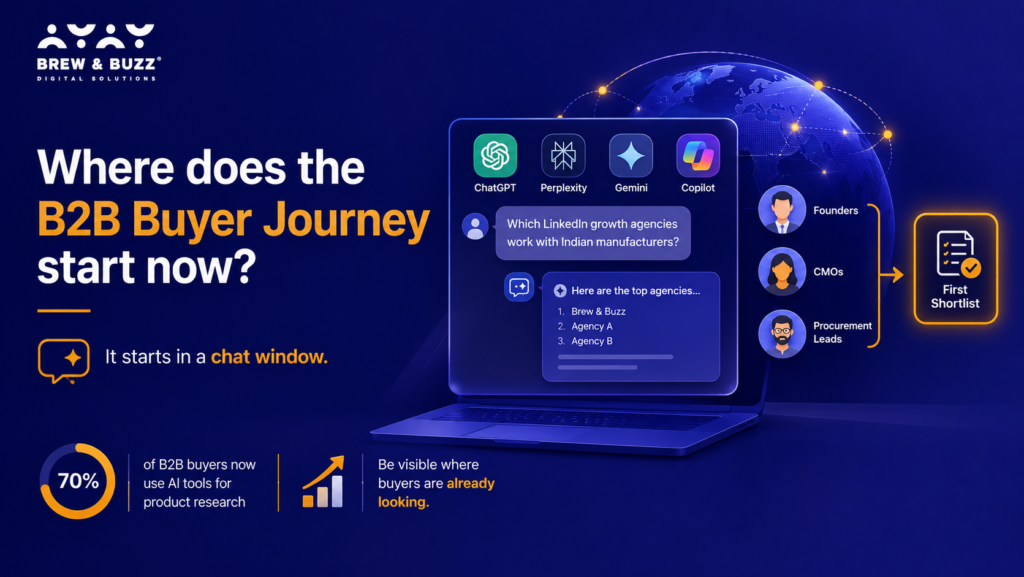
Increasingly, in a chat window. Founders, CMOs, and procurement leads are typing questions like “Which LinkedIn growth agencies work with Indian manufacturers?” into ChatGPT, Perplexity, Gemini, and Copilot, and treating the answer as a first shortlist. B2B is especially exposed to this change. Purchases are expensive, involve several approvers, and carry reputational risk, so buyers want reassurance early. A conversational tool delivers that in seconds. If the shortlist is formed before your sales team knows the buyer exists, your brand either made it in or it didn’t.
What’s the difference between being findable and being referenceable?
| Findable | Referenceable | |
| Who it helps | Buyers who already know your name | Buyers who have never heard of you |
| Depends on | Your website and search ranking | Mentions across many independent sources |
| Question it answers | Where is Company X? | Who are good providers of Y? |
Most B2B companies I work with are findable. Few are referenceable, and that gap decides who appears when a stranger asks a category question.
How do AI tools decide which brands to recommend?
They combine what they learned in training with content retrieved from the live web, then favor names that appear consistently and credibly in more than one place. That includes LinkedIn posts, review platforms such as G2 and Clutch, industry press, directories, and community discussions on sites like Reddit.
A brand described only by its own website gives an AI system a single, self-interested source. A brand described by clients, journalists, and peers gives it corroboration. Corroboration is what makes a model comfortable naming you.
What builds that presence?
No shortcut exists, and anyone selling one deserves skepticism. Three things consistently help:
- Leadership visibility on LinkedIn. Original, experience-based posts from founders and executives shape how people and machines perceive expertise. Recycled quotes don’t.
- Website content that answers buyer questions. Write service pages that address specific questions, case studies with real figures, and articles that explain how you work. Structured data (schema.org Organization, Article, FAQPage) helps search engines interpret pages and probably helps AI retrieval too, though it isn’t a guaranteed lever.
- Independent validation. Get press mentions, detailed client testimonials, and complete directory profiles. Each one is a separate source confirming your claim.
Treat this as reputation building, not a campaign. It compounds slowly.
Why does it matter for lead generation?
AI-assisted research adds a screening round before any human contact. Brands that pass it receive enquiries from buyers who already consider them credible. Brands that don’t must win trust from zero through cold outreach, which is the harder route. Outbound, paid, and referral channels still work; AI visibility changes how receptive the audience is when they arrive.
Among my clients, those with steady LinkedIn activity and well-structured websites are starting to hear I read about you where they used to get polite silence.
How can you check where you stand? A 4-step audit
- Write 5-10 questions your ideal buyer would actually ask, including your category, location, and use case.
- Run each in ChatGPT, Perplexity, Gemini, and Copilot.
- Record whether you’re named, who else appears, and which sources are cited.
- Repeat monthly and track changes.
If you’re absent, treat it as a baseline, not a failure. Then work through the three areas above in order.
The buyers consulting AI before contacting vendors won’t revert to old habits. The question is whether your brand is part of what they hear.
Frequently Ask Questions
Because they get a synthesized answer in seconds rather than pages of results to sift through. That speed matters most in the early, exploratory stage.
Mainly how often and how credibly you appear across independent sources, such as LinkedIn, review sites, press, and directories. Your own website alone is rarely enough.
It likely contributes. Substantive posts from named experts create visible, attributable signals, though no platform guarantees inclusion.
A brand is referenceable when an AI tool can name it confidently to someone who has never heard of it, because multiple trustworthy sources back it up.
No. It adds an earlier screening stage that affects how well those channels convert.
Ask several AI assistants the questions your buyers would ask, and log whether you appear.
There’s no fixed timeline. Progress depends on consistency, and steady effort compounds better than bursts.