
If you are still running B2B LinkedIn marketing the same way you did two years ago, static image posts, generic company page updates, and the occasional sponsored content, you are not just behind. You are invisible.
LinkedIn has undergone the most significant product evolution in its history. BrandLink in-stream video ads. AI-powered Accelerate campaigns. Top Voices 360 creator sponsorships. A vertical video feed that never went away. These are not minor tweaks. They represent a fundamental shift in how B2B buyers discover, evaluate, and trust brands on the platform.
For manufacturers, exporters, and B2B service firms, especially those running B2B LinkedIn marketing in India, this shift is both an opportunity and a warning. The rules have changed. Here is exactly what is new, why it matters, and what you need to do right now.
The Big Shift: Why Video Is Now the Default in B2B LinkedIn Marketing
Video on LinkedIn is no longer a nice-to-have experiment. It is the primary format the platform’s algorithm rewards and the primary format that B2B buyers in India actually respond to.
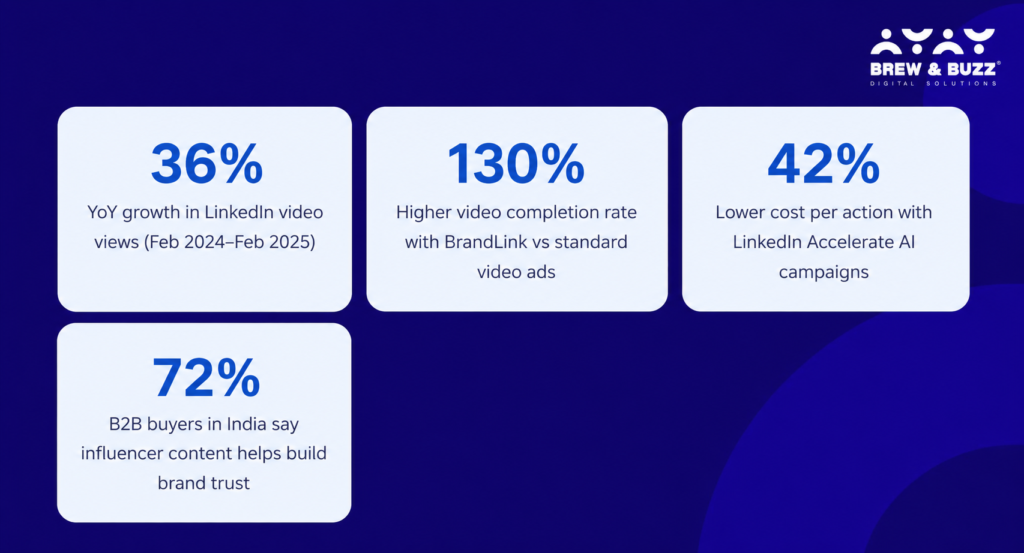
LinkedIn’s own data shows that video views grew 36% year-over-year, with video content being created 2x faster than any other post type. The platform has made the TikTok-style vertical video feed permanent, a clear signal that short, authentic video is a core part of the product roadmap, not a fleeting trend.
Here is why this matters specifically for B2B LinkedIn marketing in India
AI-generated text content has flooded professional feeds, making buyers skeptical of written posts. A real face on camera, a founder talking about a product challenge, a production manager explaining a quality process, and an MD addressing a buyer’s concern build trust in a way that polished company-page copy simply cannot. According to research cited by LinkedIn, 78% of B2B buyers prefer receiving information via video compared to just 9% who prefer text.
BrandLink: LinkedIn’s Most Powerful B2B Video Ad Format
LinkedIn’s Wire Program has been officially renamed and expanded into BrandLink, and it is the most significant development in B2B LinkedIn ads in recent years.
BrandLink allows advertisers to run in-stream video ads immediately before content from trusted publishers Forbes, Business Insider, Morning Brew, Fast Company, Inc. Magazine, and top creator videos from names like Steven Bartlett, Rebecca Minkoff, Bernard Marr, and Gary Vaynerchuk. For Indian B2B brands, LinkedIn has also partnered with regional publishers and made BrandLink available in multilingual formats.
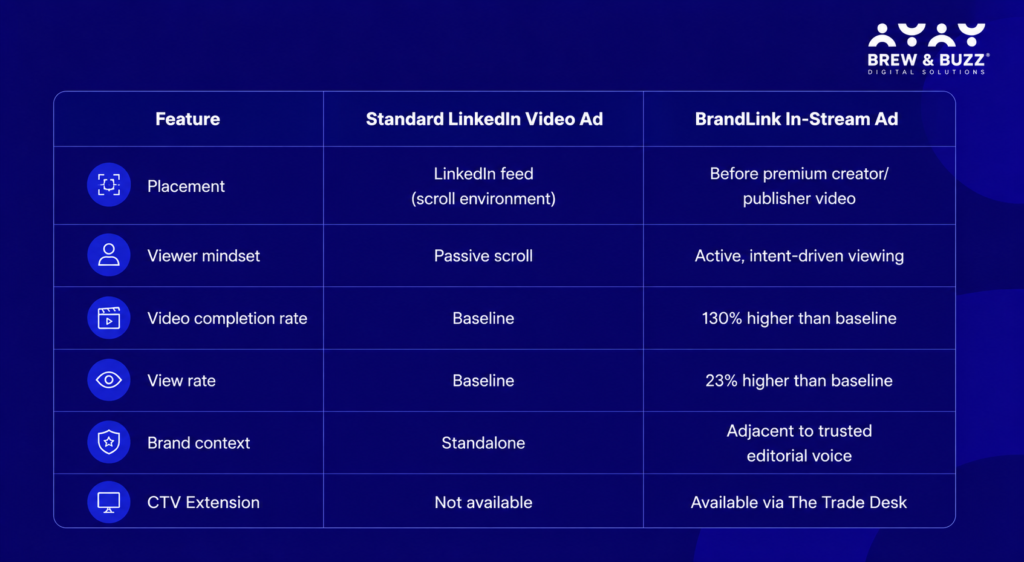
The results from early adopters are striking. Advertisers using BrandLink are seeing a 130% higher video completion rate and a 23% higher view rate compared to standard video ads. Lenovo India was among the first in their industry category to use BrandLink for the launch of their Aura Edition AI PC, describing it as a way to drive awareness and reach the right professionals at scale.
BrandLink vs Standard LinkedIn Video Ads: A Quick Comparison
Top Voices 360: Creator-Led Marketing for B2B
Alongside BrandLink, LinkedIn has launched Top Voices 360, a premium creator sponsorship opportunity that allows B2B brands to partner directly with LinkedIn’s verified Top Voices to create content that reaches decision-makers through a trusted, expert-led format.
This is significant because LinkedIn’s own Global B2B Marketing Outlook survey, conducted across India, the US, the UK, France, and Germany, found that 82% of B2B marketers who work with creators consider influencer campaigns essential for delivering measurable ROI. In India specifically, that number is even stronger: 88% of Indian B2B marketers agree that trusted-voice campaigns are essential for ROI.
The shift here is real. B2B influencer marketing is no longer a B2C concept borrowed awkwardly into professional contexts. When a recognised LinkedIn Top Voice in supply chain, manufacturing, or SaaS creates content that your brand sponsors, that credibility transfer is measurable. 70% of B2B buyers in India say influencer content plays a critical role in the consideration stage of their buying process.
LinkedIn Accelerate: AI-Powered Campaign Creation for B2B Marketers
For companies running B2B LinkedIn ads, LinkedIn’s AI-powered campaign tool, Accelerate, is now generally available globally and supports video ads alongside single-image and document formats.
Here is how Accelerate works: you drop in your landing page URL, and the AI drafts your Ideal Customer Profile, audience filters, ad copy, and starting creative. It automatically handles targeting, bidding, and placement decisions. The result is a campaign that can be set up in minutes rather than hours — and one that performs significantly better on cost efficiency.
Accelerate campaigns have shown up to a 42% lower cost per action compared to Classic campaigns run by the same advertisers. For small and mid-sized B2B companies in India where marketing teams are lean, this is a meaningful shift — AI is doing the heavy work of campaign optimization that previously required a specialist with years of LinkedIn ads experience.
LinkedIn has also expanded Accelerate’s objectives to include brand awareness, engagement, website conversions, video views, and lead generation, making it a genuinely full-funnel tool, not just a quick-launch shortcut.
The Algorithm Has Changed, And It Favours Human Voices
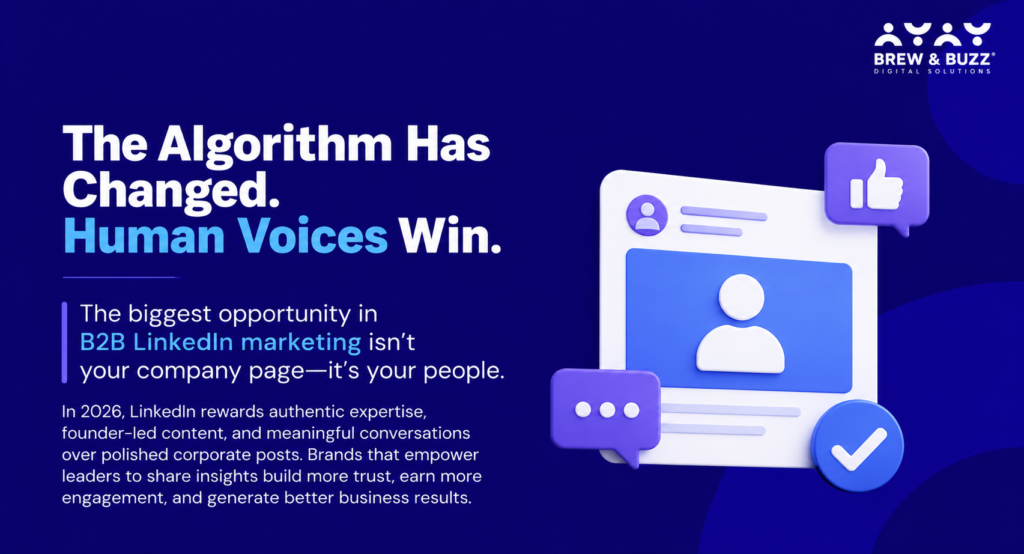
Understanding the new LinkedIn algorithm is non-negotiable if you are serious about B2B LinkedIn marketing in India. The platform’s June 2023 update — now reinforced with large language models as of August 2025 no longer rewards reach for its own sake. It rewards genuine expertise, authentic voice, and meaningful conversations.
The most important data point: personal profiles generate 8 times more engagement than company pages. Company page organic reach dropped 60-66% between 2024 and 2026. This is not a temporary dip; it is structural. LinkedIn’s algorithm allocates 65% of feed visibility to personal profile content and just 5% to company pages.
What this means for B2B teams is direct: your MD, founder, sales head, and technical experts need to be your primary content channels. A company page is a credibility anchor and an ad vehicle — it is not an organic growth engine in 2026.
What the Algorithm Rewards in 2026
Native video posted directly to LinkedIn (not YouTube links) gets a significant distribution advantage. Short-form vertical video under 60 seconds with captions consistently outperforms other formats. Posts that open with a sharp, specific observation from real experience outperform polished thought-leadership essays. Saves and shares, not just likes, are now treated as the highest-intent engagement signals the algorithm tracks. Format rotation matters: posting the same format back-to-back suppresses reach by 20%.
AI Tools for B2B Video Content Creation on LinkedIn
One of the biggest barriers for B2B companies, especially manufacturers and exporters is content production. Video feels expensive and slow. AI has largely removed that barrier.
B2B marketers using AI video tools are seeing 42% higher engagement than those editing manually, according to G2 Learning Hub data. Production time for thought leadership content has dropped from hours to under 15 minutes with tools like Pictory, which converts blog posts and articles into LinkedIn-ready videos with AI-generated voiceovers and b-roll sourcing.
Here are the AI tools most relevant for B2B LinkedIn marketing in India
CapCut (LinkedIn-integrated): Added LinkedIn-specific export features in late 2025. Automatically adjusts aspect ratios, generates closed captions, and suggests posting times based on network activity. Ideal for quick social video production.
VEED.io: Built for B2B teams with brand kit integration and team collaboration. The AI removes filler words from spoken content and generates chapter markers for longer videos, useful for product demos and webinar clips.
Pictory: Transforms written blog posts into LinkedIn videos. Scans text, creates storyboards, sources b-roll, and generates voiceovers. Cuts video production from hours to under 15 minutes for thought leadership content.
Lumen5: Specialises in converting statistics and reports into animated infographics. The 2026 update added industry-specific templates for finance, tech, and healthcare — relevant for exporters and service firms creating data-rich content.
LinkedIn Accelerate (native): LinkedIn’s own AI campaign tool now generates ad creatives directly from your landing page. Not a standalone video tool, but for running AI-assisted video ad campaigns, it is the most tightly integrated option available.
What This Means Specifically for B2B Companies in India
India is not a secondary market for LinkedIn’s video and AI expansion — it is a primary one. LinkedIn’s Global B2B Marketing Outlook included India in its research base, and the findings for Indian B2B marketers are specific and actionable.
66% of B2B buyers in India say short-form social video content helps inform their buying decisions. 83% of those who consume video say video-led influencer content is among the most trusted forms of B2B content. 93% of Gen Z B2B buyers in India — who are now entering procurement and decision-making roles — engage with B2B influencer content monthly, 14% higher than all other buyer groups combined.
What this means for Indian manufacturers, exporters, and B2B service firms is concrete: the people your sales team is trying to reach are already on LinkedIn, already watching video, and already making buying decisions based on the content they see from founders, industry experts, and trusted voices. If your brand has no video presence, no thought leadership content from key people, and no paid video strategy, you are invisible in the channel where your buyers are spending their research time.
Frequently Asked Questions
Several AI tools are now directly relevant for B2B content marketing on LinkedIn:
LinkedIn Accelerate uses AI to generate campaign audiences, ad copy, and creatives from your landing page URL — reducing campaign setup time and improving cost efficiency by up to 42% vs Classic campaigns.
VEED.io offers team collaboration, brand kit integration, and AI-powered filler word removal for cleaner video content.
Pictory converts written blog posts and articles into fully produced LinkedIn videos in under 15 minutes.
Lumen5 converts data, reports, and statistics into animated video infographics — useful for B2B companies with complex technical content.
Taplio is an AI writing assistant for LinkedIn posts that helps develop authentic content with consistent brand voice — content that can later be amplified through paid promotion.
Supergrow connects organic LinkedIn content, paid campaigns, and outreach into one flow — particularly useful for account-based marketing approaches.
The common thread across all of these: AI handles production speed and efficiency, but the content still needs an authentic human voice and genuine expertise to perform well on LinkedIn’s current algorithm.
Several players now offer AI-powered video advertising specifically for B2B contexts:
LinkedIn itself — through BrandLink (in-stream video ads before trusted publisher and creator content) and Accelerate (AI-automated campaign creation and delivery), LinkedIn has become a direct provider of AI-powered video ad solutions.
The Trade Desk — partnered with LinkedIn to extend B2B audience targeting to Connected TV (CTV) inventory, allowing B2B brands to run video ads on premium TV screens using LinkedIn’s professional audience data.
Visla — an AI video platform specifically built for B2B content teams to go from idea to publish-ready LinkedIn video quickly, including script generation, editing, and format optimization.
CapCut for Business — offers LinkedIn-specific video export features and AI-powered subtitle generation, making it suitable for corporate video content production.
Factors.ai — focused on B2B advertising analytics and optimization, connecting LinkedIn ad performance to CRM pipeline data.
For most B2B companies in India, starting with LinkedIn’s own native tools — BrandLink and Accelerate — is the most practical first step before adding third-party platforms.
For B2B marketers creating video ads, the most effective AI tools in 2026 fall into two categories:
Production tools (creating the video itself):
Pictory — converts text content into video; best for thought leadership and educational ads.
VEED.io — records, edits, captions, and formats video for LinkedIn; includes brand kit integration.
CapCut — fast mobile-first editing with LinkedIn-specific export settings and AI captioning.
Lumen5 — builds data-rich animated videos from reports and statistics; ideal for B2B companies with complex product or service information.
Campaign and distribution tools (running the video ad):
LinkedIn Accelerate — AI-automated campaign creation; input your landing page and the AI handles targeting, bidding, and ad delivery.
LinkedIn BrandLink — places your video ad in-stream before trusted creator and publisher content; delivers 130% higher completion rates vs standard video ads.
Factors.ai — connects LinkedIn ad data to your CRM, so you can see which video ads are actually driving pipeline, not just impressions.
The key insight: AI tools speed up production, but the single biggest driver of B2B video ad performance is authentic, specific content. A founder on camera addressing a real buyer problem will outperform a polished AI-generated ad almost every time.
Video ads improve B2B marketing campaigns in three specific, measurable ways:
1. Higher buyer preference and trust. 78% of B2B buyers prefer receiving information via video compared to 9% who prefer text. In India specifically, 66% of B2B buyers say short-form social video helps inform their buying decisions. Video is not just a format preference — it directly affects how much buyers trust the brand they are evaluating.
2. Better funnel performance at the consideration stage. Video-warmed LinkedIn members — those who have watched your video content — are 1.6 times more likely to open a lead generation form compared to non-warmed members during a 30-day nurture window. This means video at the top of the funnel measurably improves conversion rates at the bottom of the funnel
3. Higher completion and view rates than static formats. LinkedIn BrandLink in-stream video ads deliver 130% higher completion rates than standard video ads. AI-generated short-form video now drives 42% of B2B engagement on LinkedIn. These are not incremental improvements — they are structural advantages for brands that commit to video as a primary format.
For B2B companies on LinkedIn, the practical implication is straightforward: video should be present in every 4th post minimum on personal profiles, and video should be the primary creative format in any paid campaign targeting awareness or consideration objectives.
This is the question every B2B founder and sales head eventually asks — and the honest answer is that LinkedIn lead generation in 2026 works through a specific sequence, not a single tactic. Here is the full picture
Optimise the profile before anything else. Your personal LinkedIn profile is a landing page. Before you post a single piece of content or run a single ad, your headline must state clearly who you help and how, your About section must speak to your buyer’s problem (not your biography), and your featured section must link to a case study, lead magnet, or contact page. A buyer who is curious about you will check your profile first — if it is vague or generic, the lead dies there.
Build consistent organic content through your personal profile. The content-to-DM funnel is the most reliable organic lead generation approach on LinkedIn right now. The sequence works like this: publish specific, valuable content in your niche for 60–90 days. Your target buyers start following and engaging. When someone engages multiple times across different posts, that is a warm signal — they know who you are and they have found your content useful. At that point, a direct message with a relevant, specific question or offer converts at a significantly higher rate than cold outreach to a stranger. The prospect who has been reading your content for six weeks already trusts your expertise — the sales conversation starts at a completely different baseline.
Use LinkedIn Lead Gen Forms in your paid campaigns. For B2B LinkedIn ads, Lead Gen Forms are the single highest-converting paid format available. When a decision-maker clicks your ad, a pre-filled form opens inside LinkedIn — no redirect to an external landing page, no friction of re-entering details. For Indian B2B companies running ads targeting procurement heads, MDs, and CXOs, Lead Gen Forms consistently outperform click-to-website campaigns in cost per lead.
Target with precision, not volume. LinkedIn’s targeting is its core advantage over every other platform for B2B. You can target by job title, seniority level, company size, industry, and even specific company names for account-based marketing. For manufacturers and exporters, targeting by industry (Manufacturing, Import and Export) combined with seniority (Director, VP, C-Suite) and company size (50–500 employees) typically produces the tightest, most qualified audiences. Start broader than you think necessary and narrow based on what the data shows.
Combine organic warmth with paid reach. The most effective B2B LinkedIn lead generation system combines both channels. Organic content from founder and employee profiles builds awareness and trust. Paid campaigns — especially Thought Leader Ads that promote your top-performing organic posts — extend that reach to buyers outside your network. Video-warmed LinkedIn members are 1.6x more likely to open a Lead Gen Form than cold audiences, which is why video content at the top of the funnel directly improves your paid conversion rate at the bottom.
What does not work: Spray-and-pray connection requests with an immediate pitch. Generic just checking in messages. Company page posts with no employee amplification. Campaigns optimised for clicks rather than leads. Running ads for less than 5–7 days before changing the targeting or creative — LinkedIn’s algorithm needs data to optimise, and cutting campaigns short resets the learning process entirely.
If you are starting from zero, the 90-day sequence looks like this: Month 1 — profile optimisation and consistent posting from personal profiles. Month 2 — first paid test using Accelerate with a Lead Gen Form objective. Month 3 — refine targeting based on lead quality, add BrandLink or Thought Leader Ads to extend reach. By Month 3, you should have enough data to know your cost per lead and which buyer segments are converting — and from that point, scaling is a budget decision, not a strategy decision.