
You spent ₹2 Lakhs on ads. You got 150 leads. Your sales team called 140 of them. Three actually had a need. One bought. Sound familiar? The problem is not your ads. The problem is that no one told you the difference between a lead, an MQL, and an SQL — and why it changes everything.
Here is a question that should make every B2B founder pause: what exactly is a lead in your business?
If your answer is anyone who fills our contact form – you are in good company. Almost every B2B company in India measures leads the same way. And almost every B2B company in India has the same frustrating experience: lots of leads, very little revenue.
Understanding the difference between a Lead, an MQL, an SQL, and a SAL is not corporate jargon. It is the most practical thing a B2B founder can learn — because it changes how you measure your ads, how you brief your agency, and how your sales team spends its time.
What Is a Lead, MQL, SQL, and SAL in B2B Lead Generation
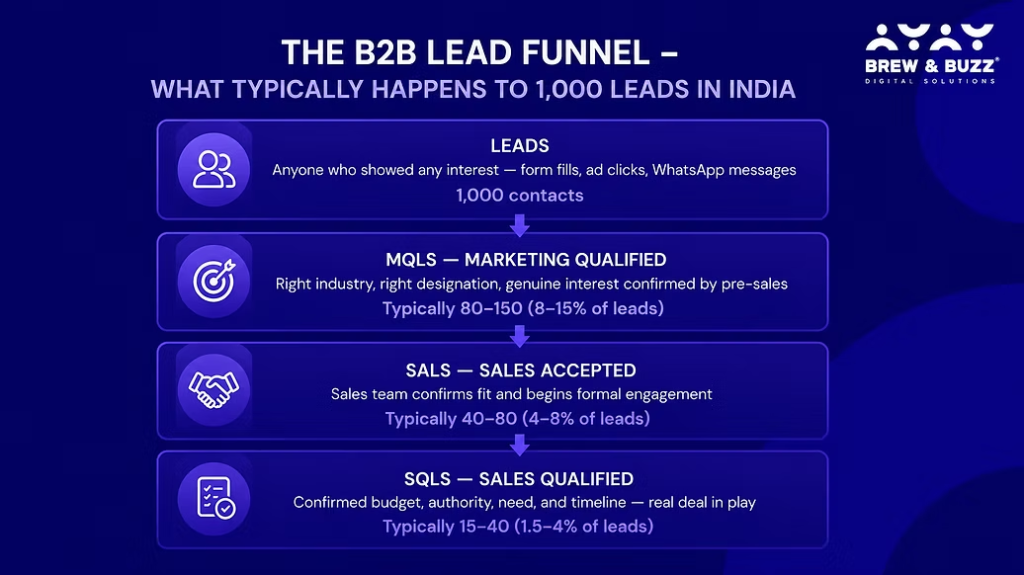
Think of these four stages as a filter system. At the top, you have everyone who ever showed any interest in your business. By the bottom, you have only the people genuinely worth your sales team’s time. Each stage removes the noise and keeps the signal.
Lead
Any contact that has shown some interest in your product or service. They filled a form, sent a WhatsApp, responded to a LinkedIn message, or downloaded something from your website. You know their name and contact. That is it. Nothing more is confirmed.
MQL — Marketing Qualified Lead
A lead that has been checked against a set of agreed criteria. You have confirmed they are in the right industry, have the right designation or buying authority, and have shown a level of genuine interest — not just curiosity. An MQL is worth a sales conversation. It is not a guaranteed sale.
SAL — Sales Accepted Lead
The stage between MQL and SQL. After marketing creates an MQL, the sales team formally reviews and accepts it — confirming it meets their own criteria before investing time in a full sales process. The SAL stage is what stops marketing and sales from blaming each other when conversion rates are poor.
SQL — Sales Qualified Lead
A lead that has been confirmed to have a real business need, an available budget, the authority to make a purchase decision, and a defined buying timeline. An SQL is the point where full sales effort — demos, proposals, negotiations — is genuinely worth investing. In B2B lead generation in India, reaching the SQL stage is where money gets made.
Why Most Indian B2B Companies Waste Their Ad Budget on Unqualified Leads
The answer is surprisingly simple: Indian B2B companies measure ad success by the number of leads, not the quality. And the platforms they advertise on – primarily Meta -are designed to deliver maximum lead volume, not maximum lead quality.
When you tell your agency generate more leads, they optimise your campaign for form fills. The Meta algorithm finds the people most likely to click and fill a form. These are often curious individuals, students, or people in completely different industries who tapped your ad on impulse.
The agency was not lying – they genuinely generated 180 leads. But the business had no lead qualification layer. The sales team wasted 3 weeks calling 180 people, most of whom had no idea why they were being called. The three genuine leads were buried in the noise and called too late – after they had already bought from a competitor.
The fix is not to generate fewer leads. The fix is to add a qualification layer between the lead and the sales team — so that only MQLs get through.
Checklist: Is Your B2B Lead Generation Producing MQLs — or Just Noise?
Run through these questions honestly. If more than three answers land in the red, your lead generation system is producing volume — not value.
You know the designation of every lead before your sales team calls them
If you cannot answer what is this person’s job title and authority level before picking up the phone, you are cold-calling — not following up on a qualified lead.
Your agency reports leads, but cannot tell you how many were MQLs
If your monthly report shows 180 leads generated but no MQL breakdown, your agency is optimising for vanity metrics. Leads without qualification data are noise, not a result.
Your sales team follows up on less than 30 leads per month but has a healthy pipeline
Fewer, better-qualified leads mean your sales team spends time selling — not filtering. A team following up on 20 MQLs will consistently outperform a team chasing 200 raw leads.
You measure ad ROI by cost-per-lead, not cost-per-MQL
Cost-per-lead is a meaningless metric in B2B. A ₹500 lead that never converts is 10x more expensive than a ₹5,000 MQL that closes a ₹10 Lakh deal. Redefine your KPI as cost-per-MQL immediately.
Your sales team calls every lead directly from the form, with no pre-qualification step
Without a pre-sales qualification step, your most experienced sales people spend hours on calls with students, wrong-number contacts, and low-intent form fills. This is both demoralising and expensive.
You have agreed MQL criteria with your marketing team or agency — in writing
If marketing and sales have never sat down and defined what an MQL looks like for your specific business, they are working towards different goals. This one conversation — what is a qualified lead for us? – changes your entire B2B lead generation strategy.
Frequently Ask Questions
What is the difference between a Lead, MQL, and SQL in B2B?
A Lead is any contact that shows interest — a form fill, a WhatsApp message, or a LinkedIn reply. An MQL (Marketing Qualified Lead) is a lead checked for fit — right industry, right designation, and genuine intent confirmed. An SQL (Sales Qualified Lead) is an MQL verified to have a real budget, a defined need, and an intention to buy within a reasonable timeframe. In B2B lead generation in India, most companies receive many Leads but very few SQLs — the gap between them is where most ad budgets are wasted.
What is an MQL in B2B lead generation?
An MQL, or Marketing Qualified Lead, is a lead that has met a set of pre-agreed criteria suggesting it is worth a sales conversation. In B2B lead generation in India, MQL criteria typically include the lead’s designation, industry, company size, and the specific action they took — such as visiting a pricing page, responding to a LinkedIn outreach, or downloading a capability deck. An MQL is not a guaranteed sale. It is a verified signal that this person is more likely to buy than a random contact.
What is an SQL in B2B sales?
An SQL, or Sales Qualified Lead, is a lead the sales team has spoken to and confirmed has a real business need, an available budget, the authority to make a purchase decision, and a defined buying timeline. In B2B digital marketing in India, the SQL is the stage where full sales effort — demos, proposals, negotiations — is genuinely justified. An SQL that does not convert is a sales problem. A lead that never becomes an SQL is a marketing or qualification problem
Why do most Indian B2B companies waste their ad budget on unqualified leads?
Most Indian B2B companies waste ad budget on unqualified leads because they measure campaign success by lead volume rather than lead quality. Meta and Google campaigns are optimised by the algorithm to generate maximum form fills — not maximum MQLs. Without a qualification layer between the ad and the sales team, every curious click becomes a “lead” on paper. A company generating 200 leads per month with no MQL filter is often performing worse than a company generating 20 verified MQLs per month
How do I qualify B2B leads without expensive software?
To qualify B2B leads without expensive software, use a simple 5-point manual scoring system: score each lead on designation (decision-maker or not), industry fit, company size, stated need, and urgency of timeline — each out of 2 or 3 points for a total of 10. Any lead scoring 7 or above becomes an MQL and receives a priority sales call. Leads scoring 4–6 go into a nurture sequence. Leads below 4 are removed from the active pipeline. This system can be managed entirely in a Google Sheet — no CRM subscription required.
What is a SAL in B2B marketing?
A SAL, or Sales Accepted Lead, is the stage between MQL and SQL. After marketing qualifies a lead as an MQL and passes it to sales, the sales team formally reviews and accepts it before investing time in a full sales process. The SAL stage prevents marketing and sales teams from blaming each other for poor conversions. If a lead is accepted by sales but never converts, it is an SQL problem. If the sales team rejects it, the MQL criteria need to be reviewed and tightened.
How does B2B LinkedIn marketing help generate better quality MQLs?
B2B LinkedIn marketing generates better quality MQLs than most other channels because LinkedIn targeting is based on professional identity — job title, company, industry, and seniority. When you attract or reach out to a lead on LinkedIn, you already know their designation and company before the first conversation. This means every LinkedIn lead enters the qualification process with more context than a Facebook or Google form fill. LinkedIn-sourced leads consistently score higher on MQL criteria and require fewer qualification calls before reaching the sales team.